
Municipal Gallery of Athens
The building was meant to spin silk, not display paintings. When the Danish architect Christian Hansen drew up the Metaxourgeio in the early 1830s, Athens was barely a town - a scattering of houses beneath an Acropolis still scarred by siege. Two centuries later, that same long, classical structure on Avdi Square holds nearly three thousand works by the leading Greek artists of the 19th and 20th centuries. The Municipal Gallery of Athens moved here in October 2010, and in doing so it gave a wandering collection a permanent home inside one of the oldest surviving buildings of the modern city.
Content and Container
For decades the gallery had a problem its director once called unforgivable: it could never show its permanent collection and temporary exhibitions at the same time. There simply wasn't room. Works rotated in and out, and visitors kept asking why a city gallery had nothing permanently on view. The move to Metaxourgeio - a former industrial quarter now thick with cultural life - solved it. "It fits content with container," the gallery's director, Nelli Kyriazis, said of housing modern art inside a reclaimed factory. The collection leans deliberately toward the contested, fertile decades of the 1930s and 1940s, the years when Greek artists wrestled hardest with what it meant to be both modern and Greek.
A Roll Call of Greek Masters
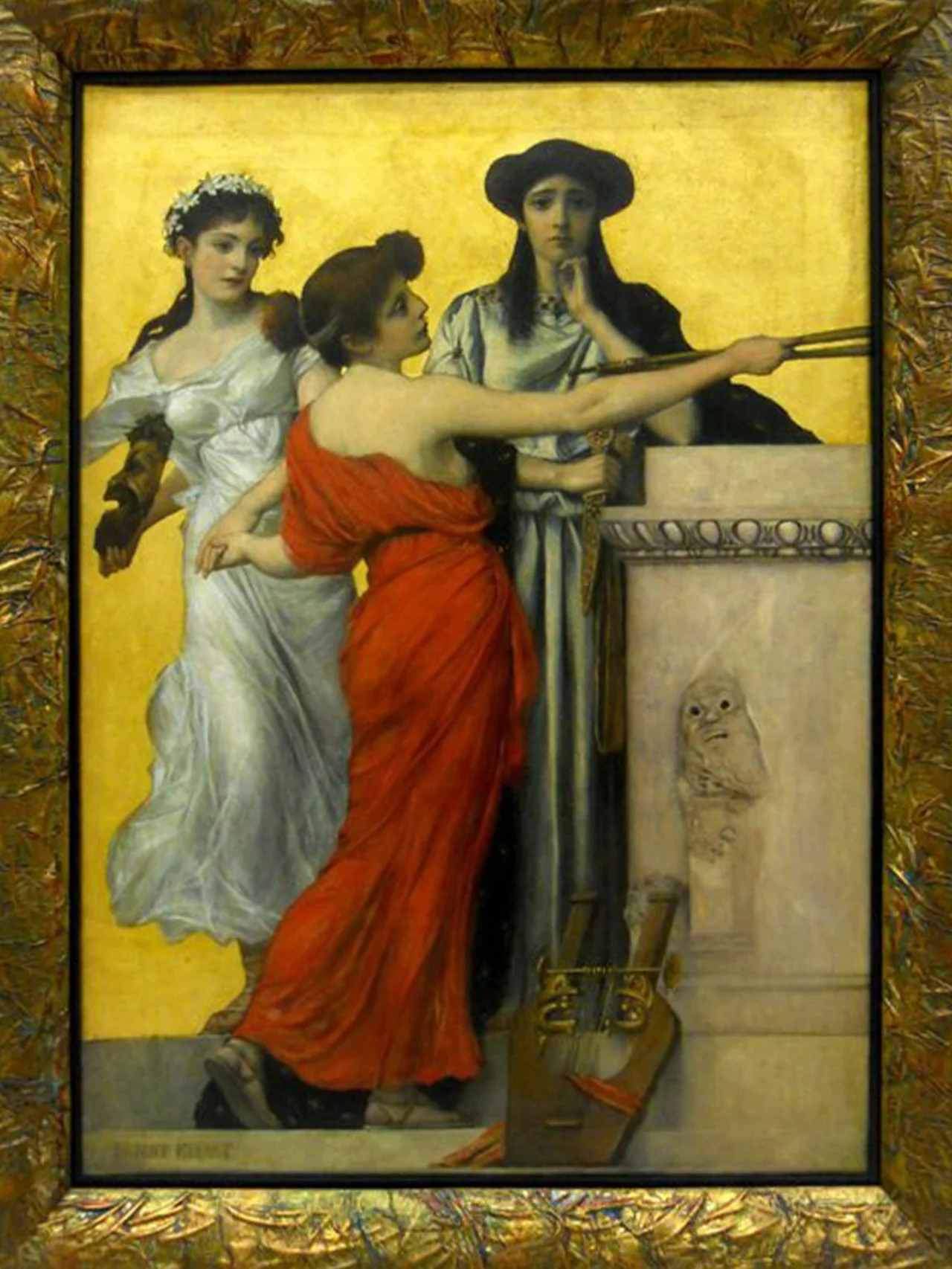
The walls read like a survey of modern Greek painting. There is Georgios Jakobides, the Munich-trained master of luminous portraits; Nikolaos Lytras, son of a great painter and a force in his own right; the brooding expressionist George Bouzianis; the watercolorist Angelos Giallinas; and Yiannis Moralis, whose spare, lyrical figures shaped a whole generation. The 19th century gets a quieter showing through names like Spyridon Prosalentis and Dionysios Tsokos, but the heart of the collection beats in the modern era. A series of master engravers - among them Vaso Katraki, whose carved stone prints carry a monumental weight - anchors the gallery's strength in printmaking, an art form Greece has long made its own.
The Many Lives of the Metaxourgeio
Few buildings have failed at so many things before finding their purpose. Hansen designed it around 1834 as a European-style commercial center, but it stood abandoned for nearly two decades. An Austrian company bought it in 1852 to make steam-powered silk, then went bankrupt before a single thread was spun. It served briefly as a hospital. From 1855 it finally worked as a silk mill - the Metaxourgeio that gave the whole neighborhood its name - becoming the largest such operation in the Balkans, until cheap Chinese silk imports shut it down in 1875. In 1944 it housed a garrison of the wartime resistance army ELAS. After a 1960 fire and long neglect, the owner's grandson donated it to the City of Athens in 1993. The factory that never quite succeeded at industry succeeded, at last, at art.
Hansen's Athens
Christian Hansen did not just design this building; he helped design the look of an entire capital. Arriving under King Otto, when Athens was a small town with little beyond the Acropolis to suggest grandeur, Hansen became one of the architects of its rebirth. He worked on the restoration of the Temple of Athena Nike, damaged in the Ottoman siege, and designed the great university that was counted among the finest buildings in 19th-century Europe. His younger brother Theophil joined the effort, designing the Academy, the Observatory, and the famous Hotel Grande Bretagne. The Hansen brothers gave the new Athens its neoclassical face. That this humble silk factory now holds the city's art collection feels like a fitting late chapter.
From the Air
The Municipal Gallery of Athens stands at 37.983 N, 23.719 E, on Avdi Square in the Metaxourgeio district just northwest of the Athens historic center. The long neoclassical building sits within dense inner-city blocks - use the Acropolis to the southeast and the green of the National Garden farther east as orienting landmarks. Athens International Airport (LGAV) lies about 30 km to the east-southeast. Admission is free; the gallery is closed Mondays. Best viewed on clear days when the low Attic light brings out the city's pale rooftops.
Nearby Stories
- Great Sand Beach 5 km away
- Battle of Delium 7.7 km away
- Tower of Aliartos 9 km away
- HMHS Britannic 10 km away
- Saronic Gulf 15 km away
- Sousaki Volcano 17 km away
- Sanctuary of Apollo Maleatas 24 km away
- Skyros 66 km away