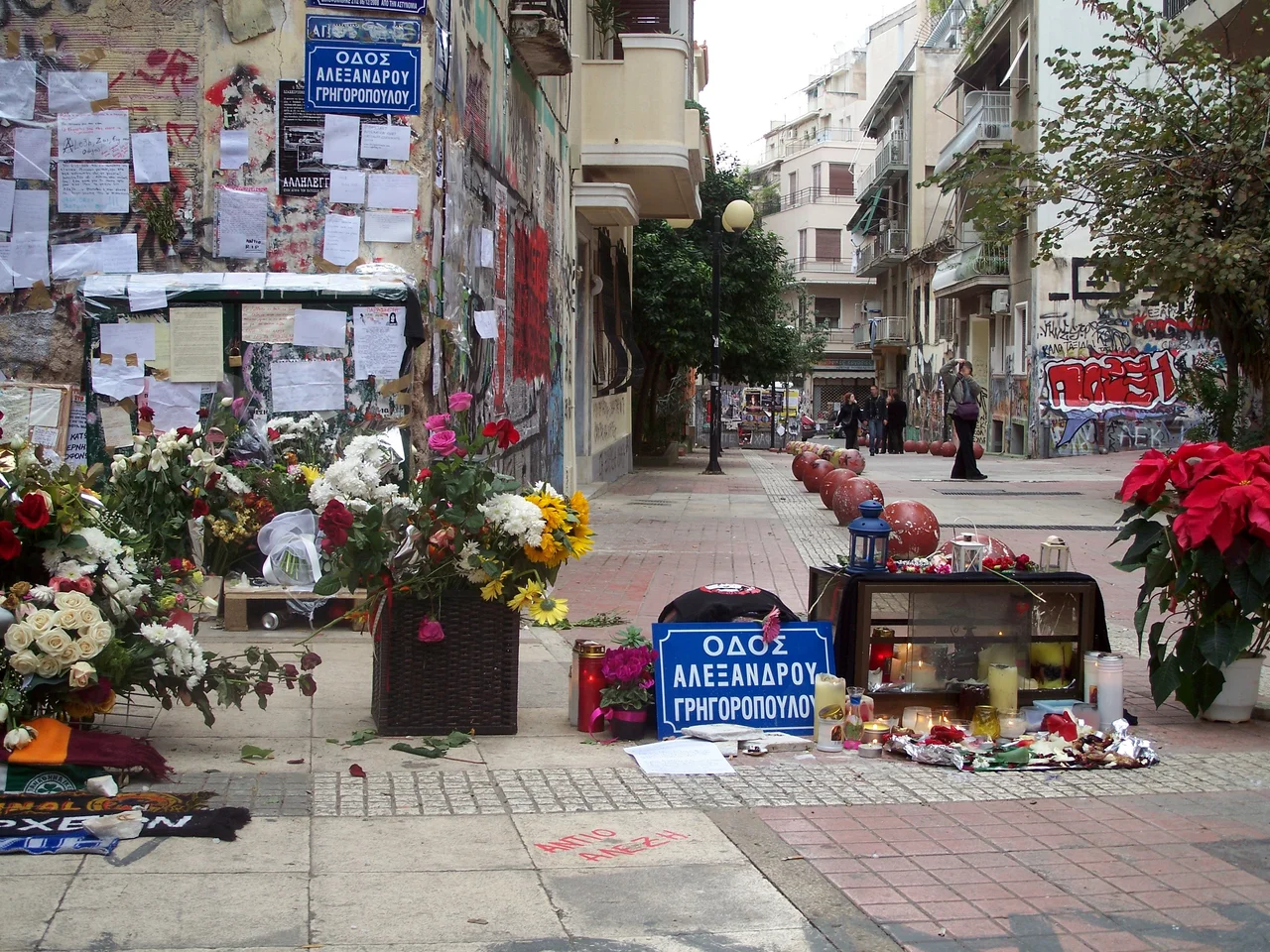

Murder of Alexandros Grigoropoulos
On the evening of 6 December 2008, a 15-year-old boy named Alexandros Grigoropoulos was out in the Exarcheia neighbourhood of Athens with a friend. He was a schoolboy, a child of the city. Before nine o'clock that night a police officer fired a weapon on Tzavella Street, and the bullet struck Alexandros in the heart. He died there, on a corner that has since become a place of mourning. Every December, Athens remembers him with marches on the anniversary of his death.
A Boy in Exarcheia
Alexandros Grigoropoulos was fifteen years old. That single fact sits at the center of everything that followed - not a symbol, not a statistic, but a teenager who should have grown up. He was in Exarcheia, a neighbourhood long associated with students, artists, and political life, when a police patrol car passing through was heckled by a group of young men. The car drove off, but two officers returned on foot. One of them, special guard Epaminondas Korkoneas, fired. The forensic examination was precise and merciless in its plainness: the bullet penetrated the boy's heart and lodged in his tenth thoracic vertebra. The coroner's conclusion used the word homicide.
A City Erupts
News of the shooting moved through Greece like a current. Within hours, demonstrations had begun; within days, they had spread into weeks of unrest across the country that history now calls the 2008 Greek riots. The grief was raw and the anger was national, cutting across the usual political lines. The then-Minister of the Interior offered his resignation, though the prime minister refused it, and the President of the Republic, Karolos Papoulias, called the killing a "trauma to the rule of law." Amid the turmoil, a television station broadcast an amateur video of the moment altered with added sounds of unrest - an act later admitted and widely condemned. Through it all, Alexandros's mother asked, in a letter to the press, only that her son's memory be treated with respect.
The Long Road Through the Courts
The case would take more than sixteen years to resolve, and it resolved more than once. Korkoneas claimed he had fired into the air and that the death was a tragic ricochet - an explanation the forensic evidence dismantled, since the bullet's downward path could not have come from a shot rebounding off the road. In October 2010, a court found him guilty of intentionally killing Grigoropoulos and sentenced him to life imprisonment; his colleague was convicted as an accomplice. But the sentence did not hold. A 2019 appeal cut it to thirteen years and freed him. Greece's Supreme Court overturned that ruling; a retrial in 2022 again released him, prompting the family's lawyers to call the decision a "legal coup."
Justice, and Remembrance
The reckoning came at last in the summer of 2025. On 4 June - the day Alexandros would have turned thirty - the Lamia appeals court reimposed a life sentence on Korkoneas, rejecting the leniency that had twice set him free. Seventeen years after a single shot on Tzavella Street, the legal record settled on the gravity of what had been done. But the verdict was never the whole story. Each December the marches return, and flowers are still left at the corner where a fifteen-year-old's life ended. Exarcheia has not forgotten Alexandros Grigoropoulos, and neither, it seems, has Greece - the boy first, the case second, the loss permanent.
From the Air
The site of the shooting is on Tzavella Street in Exarcheia, central Athens, at approximately 37.984 N, 23.735 E - a dense inner-city neighbourhood immediately north-northeast of the National Archaeological Museum and the Polytechnic. The Acropolis lies about 1.5 km to the southwest as the primary orienting landmark. Athens International Airport (LGAV) is about 30 km to the east-southeast. This is a place of memory rather than a scenic overflight; tightly built urban blocks, best understood in the context of the surrounding historic center.
Nearby Stories
- Great Sand Beach 5 km away
- Battle of Delium 7.7 km away
- Tower of Aliartos 9 km away
- HMHS Britannic 10 km away
- Saronic Gulf 15 km away
- Sousaki Volcano 17 km away
- Sanctuary of Apollo Maleatas 24 km away
- Skyros 66 km away