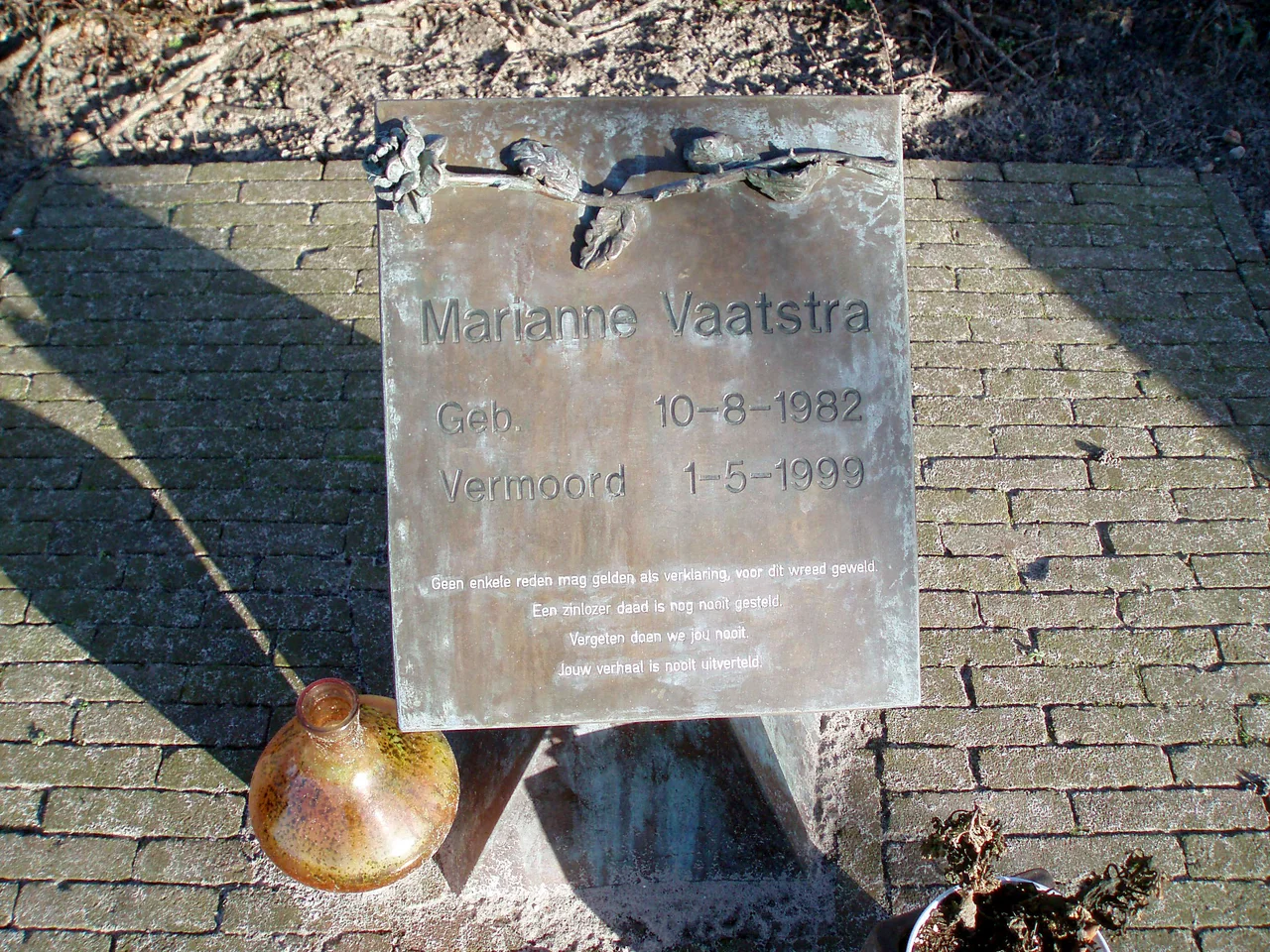

Murder of Marianne Vaatstra
She was sixteen and three weeks from her seventeenth birthday. On the evening of 30 April 1999, Marianne Vaatstra cycled out of Kollum toward her parents' home in De Westereen, the flat Frisian countryside rolling past her bike lamp. She never arrived. The next morning, a farmer walking through a field near the hamlet of Feankleaster found her body, her throat cut. The bike was nearby. A cheap plastic cigarette lighter lay in the grass beside her. That lighter, and a single trace of DNA on it, would eventually undo her killer. But not for thirteen years.
A Girl, Not a Case
Marianne Vaatstra was born on 10 August 1982. By 1999 she was a Frisian teenager doing what Frisian teenagers do on the last evening of April: out with friends in Kollum, the long northern dusk stretching, the ride home a familiar ribbon of road between villages most people outside Friesland have never heard of. She was a daughter to Bauke and Maaike. She had her whole life in front of her, the kind of life that comes after exams and first jobs and the slow rituals of growing up in a small place where everyone knows everyone. The thing to hold onto, before any of the rest of this story is told, is that Marianne was a person before she became a headline. The case that bears her name kept her family in public view for the next quarter century, but she existed first, and her parents have spent the years since insisting that the world remember her that way.
The Wrong Story
Within hours, suspicion fastened onto the wrong people. A center for asylum seekers stood near the crime scene, and the rumor moved faster than any evidence. By October 1999, locals were rioting at a municipal meeting in Kollum, pelting the mayor with eggs, demanding the new center never open. Riot police were stationed near the asylum building. An Iraqi resident was eventually cleared by DNA evidence, but the damage to that community was already done. Looking back, the early investigation became a study in how grief and fear can be aimed in the wrong direction. The killer was not a stranger from somewhere else. He was a neighbor. He had bought the lighter in a local shop. He had driven home to his farm afterward and gone on with his life, sitting in the same Frisian villages where Marianne's parents were now learning how to grieve in public.
Thirteen Years of Silence
The first DNA sweep, late in 1999, asked 170 men in the immediate area for samples. 162 cooperated. None matched. Investigators built a profile: white, Western European, male, living within about 15 kilometers of the field where Marianne was found. The case went cold. Bauke Vaatstra refused to let it go quiet. He pushed, year after year, for the Dutch government to authorize something the Netherlands had never done at scale: a mass voluntary DNA screening of thousands of local men, looking not only for the killer himself but for any close male relative whose Y-chromosome would point to him. The legal and ethical objections were substantial. Civil-liberties groups warned about a precedent that could not be uncaged. Bauke's argument was simpler. Somewhere within a short drive of his daughter's grave, a man knew what he had done and was still living his life.
September 2012, Aldwâld
Permission finally came. In the autumn of 2012, around 8,000 men in the area around the crime scene were asked to give a cheek swab. The science would catch the killer through his own DNA or through that of a close male relative who matched the trace on the lighter. Jasper Steringa, a 45-year-old dairy farmer in the village of Aldwâld, gave a sample. He knew what it would show. He had no false hope about modern genetics; if a brother, a cousin, or an uncle matched, investigators would walk back through the family tree until they found him. He waited six months for the lab to confirm what he already understood. On the night of 18 November 2012, police arrived at his farm. Within ten minutes of speaking with his lawyer, he confessed.
What the Family Built
Steringa was sentenced to eighteen years in prison in April 2013. The Dutch legal system had its answer. But the Vaatstras had spent thirteen years building something larger than one verdict. In 2013, Bauke received the Machiavelli Prize for forcing the breakthrough that legitimized large-scale DNA screening in Dutch criminal investigations. The technique he fought for has since helped solve other cold cases across the Netherlands. Marianne's mother Maaike Terpstra spent the following years protecting her daughter's story from the conspiracy theorists who circled the case, trying to extract some other narrative from a tragedy that turned out, in the end, to be terribly simple: a girl cycling home, a man with a knife, a lighter left in the grass. The Vaatstras turned the worst thing that can happen to a family into something that protects other families. The field outside Feankleaster is just a field again. But the way the Netherlands investigates its missing daughters changed because Marianne lived in Friesland, and because her parents would not stop asking.
From the Air
Located at 53.27°N, 6.12°E in northern Friesland, between Kollum and De Westereen near the hamlet of Feankleaster. Recommended viewing altitude FL080-FL120 for the broader landscape of Dantumadiel and Noardeast-Fryslân. Nearest airports: Drachten (EHDR) to the south, Groningen Eelde (EHGG) to the east. Flat polder country with scattered villages; the Lauwersmeer and Wadden coast lie a short distance to the north.
Nearby Stories
- Eems Canal 9.6 km away
- Gorredijk 11 km away
- Súdwest-Fryslân 11 km away
- Liauckamastate 17 km away
- Veenkoloniën 18 km away
- Schule am Meer 20 km away
- HVDC DolWin1 46 km away
- West Sole Gas Field 295 km away