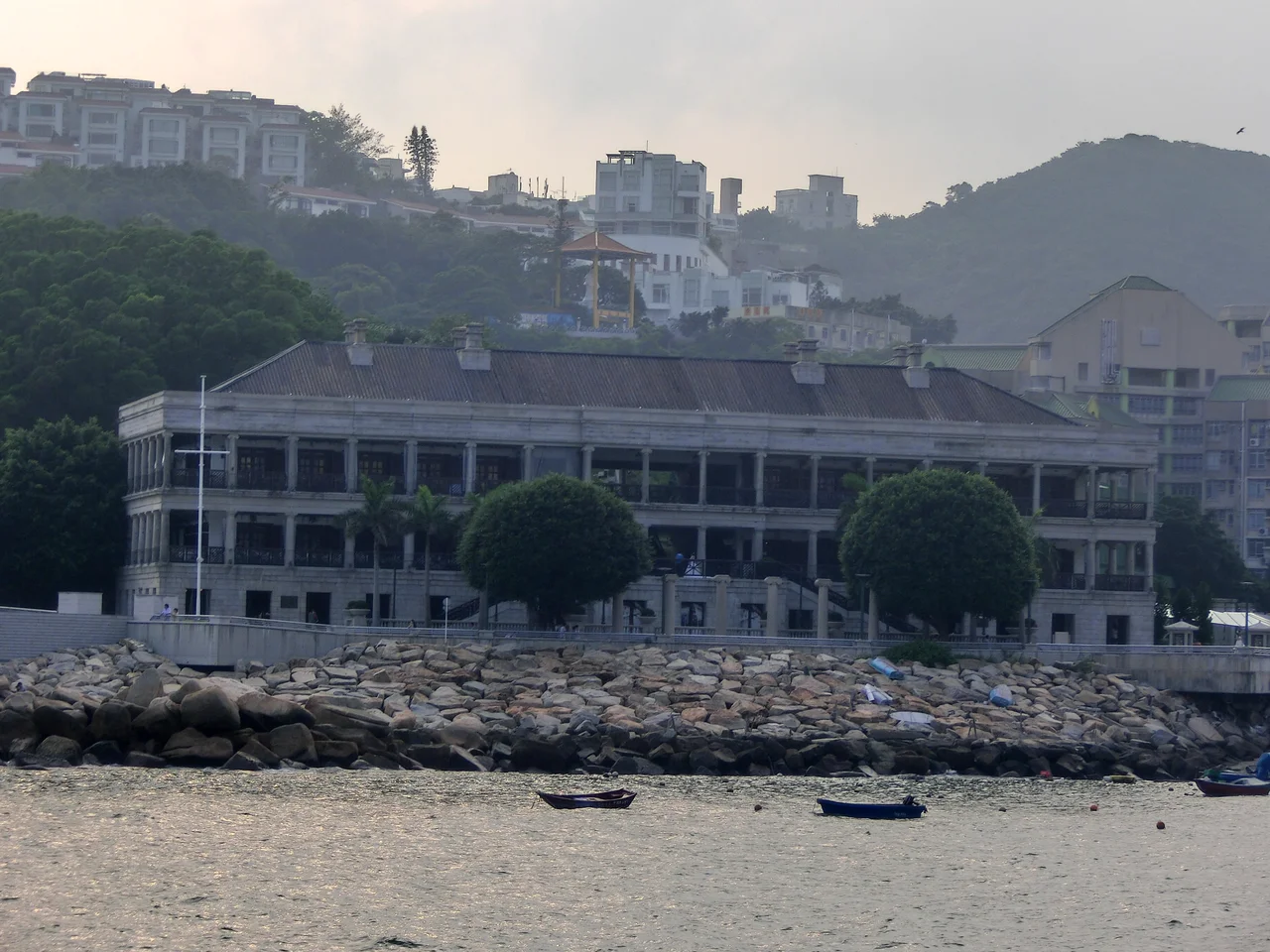

Murray House
In 1982, workers began removing a building in Hong Kong's Central district one stone at a time. Each of the more than 3,000 blocks was labelled, catalogued, and placed in storage. The Bank of China Tower needed the site. Murray House — built in 1846 as officers' quarters for Murray Barracks — had nowhere to go but into crates, waiting for someone to decide whether it was worth putting back together.
Built for Officers in a New Colony
Murray House went up in 1846, four years after the Treaty of Nanking formalised British sovereignty over Hong Kong Island. It was designed as officers' quarters for Murray Barracks — the garrison complex that occupied a large stretch of what is now the Admiralty financial district. The building's Neoclassical design was conventional for its era: heavy stone walls with flat-arched openings on the ground floor, lending the structure a sense of mass and solidity, while lighter Doric and Ionic columns on the upper floors allowed ventilation in the subtropical heat. Verandas ran around all sides on every level — a practical adaptation to monsoon climate as much as an aesthetic choice. It was, by the standards of early colonial Hong Kong, a substantial and well-considered building.
A Government Building with an Unusual History
For much of its life in Central, Murray House served as a government administrative building. One of the older surviving public structures in the colony, it accumulated the kind of institutional memory that comes from long continuous use. It also accumulated something stranger: a reputation for haunting. Exorcism ceremonies were performed inside the building — one in 1963, another in 1974 that was televised. The government, recognising that it owned the premises and that the occupants or their successors had concerns about the spiritual atmosphere, granted permission for the ceremonies to proceed. What exactly prompted these rites, or what was reported to have been experienced inside, the historical record does not precisely specify. The building stood through all of it, its stone walls indifferent to ceremony.
Dismantled to Make Way for Glass and Steel
The 1980s brought a different kind of pressure. The Bank of China Tower — I.M. Pei's angular, 72-storey landmark — required the Murray House site. A decision was made not to demolish the building outright but to preserve the fabric for potential future use. Workers numbered each block and removed them with care, producing an inventory of a Victorian Neoclassical building in component form. The stones went into storage as the Bank of China Tower rose behind them. For the better part of two decades, Murray House existed as a catalogue entry rather than a building — more archive than architecture.
Rebuilt in Stanley
In 1990, the Housing Department proposed resurrecting Murray House on the waterfront at Stanley, a coastal town on the south side of Hong Kong Island, a world apart in character from the financial district where the building had spent its first 136 years. Work progressed slowly — the restoration was completed in 2001 and the building reopened in 2002. Today it stands beside Blake Pier at Stanley, housing restaurants and shops, its columns and verandas looking out over a bay of fishing junks and weekend sailors. The Hong Kong Maritime Museum occupied the ground floor for several years before moving to Pier 8 in Central in 2013. The rebuilt house is now a popular venue for wedding photographs — its colonial colonnades providing a backdrop with visible history.
The Question of What It Is Now
Murray House was originally classified as a Grade I historic building — the highest designation in Hong Kong's heritage system. After the move, the rebuilt structure was not regraded. The authorities determined that the relocation had failed to meet international standards for heritage preservation: moving a building, however carefully, severs it from its original site and context in ways that complicate its status as an authentic historic structure. This is a genuine debate in heritage practice globally, and there is no simple answer. The stones are original. The setting is not. What Murray House offers in Stanley is something real — material evidence of 1846 craftsmanship, a Neoclassical form that predates most of the city around it — even if the conversation about what that means, and how to value it, remains unresolved.
From the Air
Murray House now stands at 22.2182°N, 114.21°E in Stanley, on the southern coast of Hong Kong Island. From the air at 2,500 feet, Stanley Bay is clearly visible as a sheltered inlet on the island's southern side, with the Neoclassical columns of Murray House identifiable along the waterfront near Blake Pier. The original site in Central (where the Bank of China Tower now stands) is approximately 5 nautical miles to the north-northwest. Hong Kong International Airport (VHHH) is approximately 23 nautical miles to the west.
Nearby Stories
- Lok Ma Chau Loop 2.3 km away
- Portas do Cerco 2.3 km away
- Kweilin Incident 17 km away
- Wanshan Archipelago Campaign 34 km away
- Nanxiong Formation 115 km away
- Battle of Nanpeng Island 148 km away
- Heyuan 169 km away
- Cape Maobitou 632 km away