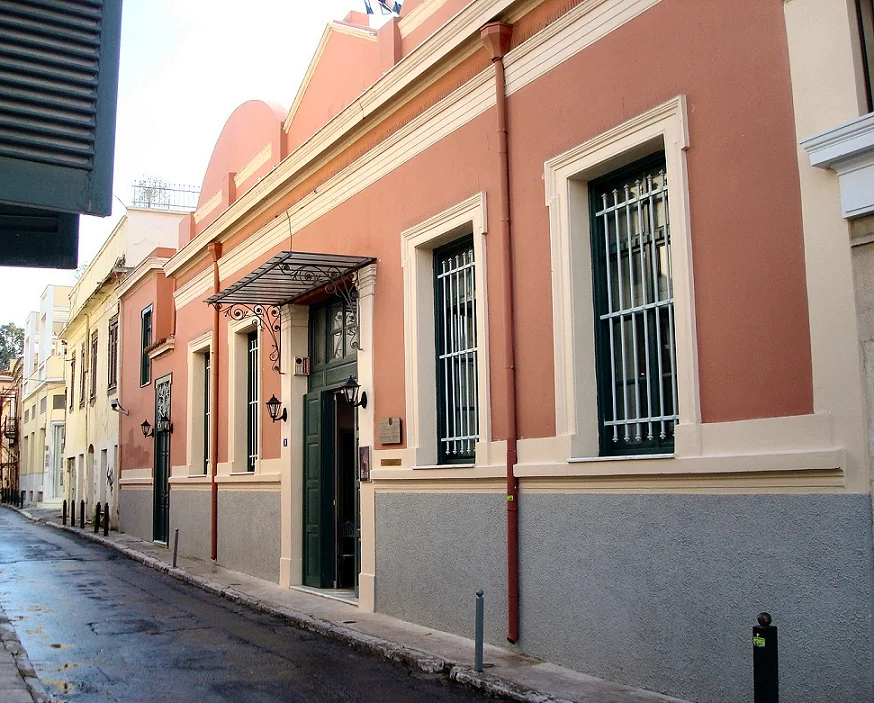

Museum of Greek Folk Art
Walk the lanes of Plaka and the Museum of Greek Folk Art reveals itself in pieces. It is not one grand building but a constellation of them - a domed Ottoman mosque on Monastiraki Square, the last surviving Turkish bathhouse in Athens, a townhouse on a narrow Plaka street. Each holds a fragment of the same idea: that the truest portrait of a people is not in its marble temples but in the things ordinary hands have made. Founded in 1918, the museum collects the embroidered, woven, carved and painted Greece - the work of villagers and craftspeople whose names history rarely recorded, and of one shy, self-taught painter whose name it could not forget.
From Mosque to Museum
The museum opened in 1918 as the Museum of Greek Handicrafts, housed inside the Tzistarakis Mosque on Monastiraki Square - an eighteenth-century Ottoman building that had already lived several lives by the time it became a showcase for Greek craft. The institution later became the National Museum of Decorative Arts, and in 1959 it took its present name, the Museum of Greek Folk Art. In 1973 the heart of the collection moved to 17 Kydathinaion Street in Plaka, and the mosque became an annex rather than the main hall. The journey from imperial place of worship to celebration of indigenous craft says something about modern Greece itself - a nation reclaiming and curating its own folk identity, building by building.
The Handmade Country
The collection spans from roughly 1650 into modern times, and it is gloriously tactile. There is embroidery and weaving, regional costumes stitched with the distinct identity of each island and mountain village, silverware and metalwork, woodcarving and stone carving. These are objects made to be used - dowry chests, festival dress, household ceramics - elevated by skill and patience into art. At the Tzistarakis Mosque, the V. Kyriazopoulos Collection of Folk Pottery fills the old prayer hall with the earthenware of Greek kitchens and workshops: jugs, plates and vessels glazed in the colors of a domestic life that stretched back centuries and is now, in many places, gone.
The Painter Who Dreamed in Color
Among the museum's treasures are the works of Theophilos Hatzimichail (1868-1934), perhaps the most beloved of all Greek folk painters. Theophilos was a wanderer and an eccentric, dressing in traditional costume, painting on walls, signboards and shop fronts for food and small change while villagers often mocked him. He had no formal training and no interest in fashion or fame. He painted heroes of the Greek War of Independence, saints, landscapes and scenes from everyday life with a flat, vivid, dreamlike intensity all his own. Recognition came only near the end of his life and grew steadily after his death, until the outsider became a national figure. His canvases here glow with the unschooled conviction that made him an icon of Greek folk art.
The Bath-house of the Winds
One annex is unlike any other. At 8 Kyrristou Street in Plaka stands the Bath-house of the Winds, the only surviving public bathhouse, or hammam, in Athens - a remarkably well-preserved remnant of the Ottoman city. Step inside and the air changes: low domes pierced with star-shaped openings filter the daylight, and the cool stone still seems to hold the steam of centuries past. A bathhouse was once a center of social life, where the city gathered, gossiped and bathed. Preserved and opened as part of the Folk Art Museum, it lets visitors stand inside a piece of everyday Ottoman Athens - itself an artifact, the building as exhibit.
From the Air
The Museum of Greek Folk Art is centered in Plaka and Monastiraki at roughly 37.973 N, 23.732 E, in the historic core of Athens directly beneath the Acropolis. Its annexes spread across a few hundred meters: the Tzistarakis Mosque on Monastiraki Square, the main building on Kydathinaion Street, and the Bath-house of the Winds on Kyrristou Street. The nearest major airport is Athens International (LGAV), about 28 km to the east-southeast. From the air, the Acropolis rock and the green expanse around it form an unmistakable landmark; the Plaka neighborhood is the dense, low-rise tangle of streets hugging its northern slope. Clear Attic skies make the marble of the Parthenon visible from a considerable distance.
Nearby Stories
- Great Sand Beach 5 km away
- Battle of Delium 7.7 km away
- Tower of Aliartos 9 km away
- HMHS Britannic 10 km away
- Saronic Gulf 15 km away
- Sousaki Volcano 17 km away
- Sanctuary of Apollo Maleatas 24 km away
- Skyros 66 km away