
Museum of Liverpool
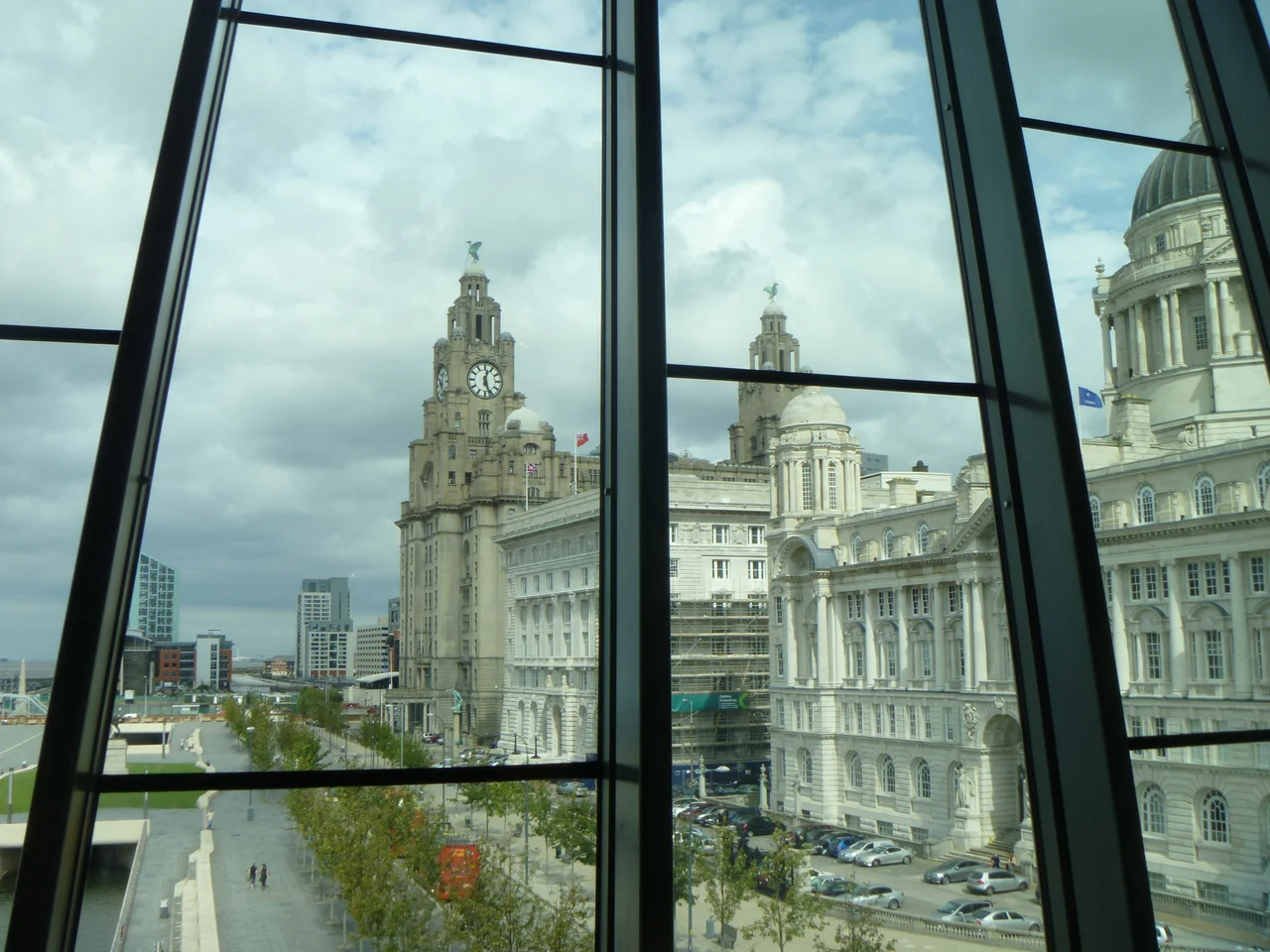
On a Tuesday morning when the museum is quiet, you can stand on the upper gallery floor and look out through Buro Happold's vast cantilevered window at the Three Graces and the Mersey, and behind you, on a plinth, is a steam locomotive built in 1838. The Lion is one of the oldest surviving steam locomotives in the world. She starred in the 1953 Ealing comedy The Titfield Thunderbolt. The museum she lives in opened in 2011, built on a vacant site at Mann Island for £72 million by the Danish architects 3XN, and tells the story of Liverpool through 6,000 objects spread across 8,000 square metres of exhibition space. The building has been called many things since it opened -- some of them rude -- but inside, the city's history is laid out with genuine love.
Mann Island
Mann Island sits at Pier Head, between the Royal Liver Building and the Albert Dock, on ground reclaimed when the original tidal inlet called the Pool was filled in during the eighteenth century. By the late twentieth century it was a wasted strip of car parks and access roads at the edge of the city's most famous waterfront. The decision to build a major new museum here was both a regeneration play and a deliberate statement: that Liverpool's story belonged at the riverside, not tucked away inland. The competition was won by 3XN, a Copenhagen practice known for unusually theatrical museum architecture, working with British engineers Buro Happold. Construction was led by Galliford Try and cost £72 million. The museum opened to the public on 19 June 2011, replacing the older Museum of Liverpool Life. From outside, it is a sleek wedge of pale Jura limestone with a great glass window cantilevering out toward the Mersey. The form is angular and modern in a way that sits uneasily alongside the Edwardian baroque of the Liver Building and the Cunard Building next door, and the building has divided opinion ever since. Inside, the floor plan is generous -- 8,000 square metres of gallery space, a wide central atrium, a spiralling staircase that has become the museum's signature image.
Four Themes
The permanent collection is organised around four core themes. The Great Port tells the story of how the Mersey estuary became one of the world's busiest trading harbours, from the small medieval borough King John chartered in 1207 to the era of the Cunarders and the container terminals at Seaforth. Global City follows the impact of Liverpool's commerce on the wider world -- the slave trade, the cotton trade with the American South, the timber and grain imports that fed Britain through the Industrial Revolution and the world wars. People's Republic, the gallery on the upper floor, looks at Liverpool's own population: settlement from Neolithic times onwards, Irish and Welsh immigration, the Chinese community that is the oldest in Europe, Caribbean and African Liverpool, Jewish Liverpool, Liverpool Polish, Liverpool Yemeni. Wondrous Place explores Liverpool's culture -- music, comedy, football, art -- including a Beatles-focused gallery and football galleries on Liverpool FC and Everton that handle the rivalry with care. The Lion locomotive holds court in the Great Port gallery, having been hauled in by road from Manchester in February 2007 while the museum was still under construction. The dust sheets came off on opening day.
The Memorial and the Murder
The People's Republic gallery contains harder material. The Hillsborough memorial — a permanent installation honouring the 97 Liverpool fans who died in the crush at the FA Cup semi-final on 15 April 1989 — was unveiled here in 2011 and has become a place of quiet pilgrimage. The museum also holds material from the Toxteth riots of 1981, when racial tension in the L8 postcode exploded into nine days of disturbances; from the 1947 dock strike; from the work of the Militant tendency that controlled Liverpool City Council in the 1980s and brought the city to the brink of bankruptcy. None of this is sanitised. The galleries acknowledge that Liverpool's modern self emerged from real damage -- managed decline by successive governments, mass unemployment in the 1980s, the slow collapse of the docks as containerisation moved freight to Felixstowe and Southampton. But they also acknowledge the city's astonishing capacity to remake itself. The European Capital of Culture year in 2008. The G7 foreign ministers' summit at the museum from 10 to 12 December 2021. The Eurovision Song Contest hosted on behalf of Ukraine in 2023, with Liverpool dressed in blue and yellow.
Lennon's Glasses, Yoko's Tribute
The Beatles material is unavoidable and the museum handles it with the right amount of pride. John Lennon's spectacles, his school report card, his original lyrics to several songs, are on display in the Wondrous Place gallery. Paul McCartney's piano is here. There are stage outfits from the Mathew Street days at the Cavern Club, where the group played 292 times between 1961 and 1963. From September to November 2012, the Liverpool Love exhibition brought back items contributed by people who had shaped or been shaped by the city — Yoko Ono lent a piece, Sir Peter Blake (creator of the Sgt. Pepper sleeve) contributed, the comedian Noel Fielding sent in a portrait. The museum's flexible gallery spaces rotate exhibitions constantly, drawing from National Museums Liverpool's vast wider collection. A Walker Art Gallery painting will appear for a season; a piece of decorative ironwork from Sudley House will rest here for a month. The intention is that no two visits be quite the same. For a museum that is meant to be the definitive statement of what Liverpool is and has been, that constant restlessness feels exactly right.
From the Air
Located at 53.403N, 2.996W at Mann Island, Pier Head, Liverpool waterfront, between the Royal Liver Building to the north and the Albert Dock to the south. The angular pale-stone building with a prominent glass cantilever window is unmistakable from the air, set against the more ornate Edwardian baroque of the Three Graces. Nearest airport: Liverpool John Lennon Airport (EGGP), approximately 7nm southeast. Best viewed from 1,500-3,000ft.
Nearby Stories
- RAF Wrexham 3.3 km away
- Birkdale Palace Hotel 3.7 km away
- Turton Tower 4.1 km away
- Tatton Park 5.6 km away
- Abergele Rail Disaster 9.6 km away
- Diglake Colliery Disaster 13 km away
- Ysbyty Ifan 16 km away
- Celtic Array 62 km away