
Museum of Old and New Art
Most great museums reach upward toward the light. This one burrows down into the dark. At MONA, the Museum of Old and New Art, visitors step off a ferry onto a quiet peninsula north of Hobart, walk into an unassuming building, and then descend a spiral staircase into the cliffs, dropping through three subterranean levels carved out of sandstone. One critic likened the descent to going down into Petra. There are no windows, the atmosphere is deliberately ominous, and the founder, David Walsh, cheerfully calls the whole place a 'subversive adult Disneyland.' It is the largest privately funded museum in the Southern Hemisphere, and there is nothing else quite like it on Earth.
The Gambler's Museum
MONA exists because of mathematics and nerve. David Walsh, a Hobart local, made a fortune through professional gambling, applying statistical systems to betting, and poured that money into art. He opened a modest precursor, the Moorilla Museum of Antiquities, in 2001, then closed it in 2006 for a 75-million-dollar reinvention. The new museum opened on 21 January 2011, set within the Moorilla winery on the Berriedale peninsula. Walsh built it not as a polite civic gift but as an argument, a personal collection arranged to provoke. For Tasmanians, entry has remained free, an unusual gesture from a man who otherwise delights in unsettling his visitors. He even offers an 'Eternity Membership' that grants lifetime free admission and, fittingly for a museum obsessed with death, the right to be cremated and interred in MONA's own cemetery, so that devotees can quite literally never leave.
Sex, Death, and a Machine That Digests
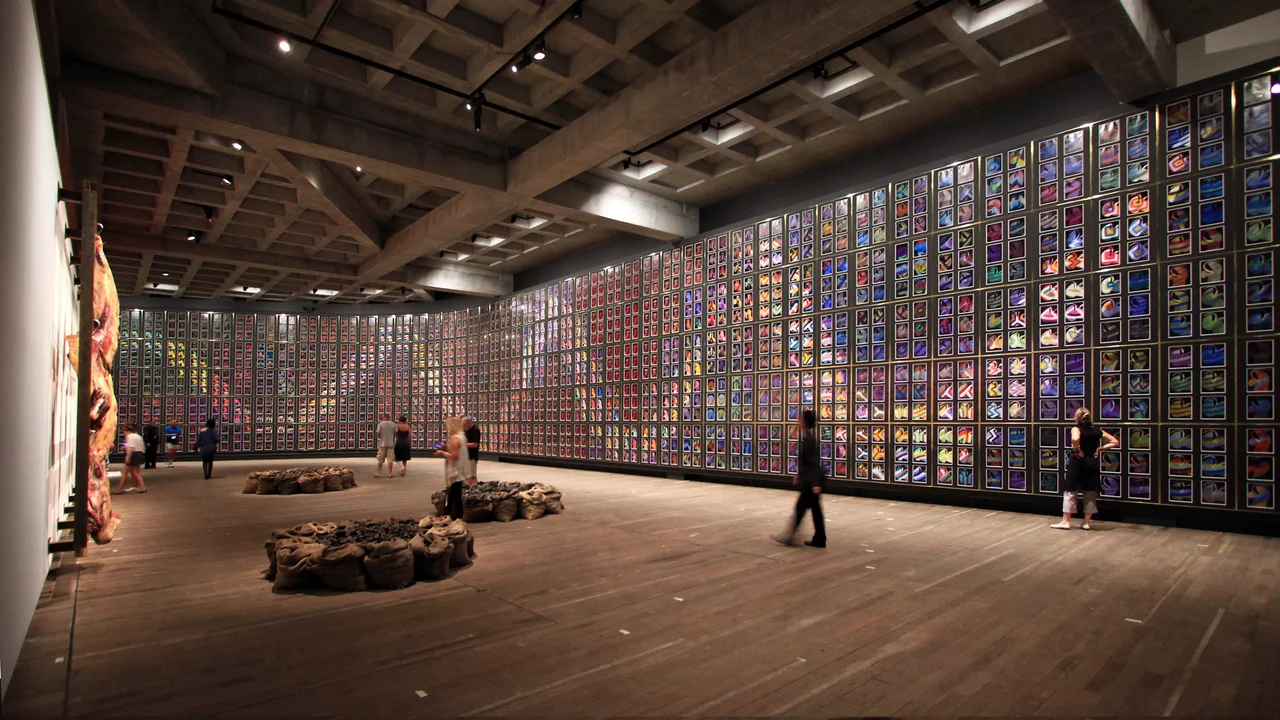
Walsh has said his museum circles two themes above all: sex and death. The collection, more than 1,900 works ranging from ancient Egyptian antiquities to confronting contemporary pieces, refuses easy comfort. The centrepiece of its opening was Sidney Nolan's Snake, a vast mural assembled from 1,620 small paintings, displayed publicly in Australia for the first time. Elsewhere sits Cloaca Professional, Wim Delvoye's machine that mimics the human digestive system and produces, daily, exactly what a digestive system produces. The works hang without labels and out of chronological order; instead, visitors carry a device called 'The O,' which lets them choose how to read each piece, from a plain summary to Walsh's own irreverent opinions.
The Ladies Lounge
MONA's appetite for controversy spilled into the courts in 2024. The museum's Ladies Lounge, an exhibition open only to women, was conceived to make men feel the exclusion that women have endured for centuries. A male visitor sued, arguing discrimination, and the legal saga that followed was pure MONA. When an early ruling demanded the space admit men, the museum converted it, briefly, into a women's toilet, and the Picasso paintings reportedly hanging inside turned out to be forgeries painted by the artist behind the exhibit. Later in 2024, a judge of the Supreme Court of Tasmania ruled the lounge could indeed exclude men, on the grounds that doing so promoted equal opportunity for a group long shut out. The artwork, in other words, won.
How a Museum Changed a City
MONA did more than fill a building; it remade Hobart's place in the world. In 2012, Lonely Planet named the city one of its top destinations for the year ahead, citing the museum directly and comparing its pull to the Guggenheim that transformed Bilbao. The museum extends its reach beyond its galleries through two festivals: the summer Mona Foma and the winter Dark Mofo, the latter wrapping the cold city in fire, food, and avant-garde music. For a remote island capital once known mostly for its colonial past, MONA offered a startling new identity, proof that one person's obsession, set loose underground, could draw the world to the bottom of the map.
From the Air
MONA sits on the Berriedale peninsula at 42.81 degrees south, 147.26 degrees east, on the western bank of the River Derwent about 12 km north of central Hobart. From the air, look for the peninsula jutting into the broad Derwent estuary, with the museum's vineyards and the MONA ROMA ferry route tracing the river back toward the Hobart waterfront; most visitors arrive by that 30-minute ferry ride. The nearest major airport is Hobart International Airport (YMHB), about 18 km southeast across the estuary; Cambridge Aerodrome (YCBG) is also nearby. Recommended viewing altitude is 1,500 to 3,000 ft AGL. The wide Derwent generally offers good visibility, though afternoon winds funneling down from kunanyi / Mount Wellington to the southwest can roughen the air over the water.
Nearby Stories
- Mount Field National Park 16 km away
- Port Arthur Massacre Memorial 18 km away
- Tessellated Pavement 32 km away
- Bruny Island 36 km away
- Van Diemen's Land 61 km away
- Franklin Dam Controversy 71 km away
- Freycinet National Park 75 km away
- Chatham Islands 2959 km away