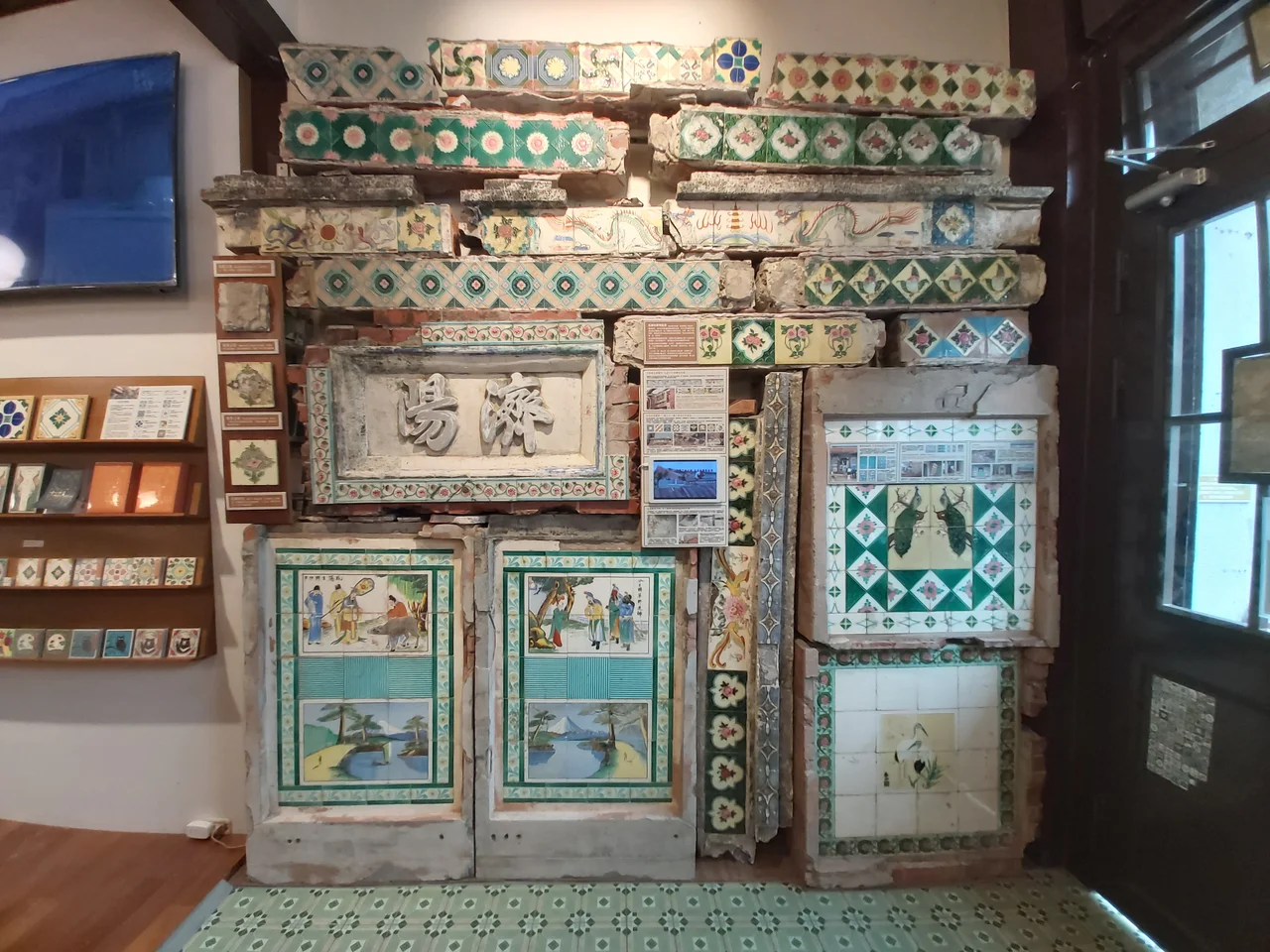

Museum of Old Taiwan Tiles
James Hsu didn't open a museum because there was demand for one. He opened it because the tiles were disappearing. The decorative ceramic tiles that covered the facades of homes, temples, and shophouses across Taiwan during the Japanese colonial period — particularly from 1915 to 1935 — were being stripped from demolition sites, broken up, discarded. Collectors were a small and scattered community. When Hsu and his friends pooled resources to purchase a former timber storage building in Chiayi City's West District in 2015, they were not so much founding an institution as rescuing an artifact, thousands of artifacts, before the last generation of buildings that had held them was gone. The Chiayi City Government provided renovation subsidies that same year. After two years of restoration, the Museum of Old Taiwan Tiles opened in late 2017: a two-story building in the city center holding more than 4,000 pieces of classical-style ceramic tile, and the story of why they matter.
Tiles as Historical Record
The tiles that the museum collects are not floor tiles or plain bathroom squares. They are decorative architectural ceramics — colorful, patterned, often hand-painted — that were produced primarily between 1915 and 1935, during the middle decades of Japanese colonial rule in Taiwan. The period coincides with the global Art Nouveau and Art Deco movements, and the tiles reflect their moment: floral motifs, geometric patterns, stylized natural imagery, and occasionally figurative designs drawn from both Japanese and Chinese aesthetic traditions. Many were manufactured in Japan or sourced through Japanese trading networks and then installed on the exterior and interior walls of Taiwanese homes as markers of prosperity and modernity. A house with decorative tiles was a house whose owners could afford to participate in the visual culture of the era. The tiles were also, in a sense, time stamps — their patterns dateable, their origins traceable, their condition a measure of how well or poorly the buildings that held them had fared.
The Building Itself
The museum's home is a former timber storage building from the Japanese colonial period, which gives the site a doubled historical texture. The building that now houses artifacts of colonial-era decorative culture was itself built to serve the timber economy that the Alishan Forest Railway brought to Chiayi — originally constructed in 1938 as the headquarters of the Defeng Timber Company. It is a two-story structure, with a ceiling of exposed original beams that visitors can see from the ground floor. The renovation preserved the building's industrial character while transforming it into exhibition space; the walls of classical-style tiles are displayed against the rough original fabric of the warehouse. Chiayi City Government's subsidy for the renovation recognized that the building's preservation served both heritage and cultural development goals. A private collector's passion, in other words, aligned with a civic interest in keeping the physical memory of the city's colonial-era built environment intact.
More Than 4,000 Pieces
The collection spans the full range of what decorative tile-making produced during the 1915 to 1935 period. Visitors encounter tiles arranged by pattern, by period, by provenance, and by architectural context — the washroom tiles that would have been installed in a prosperous household are displayed differently from the facade panels that faced the street. The sheer number of pieces in the collection — more than 4,000 — reflects how much was produced, how widely it was used, and how systematically it has been disappearing. Demolition of older buildings across Taiwan's cities has been the primary driver of tile loss; the museum functions as an archive against that attrition, preserving physical objects that would otherwise be rubble. The collection also functions as a design resource, and craftspeople and designers do visit to study patterns that have otherwise passed out of circulation.
Near the Railway Station
The Museum of Old Taiwan Tiles is within walking distance northeast of Chiayi Station on the Taiwan Railway network — the main-line station that connects Chiayi to Taipei and Kaohsiung. This location is convenient for visitors arriving from elsewhere in Taiwan, and it situates the museum in the western part of the city center, near the older commercial districts where many of the buildings that originally bore these tiles would have stood. The museum is not a large institution; its three floors fill quickly on weekends. But the intimacy works in the collection's favor. Tiles that look like surface decoration at scale become intricate objects of study when you can stand close to them, trace the glaze, and read the pattern at the scale it was designed to be read — not from a moving vehicle but from the inside of a room.
Saving the Surface
There is something quietly urgent about what the Museum of Old Taiwan Tiles is doing. Architectural ceramics are vulnerable in ways that paintings and sculptures are not: they are attached to buildings, and when buildings fall, they fall. The institutions most likely to preserve them — historic preservation boards, national museums — have typically been more interested in major monuments than in the decorative tile of a shophouse facade. Private collectors like James Hsu fill the gap that official preservation leaves, making decisions about what matters with their own resources and judgment. The museum in Chiayi is a direct result of that judgment. Whatever the tiles meant to the households that first installed them — prosperity, fashion, cultural participation — they mean something else now: evidence of a visual culture that Taiwan's rapid urbanization has been steadily dismantling. The two-story building in Chiayi's West District holds more than 4,000 pieces of that evidence, arranged for anyone who wants to look.
From the Air
The Museum of Old Taiwan Tiles is located at approximately 23.483°N, 120.446°E in the West District of Chiayi City, Taiwan. From the air at 1,500 to 2,000 feet, the West District appears as a denser grid of older commercial and mixed-use buildings west of the Taiwan Railway corridor. The nearest airport is Chiayi Airport (RCKU), approximately 2 km to the west. Chiayi Station (Taiwan Railway) is visible as a major rail hub immediately southwest of the museum's location. The flat Chiayi plain extends in all directions, with the Alishan mountains forming the eastern horizon on clear days.
Nearby Stories
- Paiyun Lodge 1.2 km away
- Wushantou Reservoir 4.3 km away
- 1999 Jiji Earthquake 6.5 km away
- Xiluo 7.4 km away
- Bunun Cultural Museum 27 km away
- TransAsia Airways Flight 222 28 km away
- Mudouyu Lighthouse 29 km away
- Daya Bay 551 km away