
Museum of Pavlos and Alexandra Kanellopoulou
In 1923, a young Greek couple began buying beautiful things. Over the next half-century, Pavlos and Alexandra Kanellopoulos accumulated not a hoard but a vision - some 6,500 objects reaching from Neolithic figurines to nineteenth-century icons, nearly six thousand years of human craft held in private hands. They could have kept it. Instead, in 1972, they gave it all to the Greek state. Today the collection fills a neoclassical mansion clinging to the north slope of the Acropolis, in the heart of Plaka, where the rock of the ancient city rises directly behind the windows. Few museums in Athens feel so personal: this is not a national survey but the distilled taste of two people who simply loved the past.
The Mansion on the Slope
The museum occupies the Michaleas Mansion, a three-story neoclassical house built in 1894 for the Michaleas family, its upper ceilings painted with delicate decoration that still survives. The Greek state expropriated the building in the 1960s and restored it to house the Kanellopoulos collection, which opened to the public in 1976. In 2007 a New Wing was added, designed by the architect P. Kalligas at the initiative of Alexandra Kanellopoulos and the foundation bearing the couple's name. The setting could hardly be more charged with history - Theorias Street runs along the foot of the Acropolis, and stepping out the door places you on the sacred rock's northern flank, where the city has lived continuously for thousands of years.
A City Beneath the Floor
When workers dug the foundations for the New Wing, the ground gave up its own collection. Excavations uncovered the remains of a Late Byzantine house and a stretch of the medieval fortification of Athens - the so-called Rizokastro, a defensive wall built in the thirteenth century to ring the slopes below the Acropolis. Rather than clear the finds away, the museum preserved them in place. They now sit in the basement of the New Wing, open to visitors, so that a museum of antiquities literally stands on top of the antiquity of its own neighborhood. It is a reminder that in this part of Athens, you cannot build anything without disturbing the layers of everyone who built before you.
Six Thousand Years in One House
The breadth of the collection is staggering. There are Neolithic and Bronze Age figurines and vessels, Classical vases, and a deep array of metalwork - vases, weapons, statuettes, weights, ritual equipment. There are marble sculptures, jewelry of every era in gold, silver, bronze and glass, coins, Fayum-style funerary portraits, textiles, manuscripts and early printed books. Among the ancient pottery, the black-figure and red-figure vases stand out, painted with myth, ritual and the small dramas of Archaic and Classical life. A set of Attic white-ground lekythoi - slender oil flasks made for the grave - carries delicate funerary scenes that imitate the lost grand painting of the Classical age, offering a rare glimpse of how the ancient world depicted its own grief.
The Light of the Icons
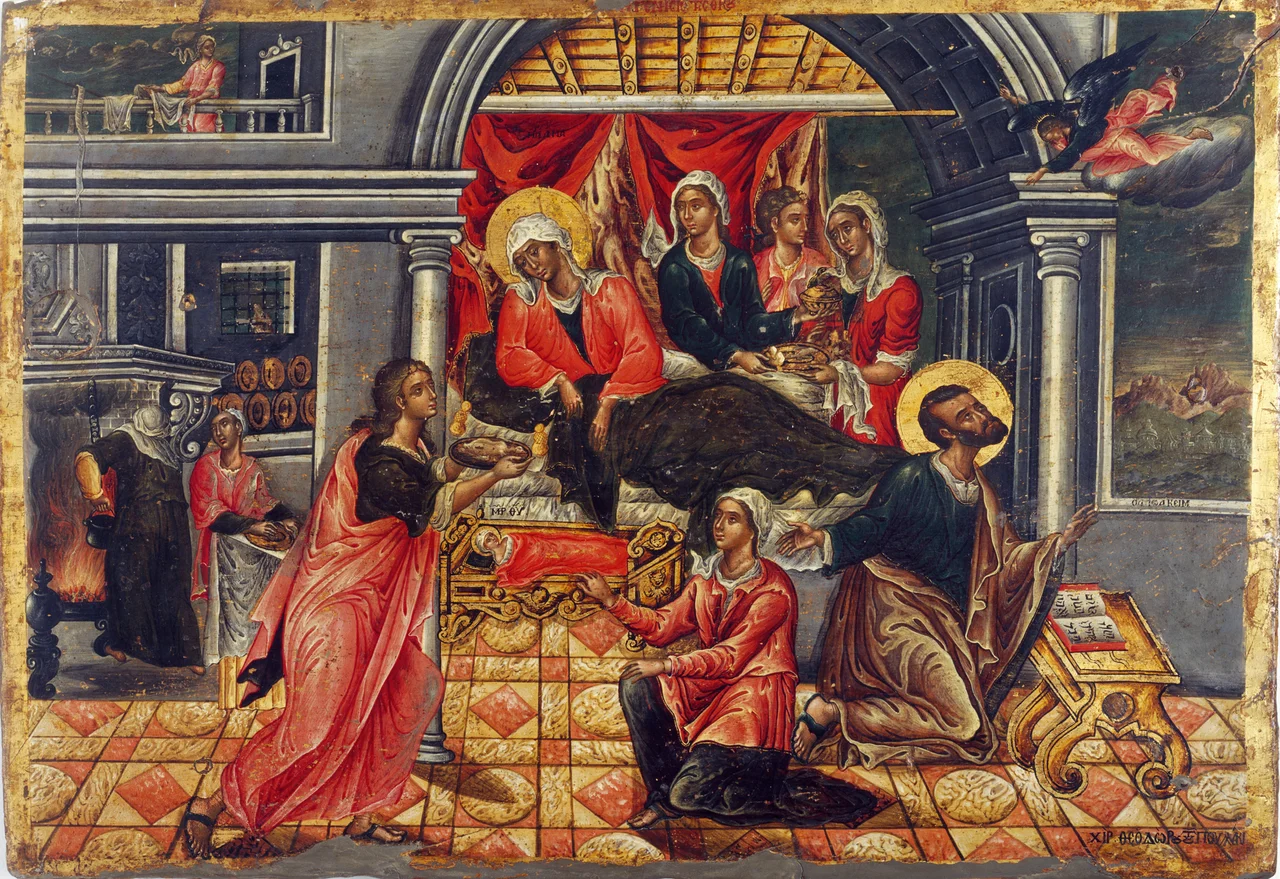
For all its ancient treasures, the collection is most renowned for what came later: more than 350 Byzantine and post-Byzantine icons, dating from the fourteenth to the nineteenth century. Pride of place goes to the Cretan School, the tradition that flourished after the fall of Constantinople, when painters on Venetian-ruled Crete fused the gold-ground gravity of Byzantine art with the modeling and depth of the European Renaissance. The museum holds works by the masters of that school - Nicolaos Tzafouris, Michael Damaskenos, Emmanuel Lambardos, Frangias Kavertzas, Ieremias Palladas, Victor, and Emmanuel Tzanes - the same tradition that trained a young Cretan named Domenikos Theotokopoulos before he left for Spain and the world remembered him as El Greco.
From the Air
The Kanellopoulos Museum sits at roughly 37.973 N, 23.726 E on the north slope of the Acropolis, on Theorias Street in the Plaka district of central Athens. The nearest major airport is Athens International (LGAV), about 29 km to the east-southeast. From the air, the Acropolis rock is the defining landmark - the museum nestles against its northern face, where Plaka's red-tiled roofs press up to the base of the ancient citadel. The clear, dry skies of the Attic basin typically give excellent visibility; the Parthenon, Lycabettus Hill, and the gulf of the Saronic Sea to the south all help orient the view.
Nearby Stories
- Great Sand Beach 5 km away
- Battle of Delium 7.7 km away
- Tower of Aliartos 9 km away
- HMHS Britannic 10 km away
- Saronic Gulf 15 km away
- Sousaki Volcano 17 km away
- Sanctuary of Apollo Maleatas 24 km away
- Skyros 66 km away