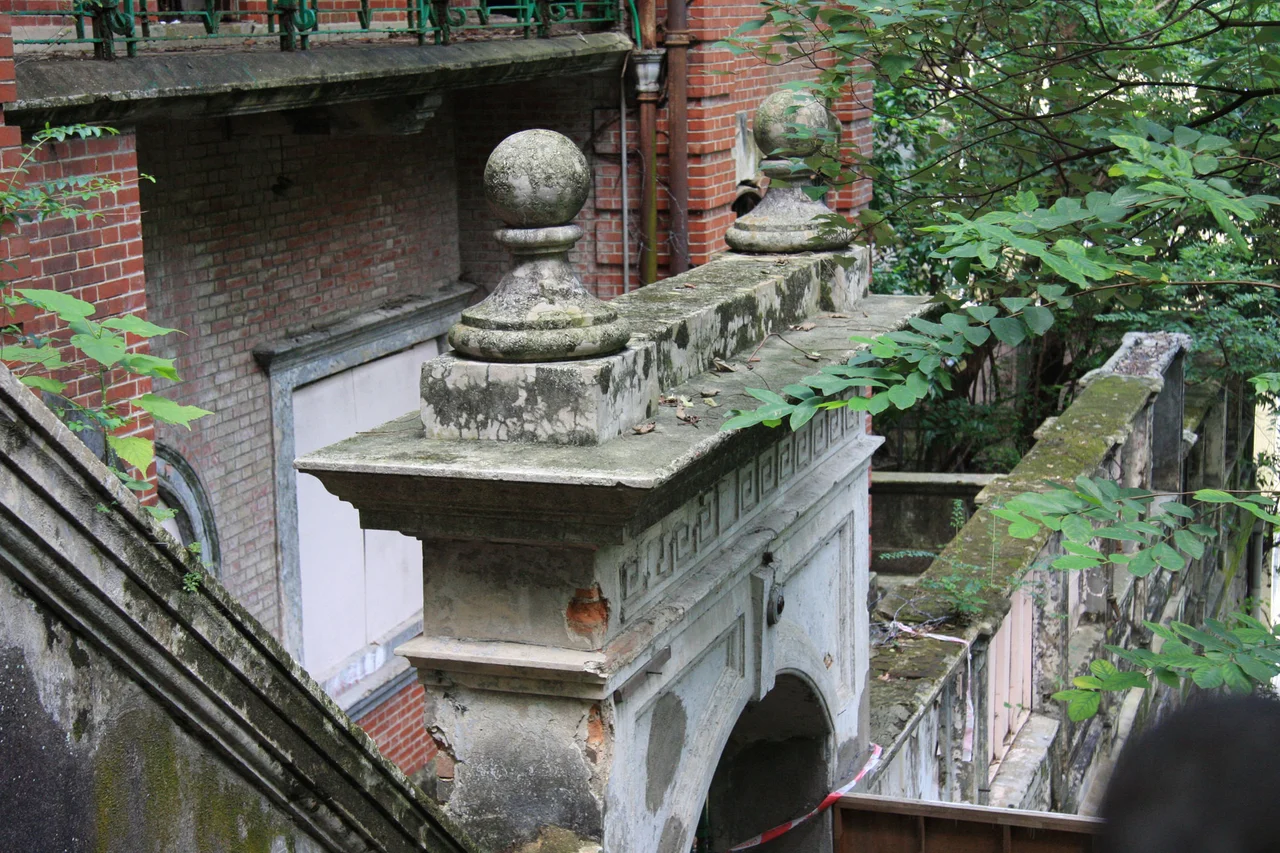

Nam Koo Terrace
The red brick building at No. 55 Ship Street does not announce itself. Wan Chai has grown up around it — towers, markets, the MTR running beneath the streets — and Nam Koo Terrace sits behind its iron gate as the city accelerates past. But the mansion has been carrying stories since 1915, and the heaviest of them have nothing to do with ghosts.
Built by a Merchant Family in a Changing District
Prominent Hong Kong businessman To Chun-man (杜仲文) first leased the Ship Street land lot in 1915. He held the position of Chief Chinese Silks Salesman for Wing On Company Limited (永安有限公司), was later promoted to Assistant Manager, and served in several community roles including as Secretary for the Commercial Chamber of the Heung Shan District. The two-storey red brick mansion he had built — completed sometime between 1915 and 1921 — reflected the aspirations of a prosperous merchant family in a district that had itself been transformed. By 1845, Wan Chai (then called Spring Garden Lane after opium merchant John Dent's personal villa) had already become an exclusive address for European businessmen. To Chun-man's choice of the hillside below Kennedy Road placed the family in a district with deep colonial and commercial roots.
Architecture That Speaks Two Languages
Nam Koo Terrace is a building designed to be read from multiple directions. The exterior presents Colonial Eclectic style combined with Classical Revival and Italian Renaissance features, executed in red brick. Rusticated quoins anchor the corners, moulded cornices cap the walls, voussoired arches frame the windows. Ironwork grilles and balcony railings add an ornamental layer. The garden-facing facade is symmetrical and colonnaded — Doric and Ionic orders in the standing columns, a curved porch with a veranda that echoes a temple portico. On the rooftop, a pavilion built in traditional Chinese style suggests that feng shui principles informed the original design, as did the asymmetrical building plan and the placement of the entrance gate beside the Ship Street steps. The building is, architecturally speaking, a negotiation between European form and Chinese spatial thinking — a negotiation common in early twentieth-century Hong Kong, but rarely executed on this scale by a Chinese merchant family.
The Years of Occupation
To Chun-man was forced to evacuate Nam Koo Terrace when Japanese forces occupied Hong Kong in December 1941. He died soon after his return when the occupation ended. During the years of Japanese control, the mansion — along with many other properties in Wan Chai — was among those the military used for purposes that caused profound and lasting harm. The Japanese occupation of Hong Kong lasted from December 1941 until August 1945. The comfort women who were forced into sexual slavery by the Japanese military across occupied Asia included women throughout Hong Kong. What happened to the women inside Nam Koo Terrace during those years is not a matter of supernatural speculation — it is a history of documented wartime atrocity that belongs to the real story of the building. The ghost stories that have grown up around the mansion draw on this history, even when they frame it in the language of the uncanny. The women who suffered here deserve to be named in what they were: victims of organised military violence, not merely sources of frightening folklore.
The Haunted House and Its Reputation
Hong Kongers call Nam Koo Terrace the Wan Chai Haunted House, and the reputation is genuine and old. Accounts of hearing cries, of figures seen at windows, of a presence in the rooms that has accumulated over decades of telling and retelling — these stories circulate freely. The building has been locked and gated for years, which only deepens the atmosphere. A German music trio called Trademark filmed the music video for their song 'I'll Be There For You' inside the house. Jen Sookfong Lee's 2025 novel 'The Hunger We Pass Down' features the mansion prominently. The folklore is inseparable from the history now, which is as much a comment on how traumatic memory persists in built environments as it is on any particular claim about what moves through the upstairs rooms after dark.
A Grade I Building in an Uncertain Future
Nam Koo Terrace holds a Grade I historic building classification — the highest designation in Hong Kong's heritage system — reflecting its architectural and historical significance. Hopewell Holdings, which owns the property, has pledged to conserve and revitalise the site as part of a larger Wan Chai redevelopment. The neighbourhood around it is dense with other rated heritage buildings: the Blue House on Stone Nullah Lane, various pre-war shophouses on Mallory and Burrows streets, the Hung Shing Temple on Queen's Road East. Nam Koo Terrace sits in the middle of this cluster, one of the oldest and most substantial, waiting for a future that Hong Kong's development pressures make genuinely uncertain. Whatever becomes of the building, the story it holds — of a prosperous family, a colonial district, a brutal occupation, and the women who suffered through it — will not be resolved by renovation.
From the Air
Nam Koo Terrace stands at 22.275°N, 114.16972°E in Wan Chai, on the northern slope of Hong Kong Island east of Central. From the air at 3,000 feet, the Wan Chai district is visible as a dense residential and commercial grid between the harbour reclamation to the north and the rising ground of Happy Valley to the south. Ship Street is a short lane running up the hillside just west of the Hong Kong Academy for Performing Arts. Hong Kong International Airport (VHHH) is approximately 23 nautical miles to the west.
Nearby Stories
- Lok Ma Chau Loop 2.3 km away
- Portas do Cerco 2.3 km away
- Kweilin Incident 17 km away
- Wanshan Archipelago Campaign 34 km away
- Nanxiong Formation 115 km away
- Battle of Nanpeng Island 148 km away
- Heyuan 169 km away
- Cape Maobitou 632 km away