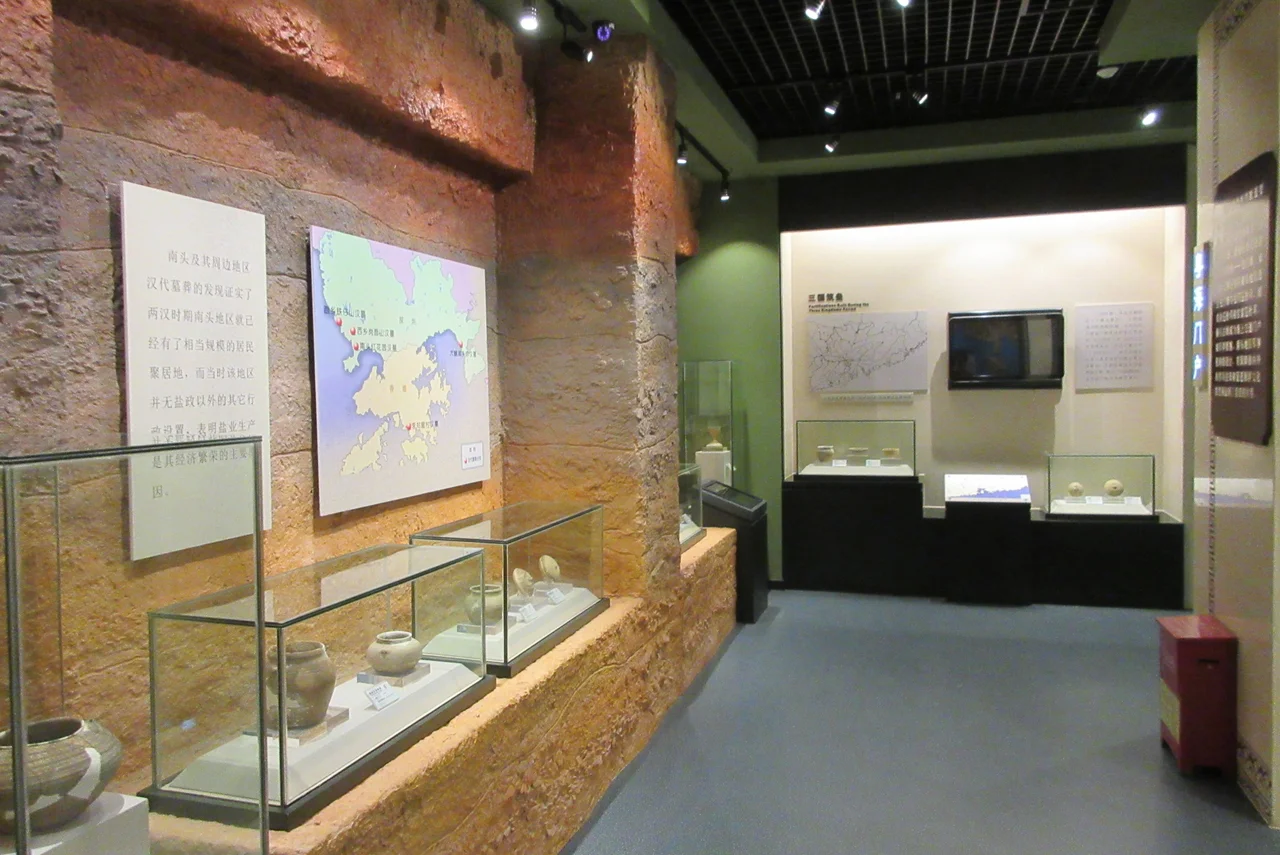

Nantou Ancient City Museum
The building that houses the Nantou Ancient City Museum once issued county orders, settled land disputes, and administered a territory that stretched across what is now Shenzhen, Hong Kong, and parts of the Pearl River Delta. Today the same structure holds glass cases of stone artifacts, old maps, and scale models of the walled city that once surrounded it. The museum opened in September 2004, inserted into the fabric of Nantou's historic town, and it remains one of the few places in Shenzhen where the city's deep past is laid out plainly and without spectacle.
The Building and Its Previous Life
The museum occupies the former government house of Bao'an County — the administrative office of a jurisdiction that, at various points in Chinese history, encompassed the lands that would eventually become Shenzhen and Hong Kong. That lineage gives the building a weight that transcends its modest scale. Two stories tall, it contains three exhibition halls arranged to guide visitors through the region's history chronologically. The structure itself is part of the exhibit: to stand inside this building is to occupy a space where county magistrates once worked, where petitions were received, and where the daily business of governing a coastal frontier was conducted for centuries.
What the Halls Contain
The museum's collection focuses on archaeological and historical artifacts from the former Bao'an County area — stone bricks, ceramics, maps of the ancient city layout, historical records, and reconstructed scenes from daily life. Photographs from the museum's gallery show displays tracing the development of Nantou from its founding in 331 CE through the Ming dynasty rebuilding of its walls in 1394, the turbulent Qing dynasty clearances, and the eventual absorption of the surrounding territory into the Shenzhen Special Economic Zone after 1980. The three halls appear to move from geological and early settlement history through the imperial administrative era and into the modern period of transformation. Maps of the Nantou ancient city — showing the wall circuits, the gate positions, and the street grid — are among the most striking elements.
A Museum Inside a Living Town
The Nantou Ancient City Museum is unusual in that it sits within a functioning urban village rather than a preserved heritage precinct. The streets around it are narrow and busy. Residents walk past the entrance on their way to and from work. Small shops and food stalls operate in the surrounding lanes. This proximity to everyday life makes the museum feel less like a curated exception and more like one layer of a place that has been continuously inhabited and continuously remade. The Shenzhen government established the museum as part of a broader effort to revitalize Nantou as a historic trail, renaming the area Xin'an Ancient City. Whether that effort has succeeded in preserving the town's character is a question the museum itself quietly poses.
Patriotic Education and Local Memory
Chinese local authorities designated the museum as a patriotic education base — a formal category within China's official cultural designation system that signals a site's role in teaching citizens about national and local history. For Shenzhen, a city whose popular image is entirely defined by the past four decades of economic growth, the Nantou Ancient City Museum represents an institutional commitment to remembering what came before the Special Economic Zone. The artifacts on display — salt production records, military fortification remnants, evidence of the imperial administrative machinery — document a place that was already old when Shenzhen was still a village.
From the Air
The Nantou Ancient City Museum is located at approximately 22.54°N, 113.92°E in the Nanshan District of Shenzhen, within the historic Nantou area. At low altitude from the west, the dense urban fabric of Nanshan gives way to the slightly lower rooflines of the old town district, where the museum is embedded. Shenzhen Bao'an International Airport (ZGSZ) lies approximately 14 nautical miles to the northwest. Hong Kong International (VHHH) is roughly 25 nautical miles to the southwest. Qianhai Bay is visible nearby to the west, and the Shenzhen Bay Bridge crossing to Hong Kong's New Territories can be seen on clear days.
Nearby Stories
- Hong Kong Disneyland 4.1 km away
- Mount Guanyin (Dongguan) 7 km away
- 2024 Lixinsha Bridge Collapse 7.4 km away
- Portas do Cerco 12 km away
- Lotus Hill 15 km away
- Nanxiong Formation 78 km away
- Heyuan 130 km away
- Checheng Fu'an Temple 629 km away