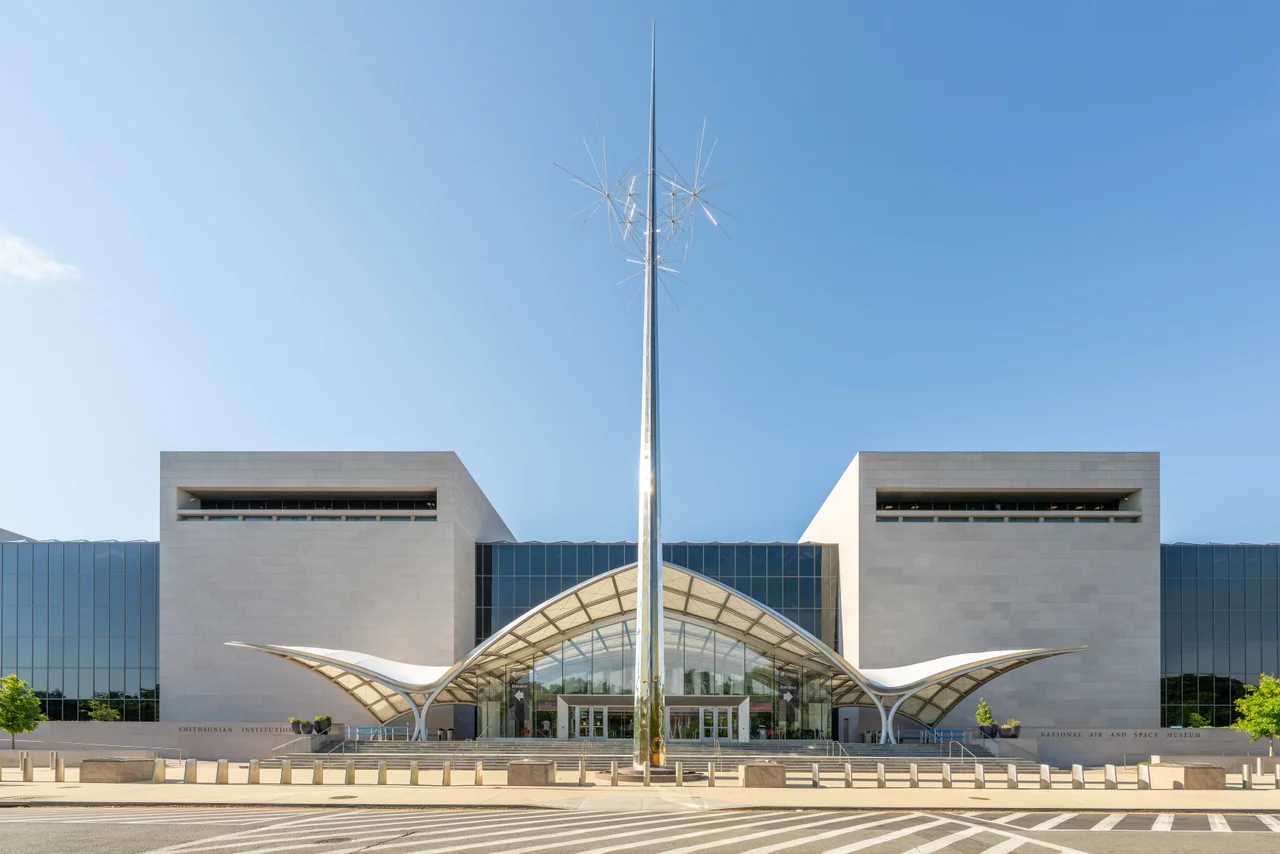

National Air and Space Museum
The Apollo 11 command module Columbia rode three astronauts to the Moon and back in July 1969 and now sits in a glass case three steps from the entrance. Above it, on cables, hangs the Spirit of St. Louis - the silver Ryan monoplane Charles Lindbergh flew across the Atlantic in May 1927. Next to them, the original Wright Flyer, the 1903 fragile pine and muslin biplane the brothers actually flew at Kitty Hawk. Three of the most consequential vehicles in the history of human movement, in three orders of magnitude of distance, all in one room. The National Air and Space Museum was opened on July 1, 1976 - dead center of the American Bicentennial - by a director named Michael Collins, who had personally piloted the third object in that room while two of his colleagues walked on another world.
From the Tin Shed
Congress passed the National Air Museum Act on August 12, 1946, signed by President Truman. The collection had been growing for decades inside the Smithsonian's storage facilities. The Chinese Imperial Commission had donated kites to the Smithsonian at the 1876 Centennial Exposition in Philadelphia rather than ship them home. The Stringfellow steam engine intended to power an aircraft, acquired in 1889, became the first piece actively collected for the future air museum. After the 1946 act, the problem became space. There was no building anywhere that could hold the collection. Pieces went on display in the Arts and Industries Building. A large temporary metal shed in the Smithsonian Castle's south yard - nicknamed the Tin Shed - housed a Martin bomber, a LePere fighter-bomber, and an Aeromarine floatplane. Missiles and rockets sat outdoors in what staff called Rocket Row. Most of the collection stayed in crates. The Space Race of the 1950s and 1960s renamed the planned museum to the National Air and Space Museum and finally pushed Congress to appropriate funds for an actual building.
Marble That Matches the Capitol
Architect Gyo Obata of HOK in St. Louis won the commission with a deliberately restrained design. The site was close enough to the Capitol that nothing too flashy could be built without disrespecting the dome. Obata designed four simple marble-clad cubes for the smaller exhibits, connected by three vast steel-and-glass atria that could hold missiles, airplanes, and spacecraft hanging from the ceiling. The marble was pink Tennessee, chosen to match the National Gallery of Art's East Building across the Mall. The west glass wall was engineered as a giant door - large enough to open and roll aircraft inside. The building opened on July 1, 1976, on schedule for the Bicentennial. Michael Collins, who had piloted Columbia in lunar orbit while Armstrong and Aldrin walked on the Moon, was the museum's director. He had also written one of the better astronaut memoirs - Carrying the Fire - in 1974, and he understood that the museum was as much about showing people what had been done as it was about preserving the artifacts that had done it.
The Enola Gay
In March 1994, the museum was planning an exhibit to mark the 50th anniversary of the atomic bombings of Japan. The centerpiece was the Enola Gay - the B-29 that had dropped the bomb on Hiroshima. A leaked draft of the exhibit script became national news. Two sentences in particular drew fire: For most Americans, this war was fundamentally different than the one waged against Germany and Italy - it was a war of vengeance. For most Japanese, it was a war to defend their unique culture against western imperialism. The Air Force Association, the Retired Officers Association, and veterans' groups argued the script politicized the bombing and insulted American servicemen. Members of Congress called the museum unpatriotic. Director Martin O. Harwit defended the script and at one point unilaterally reduced the projected American casualty figures from a hypothetical invasion of Japan by 75 percent. On January 24, 1995, 81 members of Congress called for his resignation. He resigned on May 2. The exhibit was radically reduced - The New York Times called the result the most diminished display in Smithsonian history. The forward fuselage of the Enola Gay went on display without the political context. It drew nearly four million visitors before closing in May 1998. The complete restored aircraft now sits at the museum's Steven F. Udvar-Hazy Center at Dulles.
Dulles and the Annex
The Mall building could hold the Wright Flyer, Apollo 11, the Spirit of St. Louis, and dozens of other significant aircraft - but it could not hold something the size of a Boeing 707 or a Space Shuttle. The Steven F. Udvar-Hazy Center, named for the airline executive whose donation funded much of it, opened on December 15, 2003, in a 760,000-square-foot facility on the grounds of Dulles International Airport. It houses the Space Shuttle Discovery, the SR-71 Blackbird, the only surviving Boeing 367-80 Dash prototype that became the 707, a Concorde, an Air France Boeing 707, and hundreds of other aircraft too large for the Mall building. The Mary Baker Engen Restoration Hangar lets visitors watch staff restoring aircraft in real time. The Paul E. Garber Preservation, Restoration, and Storage Facility in Suitland, Maryland holds additional restoration work.
A Billion-Dollar Renovation
Since 1976, the Mall building had received only basic maintenance. By the mid-2010s, the marble cladding was failing, the glass walls had been replaced once, and the original exhibits looked dated. In April 2014, Boeing pledged $30 million toward renovating the entrance hall - what would be renamed the Boeing Milestones of Flight Hall. By 2016, the projected total cost of the renovation had grown to roughly $1 billion: $676 million for construction, $50 million for new storage, and $250 million for new exhibits. The Smithsonian asked Congress to fund most of the building work and raised the exhibit costs privately. The renovation moved through phases. The food court built into a 1988 glass-enclosed pavilion called the Wright Place - long home to a McDonald's that opened in 2002 - was demolished to make way for the 50,000-square-foot Jeff Bezos Learning Center. Eight new galleries on the western side reopened on October 14, 2022. The remaining galleries are scheduled to reopen by 2026. As of August 2024, 13 of the museum's 23 galleries were open. In October 2025, the museum was briefly closed by a federal government shutdown. It reopened shortly after.
From the Air
The National Air and Space Museum on the National Mall sits at 38.8882 N, 77.0199 W, on Independence Avenue SW between 4th and 7th Streets. Best viewed from 1,500 to 2,500 feet AGL. The pink Tennessee marble cubes and connecting glass atria are visible from above, with the National Mall axis running east-west to the south. The U.S. Capitol dome lies a half mile east. Reagan National (KDCA) sits two nautical miles south. The Steven F. Udvar-Hazy Center is at Dulles (KIAD) - 26 miles west. The Mall museum is inside the Washington Flight Restricted Zone; GA overflight prohibited. The Udvar-Hazy Center lies just east of Dulles Runway 19R/1L and visible from approaches there.
Nearby Stories
- Gunston Hall 1.1 km away
- 2023 Baltimore Shooting 4.9 km away
- Battle of Middleburg 6.6 km away
- Crownsville Hospital Center 10 km away
- Battle of Loudoun Heights 13 km away
- First Battle of Rappahannock Station 20 km away
- Howard County, Maryland 21 km away
- Harriet Tubman Underground Railroad 50 km away