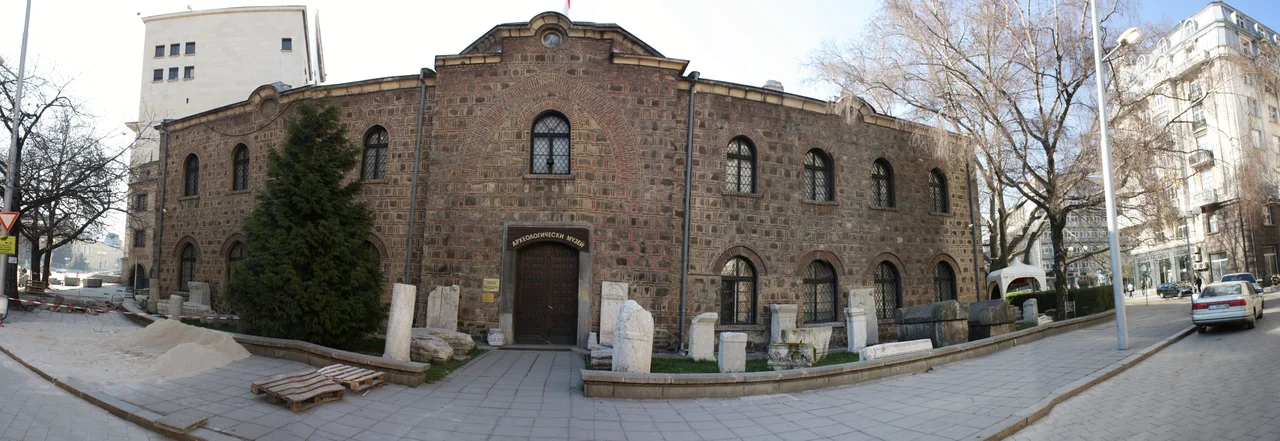

National Archaeological Museum, Bulgaria
The building was a mosque before it was a library before it was a museum. The Koca Mahmut Pasa Camii, completed in 1494, was the largest and oldest Ottoman mosque in Sofia, commissioned in 1451 by the grand vizier Mahmud Pasha Angelovic, who died before its completion. Five centuries later it holds Bulgaria's national archaeological collection: stone tools from a million and a half years ago, Thracian gold treasures, Roman sculpture, medieval Bulgarian crowns. The mosque's stone walls keep most of it safe most of the time. Sofia's summer humidity threatens the rest.
From Mosque to Museum
Bulgaria emerged from nearly five centuries of Ottoman rule after the Russo-Turkish War of 1877 to 1878. In the new principality, intellectuals who had been arguing for a national archaeological institute since the 1840s finally had a state to host one. The Bulgarian Literary Society, founded in 1869, made the museum a top priority after independence. The interim Russian administration that ran Bulgaria immediately after liberation took the first concrete steps. In 1892 a decree from Knyaz Ferdinand of Bulgaria formally established the institution, and the following year collections began to be assembled. The Czech archaeologist Vaclav Dobrusky directed the new museum from its first days, working out of the former mosque that had previously housed the National Library between 1880 and 1893. The museum was officially opened in 1905 in the presence of Ferdinand and Minister of Enlightenment Ivan Shishmanov, with all of Sofia's scattered archaeological exhibits gathered for the first time under one roof.
From the Pleistocene Down
The Prehistory Hall in the lower floor of the northern wing covers an almost incomprehensible span of time: artifacts from 1.6 million years ago to 1,600 BC, divided chronologically across Early, Middle, and Late Paleolithic, Neolithic, Chalcolithic, and Bronze Age sub-collections. Some of the earliest stone tools come from caves in the Bulgarian uplands where early humans sheltered during the last glaciations. By the Chalcolithic, the people of what is now Bulgaria were producing some of the earliest worked gold in the world. The Varna Necropolis on the Black Sea coast, excavated in the 1970s, yielded gold ornaments dated to roughly 4,500 BC, older than the gold of any contemporaneous society. The simple pottery, ritual figurines, and grave goods on display here represent thousands of generations of human life on the Balkan Peninsula, mostly anonymous, with few names and fewer stories that survived.
The Treasures
The eastern wing holds the Treasury, Bulgaria's most spectacular grave goods and hoards from the late Bronze Age to late antiquity. Two pieces draw most visitors: the Valchitran Treasure and the Lukovit Treasure. The Valchitran Treasure, found by farmers near a village of that name in 1924, consists of 13 gold vessels weighing more than 12 kilograms in total, dated to the late Bronze Age, roughly 1,500 to 1,200 BC. The largest piece is a wide gold dish over 30 centimeters across. The Lukovit Treasure, discovered in 1953, includes Thracian silver vessels and ornaments from the 4th century BC, decorated with images of horsemen and mythological scenes. Both treasures are evidence of a sophisticated Thracian society that the Greeks and Romans wrote about but knew imperfectly, a culture that practiced metallurgy and burial rites of remarkable richness. The Main Hall on the first floor displays artifacts from ancient Thrace, Greece, and Rome alongside material from medieval Bulgaria, while the second-floor Medieval Section gathers books, woodwork, drawings, and metal objects from the Bulgarian Middle Ages.
A Building That Fights the Collection
The mosque was never designed to hold a museum. Its stone walls absorb humidity from Sofia's hot continental summers, threatening the most delicate artifacts in the collection. Curators have built additional halls and administrative buildings around the original structure over the decades, but the heart of the institution remains the 15th-century Ottoman building, dim and cool in winter, dangerously damp in July and August. In 1948 the museum merged with the Archaeological Institute, originally founded in 1920 under Bogdan Filov, to form the joint institution that exists today under the auspices of the Bulgarian Academy of Sciences. Filov himself had a darker afterlife: he served as Prime Minister of Bulgaria during the World War II alliance with Nazi Germany and was executed in 1945 by the new communist government. The institute he founded outlived him. The museum he helped shape continues to launch archaeological expeditions across the country, adding new finds to galleries already crowded with millennia.
From the Air
National Archaeological Museum, Bulgaria: 42.6963 N, 23.3246 E, in central Sofia, near the Presidency, the National Assembly, and the Sveta Nedelya Cathedral. Best viewed below 3000 feet. Identifiable as a stone Ottoman mosque with multiple small domes and a missing minaret, smaller than nearby government buildings. Sofia Airport (LBSF) is about 6 nm east. Vitosha mountain rises immediately south of the city, with peaks above 7,500 feet, dominating the local horizon. Class C airspace covers central Sofia.
Nearby Stories
- Battle of the Gates of Trajan 1.3 km away
- Battle of Kresna Gorge 65 km away
- Battle of Plovdiv (1878) 70 km away
- Battle of Kosturino 114 km away
- New Europe Bridge 129 km away
- Old Bazaar, Skopje 136 km away
- Trapezitsa Fortress 142 km away
- Trajan's Bridge 193 km away