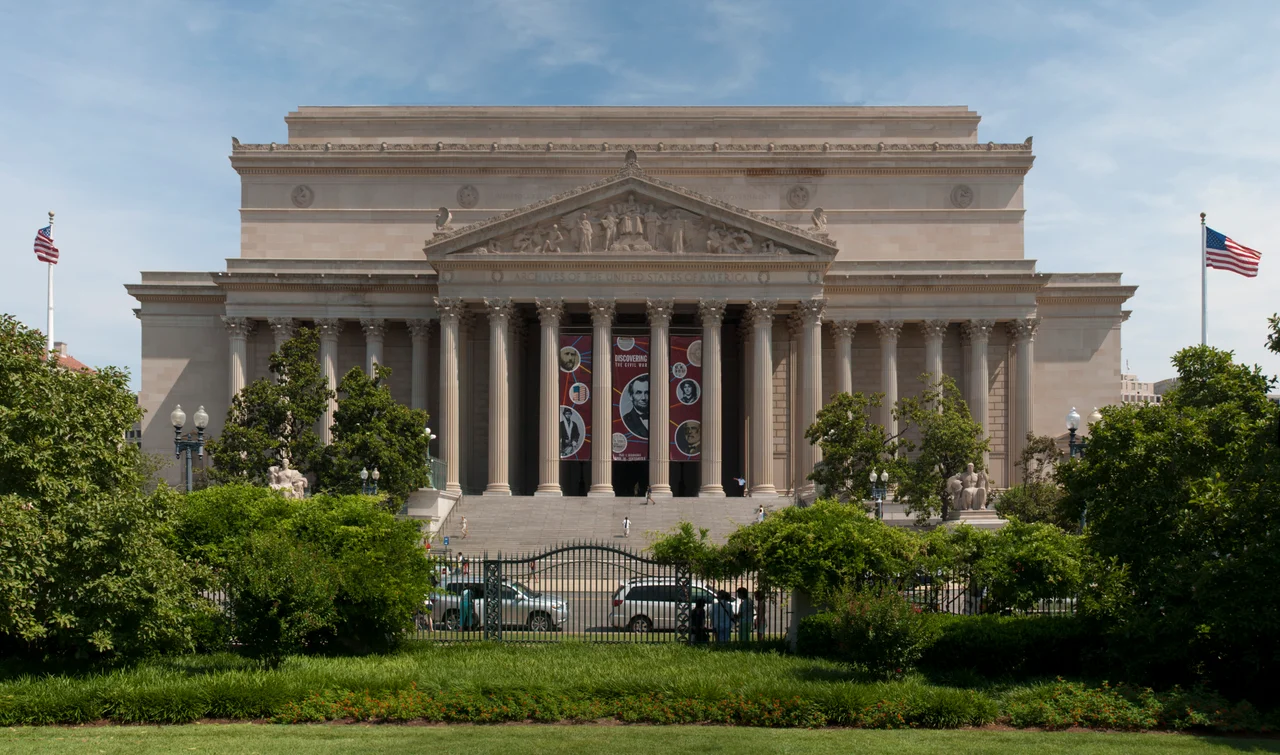

National Archives Building
Beneath the National Archives Building, an underground river still runs. Tiber Creek, the freshwater stream that once flowed through downtown Washington before the city paved over it, passes directly under the rotunda where the Declaration of Independence is displayed. Architect John Russell Pope, faced with the problem of placing one of the heaviest buildings in Washington on top of a stream, had 8,575 wooden piles driven into the soft mud below before crews poured a single concrete bowl as foundation. The piles still hold. The river still flows. Above it all, sealed in inert-gas display cases that descend each night into a hardened underground vault, sit the three documents the country has used to define itself - the Declaration, the Constitution, and the Bill of Rights. They share the rotunda with a 1297 copy of the Magna Carta, confirmed by Edward I.
150 Years Without an Archives
For most of its first century and a half, the United States federal government had no centralized place to keep its papers. Important documents were stored in agency basements, attics, and warehouses. Fires destroyed substantial portions of the early record - including a 1921 blaze in the Commerce Department building that wiped out census records from the late nineteenth century. By the late nineteenth century, architects had begun submitting unsolicited proposals for an archives building, hall of records, or temple to history. None made progress. Congress finally authorized the National Archives Building in 1926 as part of the larger Federal Triangle program, a Mellon-era plan to beautify the center of Washington and provide office space for the rapidly expanding federal bureaucracy.
Pope Replaces Simon
The first design came from Louis A. Simon, an architect in the Office of the Supervising Architect for the U.S. Treasury. He sketched a building between 9th and 10th Streets along Pennsylvania Avenue. When the entire Federal Triangle program was unveiled in 1929 as a three-dimensional scale model, the U.S. Commission of Fine Arts examined Simon's archives design and called it inadequate. They proposed John Russell Pope, the New York architect already designing the Jefferson Memorial. Pope was added to the Board of Architectural Consultants when a vacancy opened. He immediately argued for a different site - the block between 7th and 8th Streets - and a different building. Simon's design was discarded. Pope drew a neoclassical temple. Construction began September 5, 1931. President Herbert Hoover laid the cornerstone in February 1933.
Limestone Over Granite
Building above an underground stream required engineering decisions that were resolved in concrete and wood. 8,575 piles went into the unstable soil before the foundation could be poured. The choice of building material was political. Both granite and limestone had been authorized; granite and limestone suppliers each lobbied the federal government hard during the worst years of the Great Depression to use their product. The compromise reached for the Federal Triangle as a whole - limestone superstructure on a granite base - applied to the Archives too. Ingalls Stone Company of Bedford, Indiana shipped the limestone. The four monumental statues outside, carved between 1934 and 1935 from 65-ton limestone slabs, traveled to Washington on specially designed flatcars. Two stand at the Constitution Avenue rotunda entrance: Heritage and Guardianship, both by James Earle Fraser. Two more flank the Pennsylvania Avenue research entrance: What is Past is Prologue and Study the Past.
The Charters of Freedom
The rotunda displays what staff call the Charters of Freedom: the Declaration of Independence, the Constitution, and the Bill of Rights. The three documents share the central chamber with a 1297 copy of the Magna Carta confirmed by Edward I. The exhibition format is unusual - visitors can walk freely from document to document without standing in line. Photography with natural light is permitted in research rooms. The exhibition space expanded from 12,000 to more than 19,000 square feet in 2013. Also in the building's collections: the Continental Association of 1774, the Articles of Confederation, the Louisiana Purchase Treaty, photographs across the breadth of American history, and the operational records of the entire federal government's history. The Emancipation Proclamation joined the permanent display on March 27, 2026. The 1996 Inergen fire suppression system was specifically designed to extinguish a fire in the rotunda without damaging the documents themselves.
Where the Warren Commission Met
On December 5, 1963 - thirteen days after the assassination of John F. Kennedy - the Warren Commission held its first formal meeting in a hearing room on the second floor of the National Archives Building. The location was symbolic and practical. The records the commission would examine - autopsy reports, photographs, witness statements - would eventually be housed in the same building. The commission's final report became Archives material itself. The Pennsylvania Avenue National Historic Site listing in 1966 recognized the building as a contributing property. It joined the National Register of Historic Places in 1971. In December 2023 it was designated a National Historic Landmark. A larger sister facility, Archives II, opened in College Park, Maryland in 1994 to house the bulk of records too voluminous for the downtown building. Archives I keeps the documents the country has chosen to define itself by - and the river still runs beneath them.
From the Air
The National Archives Building sits at 38.8927 N, 77.0228 W, on Constitution Avenue NW between 7th and 9th Streets, on the north side of the National Mall. Best viewed from 1,500 to 2,500 feet AGL. The neoclassical rectangle with its prominent rotunda is one of the larger Federal Triangle buildings, adjacent to the Federal Trade Commission and the Department of Justice. The U.S. Capitol dome lies a half mile east. Reagan National (KDCA) sits two nautical miles south. The site is inside the Washington Flight Restricted Zone; GA overflight prohibited. The four James Earle Fraser limestone statues at the entrances are visible from close-in aerial views.
Nearby Stories
- Gunston Hall 1.1 km away
- 2023 Baltimore Shooting 4.9 km away
- Battle of Middleburg 6.6 km away
- Crownsville Hospital Center 10 km away
- Battle of Loudoun Heights 13 km away
- First Battle of Rappahannock Station 20 km away
- Howard County, Maryland 21 km away
- Harriet Tubman Underground Railroad 50 km away