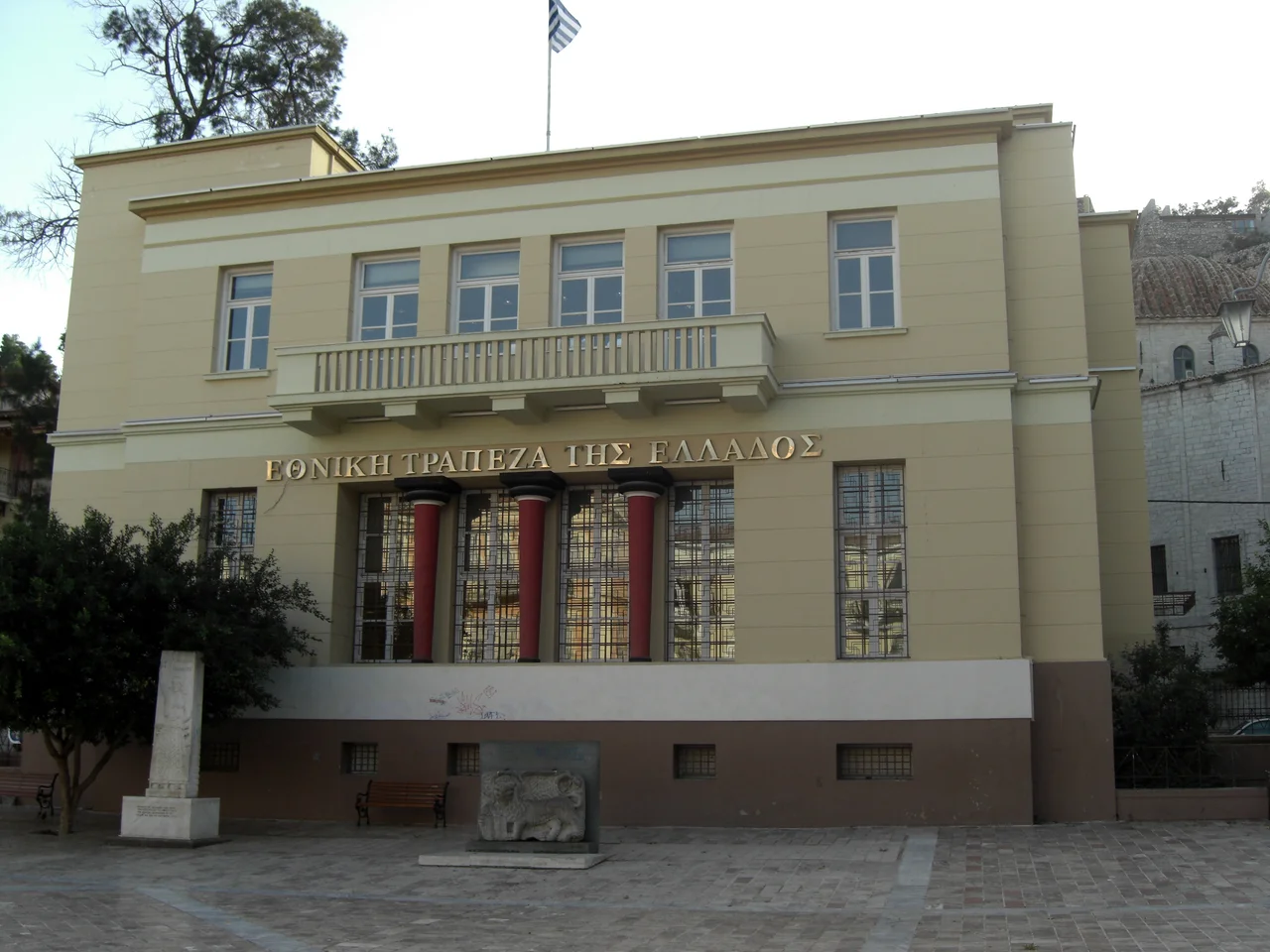

National Bank of Greece
Greece in 1841 was a decade-old kingdom with almost no money to its name. The War of Independence had drained the country, foreign loans had crippled it, and the young state needed something it had never had: a bank. The answer came from an unlikely partnership - a Swiss banker who had fallen in love with the Greek cause, and an Athens merchant who had financed the revolution itself. Together Jean-Gabriel Eynard and Georgios Stavros chartered the National Bank of Greece, the first financial institution in the modern Greek state. For nearly ninety years it would do something no commercial bank does today: it printed the nation's banknotes. Its story is, in miniature, the story of modern Greece - expansion and war, refugees and occupation, boom and near-collapse.
Two Founders, One Nation's Bank
The bank was chartered in 1841 with a capital of five million drachmas, divided into five thousand shares. Its shareholder list reads like a portrait of the era: the Greek state held the largest block, alongside private investors, the Paris house of Rothschild, and even King Ludwig I of Bavaria, father of Greece's first king. Jean-Gabriel Eynard, the Swiss philhellene who had championed Greek independence across Europe, lent the venture his prestige and his money. Georgios Stavros, a merchant who had helped fund the revolution, became the bank's first director and led it until his death in 1869. It was the first bank in the modern Greek state's history, and from the start it carried a national mission as much as a commercial one.
The Bank That Printed the Money
From 1842 to 1928, the National Bank of Greece was the country's dominant bank of issue - the institution whose notes Greeks carried in their pockets. As the nation's borders expanded, it shared that privilege regionally with others: the Ionian Bank in the Ionian Islands, the Privileged Bank of Epirothessaly, and the Bank of Crete. In 1920 it absorbed the Bank of Crete and reclaimed its monopoly over the nation's currency. That extraordinary power lasted until 1928, when it was handed to the newly created Bank of Greece - the country's first true central bank, established under the watchful eye of the League of Nations' financial organization. The National Bank had, in effect, given up the right to print money so that a modern central bank could be born.
Through Refugees and Occupation
The bank's history runs straight through the great upheavals of the twentieth century. After the 1923 Treaty of Lausanne forced a compulsory exchange of populations between Greece and Turkey, more than a million refugees poured into Greece, many of them Greeks expelled from Smyrna and Asia Minor. The National Bank played a pivotal role in resettling them, extending loans and financial instruments to absorb a human wave that reshaped the country. Then came the darkest chapter: during the Axis occupation in 1941, Germany's Deutsche Bank assumed oversight of the institution, taking operational control of Greece's largest bank as part of the machinery of occupation. Through all of it, the bank endured, expanding abroad in the 1930s with branches and subsidiaries from Cairo and Alexandria to New York City.
Crisis and Endurance
Listed on the Athens Stock Exchange since that market's founding in 1880, the National Bank grew into Greece's largest, and for a time traded on the New York Stock Exchange. Then came the Greek debt crisis of the 2010s, which struck the bank with brutal force. Holding part of the national debt, it wrote off more than nineteen billion dollars, and in 2015 its American shares were delisted from New York after a year-long collapse of more than ninety percent. It survived, recapitalized and restructured, and remains one of Greece's four dominant banks. In 1998 the Swiss architect Mario Botta consulted on a striking new wing for its Athens headquarters, completed in 2001 - a modern face on an institution nearly two centuries old, still anchoring its city block in the heart of the capital.
From the Air
The headquarters of the National Bank of Greece stands at roughly 37.981 N, 23.729 E in the commercial heart of central Athens, near Aiolou and Sofokleous Streets, a short walk north of the Acropolis. The nearest major airport is Athens International (LGAV), about 28 km to the east-southeast. From the air, the dense grid of central Athens spreads north from the Acropolis rock, with the bank's headquarters block sitting amid the city's historic financial and commercial district. Lycabettus Hill rises to the northeast and the Acropolis to the south as orienting landmarks; the clear skies of the Attic basin generally offer excellent visibility over the city.
Nearby Stories
- Great Sand Beach 5 km away
- Battle of Delium 7.7 km away
- Tower of Aliartos 9 km away
- HMHS Britannic 10 km away
- Saronic Gulf 15 km away
- Sousaki Volcano 17 km away
- Sanctuary of Apollo Maleatas 24 km away
- Skyros 66 km away