.jpg)
National Coracle Centre
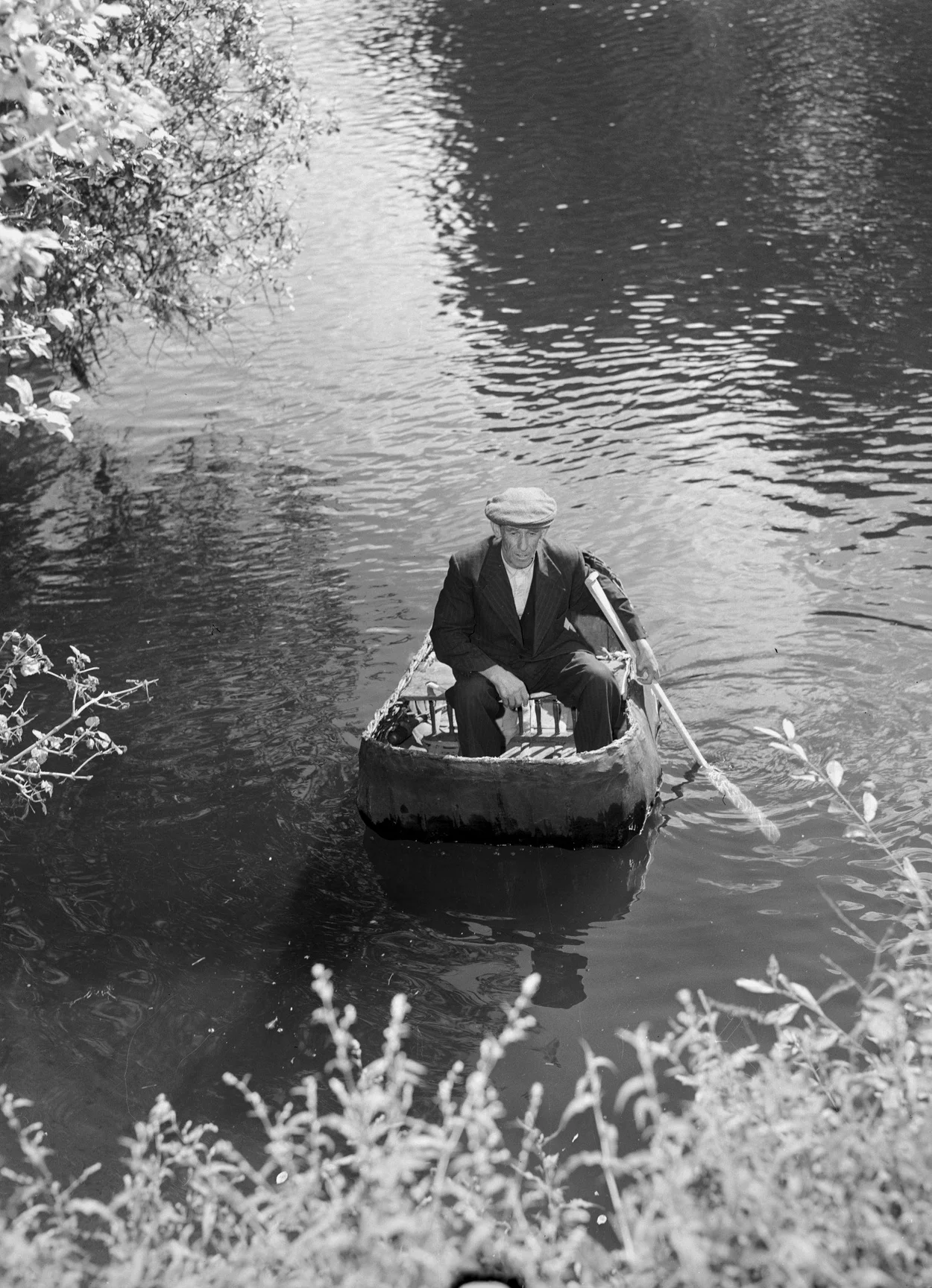
A coracle is barely a boat. It is a basket. A bowl. A bullhide pulled taut over a frame of woven willow, light enough for one fisher to carry on their back across a field and slip into a river without disturbing the salmon. The shape repeats itself, almost identically, on the Teifi in Wales and the Tigris in Iraq and the Brahmaputra in India and the Mekong in Vietnam. People who never met one another, separated by continents and centuries, kept arriving at the same answer to the same problem. In a converted flour mill above the falls at Cenarth, that answer has its only museum.
The Boat the World Kept Inventing
The Welsh word is cwrwgl. The Romans wrote about it two thousand years ago. The Hidatsa of North Dakota stretched buffalo hide over willow on the Missouri. Tibetan herders crossed glacial rivers in yak-skin versions still in use today. Marsh Arabs in southern Iraq built reed-and-bitumen variants that pre-date the pyramids. Each design responds to local materials and the temperament of local water, but the principle is universal: a craft so light it can be portaged on the shoulder, so flat-bottomed it skims through inches of water, so round that it spins like a top until the operator masters a one-handed paddling stroke that looks easier than it is. Watch a Teifi coracle fisher at work and you are watching a technique transmitted, father to son and mother to daughter, across at least sixty generations.
An Unlikely World Museum
Martin Fowler opened the National Coracle Centre in 1991, in the old flour mill at Cenarth Falls. He had been collecting coracles for years, and the collection had outgrown every available room. The mill itself, with its surviving waterwheel and millstones, became part of the exhibit: a setting for boats that, like the building, were once everyday tools rather than curiosities. The displays now include examples from Tibet, India, Vietnam, the United States, Iraq, and a dozen British river systems. Each river developed its own coracle dialect, subtle differences in beam, in stern profile, in the type of hide or coated canvas used. Walking the floors, you trace a quiet international language of small boats.
The Vietnamese Coracle and the South China Sea
One bamboo coracle in the collection carries a particular weight of memory. It was woven in Vietnam, and used by refugees fleeing across the South China Sea to Hong Kong in the years after 1975. The vessel was never designed for ocean voyages. Coracles are river craft, calm-water craft. What it took to put to sea in one is something the boat itself cannot quite explain. The Exeter Maritime Museum donated it to Cenarth, and it now sits in a quiet corner: a basket that crossed an ocean. Nearby hangs a North Dakota bull-boat made by the Hidatsa, its buffalo hide stitched to a willow frame, a reminder that this same humble form has carried people through equally desperate crossings on the other side of the world.
Poaching, Pairs, and the Living Tradition
The museum does not flinch from the rougher edges of coracle history. One gallery is devoted to poaching, the centuries-old shadow economy of Welsh river fishing, displaying the nets, lamps and gaffs that local men used to take salmon at night under the moon, sometimes within sight of the bailiff. Coracles work best in pairs, two boats holding a seine net between them, drifting downstream with the current; it is a method ideally suited to either licensed fishing or quiet theft. On the Teifi, Towy and Taf rivers a small number of licensed coracle fishers still work in the traditional way, the last commercial practitioners of a craft that elsewhere survives only as sport or demonstration. Workshops at the centre teach visitors to build their own, and now and then a new coracle, made by hand in this corner of Carmarthenshire, slips into the river just as its ancestors did when Rome ruled Britain.
From the Air
Located at 52.05N, 4.53W, beside the Teifi Falls at Cenarth in northern Carmarthenshire. The river runs west-southwest from here toward Cardigan and the sea, and a low-altitude approach along the Teifi valley provides a fine river-corridor view of the surrounding farmland and woods. Nearest aerodromes are Haverfordwest (EGFE) about 25 nm south, with Swansea (EGFH) and Pembrey (EGFP) further south on the Carmarthen Bay coast.
Nearby Stories
- RAF Haverfordwest 3.7 km away
- Great Western Railway in West Wales 7.7 km away
- West Wales 9.9 km away
- Fishguard Lifeboat Station 13 km away
- Battle of Mynydd Hyddgen 15 km away
- Strata Florida Abbey 18 km away
- Neath and Tennant Canal 21 km away
- HMS Tyler 44 km away