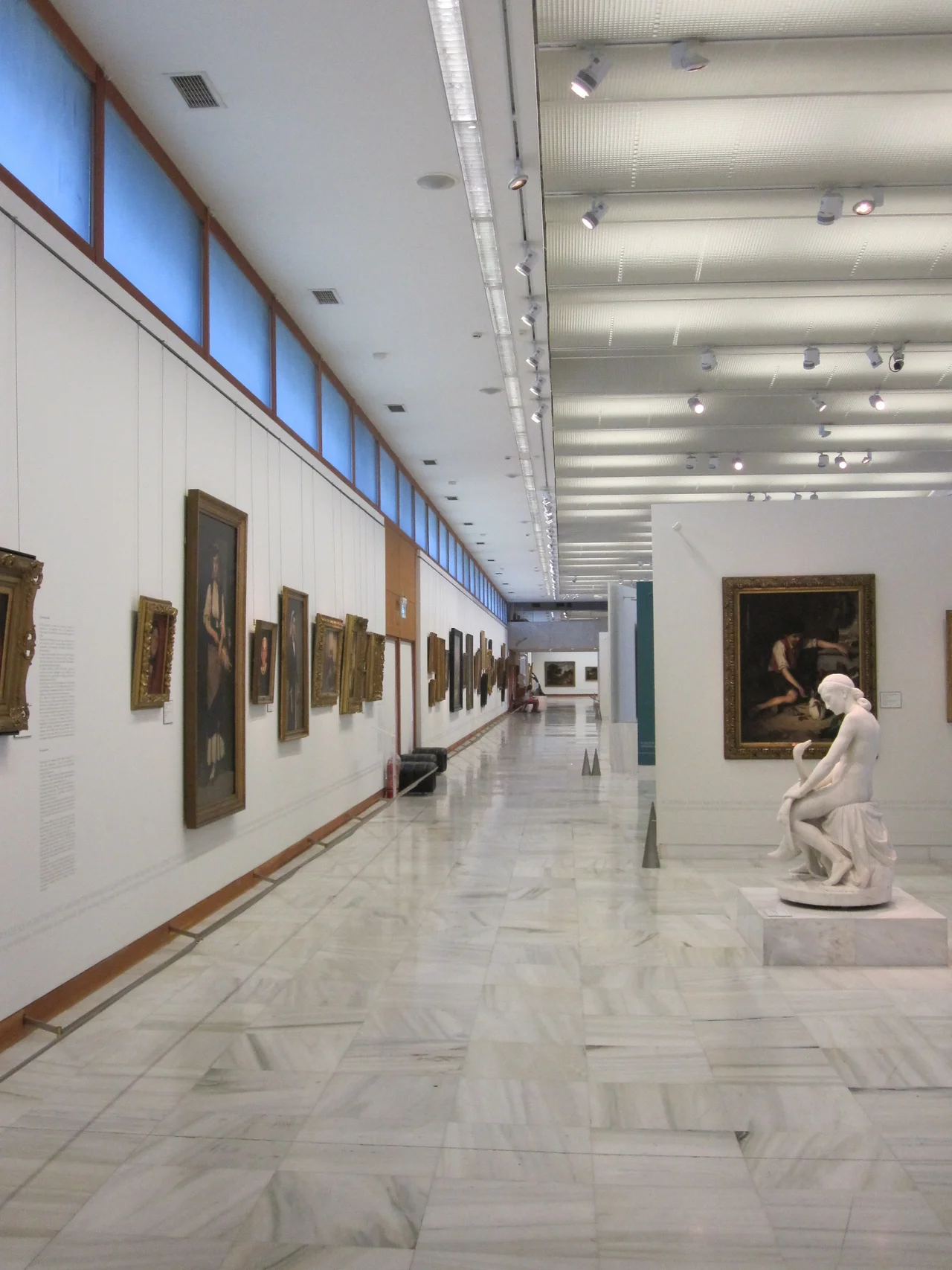

National Gallery (Athens)
It reopened one day before the bicentennial. On March 24, 2021 - the eve of the two hundredth anniversary of the Greek War of Independence - the doors of the National Gallery swung open after eight years of refurbishment, the timing no accident at all. For a nation celebrating two centuries of freedom, the gleaming new home of its art was meant to be a statement: that Greece guards not only its ancient marbles but its painters too, from the Renaissance masters to the modern Greek artists who shaped a young country's image of itself.
From a Single Room
The collection began small. In 1878 it was just 117 works displayed at the University of Athens, hardly a national gallery in anything but ambition. Its turning point came in 1896, when Alexandros Soutzos, a jurist and devoted lover of art, left his own collection and his estate to the Greek state with one wish: that they be used to found a proper museum. The institution that grew from his gift carries his name to this day. It opened in 1900 under the painter Georgios Iakovidis, a leading figure of the Munich School, who became its first curator and set the tone for a collection that would bridge Greek and European art.
Renaissance Treasures
Among the most prized holdings are the Renaissance paintings, and at their center stands a hometown hero in exile. El Greco - Domenikos Theotokopoulos - was born on Crete before he conquered Toledo, and the gallery holds several of his works, including a Crucifixion and a Saint Peter, drawing the great master back toward the Greek world that first formed him. Beside him hang Flemish, Italian, and Dutch masters: a market scene by Joachim Beuckelaer, biblical canvases by Tiepolo and Rubens, a brooding Saint Jerome by Jacopo del Sellaio. For a country known abroad for antiquity, it is a reminder that Greek collectors were also citizens of the wider European art world.
The Greek Eye
The heart of the gallery, though, is Greek. Its walls trace modern Greek painting from the post-Byzantine icon traditions of the Cretan School through the nineteenth-century academic painters and on into the boldness of the twentieth century. Here are the luminous seascapes of Konstantinos Volanakis, the allegory of History painted by Nikolaos Gyzis in 1892, and the unmistakable figures of Yannis Tsarouchis. A foreigner's perspective hangs nearby too, in works such as Delacroix's image drawn from the Greek War of Independence - the Greek struggle as Europe's Romantics chose to imagine it, hung steps from how the Greeks painted it themselves.
A Long Closure, a Grand Return
The gallery had been closed since March 2013 for the expansion that would transform it, a wait that stretched across nearly the whole decade. When it finally reopened in 2021 it was effectively a new museum: a renovated main building joined to a new wing, its sculptures rehoused in the separate National Glyptotheque in the Goudi military park. The institution had spread its reach as well, opening branches in Nafplion, Sparta, and Corfu. Roughly four million visitors passed through its doors over the surrounding years - a testament to how deeply Greeks claim this collection as their own.
Art in the Crosshairs
Art that matters can still provoke. In 2025 an exhibition titled "The Allure of the Bizarre" became the target of a member of parliament and a companion, who knocked four paintings to the floor and shattered their glass, declaring the works offensive to Orthodox Christianity. The pair were briefly detained. It was an ugly episode, but in its way a backhanded tribute: more than a century after a lawyer left his collection to the nation, the National Gallery remains a place where Greeks argue, passionately, about what their art should say - which is exactly what a national gallery is for.
From the Air
Located at 37.987 N, 23.778 E on Vasilissis Sofias Avenue in the Pangrati district, directly opposite the Hilton Athens, whose tall slab is the easiest landmark for spotting it from the air. The gallery sits east of the National Garden along the broad sweep of Vasilissis Sofias. Best viewed at lower altitudes in clear conditions. Nearest major airport: Athens International (LGAV), about 29 km east-southeast.
Nearby Stories
- Great Sand Beach 5 km away
- Battle of Delium 7.7 km away
- Tower of Aliartos 9 km away
- HMHS Britannic 10 km away
- Saronic Gulf 15 km away
- Sousaki Volcano 17 km away
- Sanctuary of Apollo Maleatas 24 km away
- Skyros 66 km away