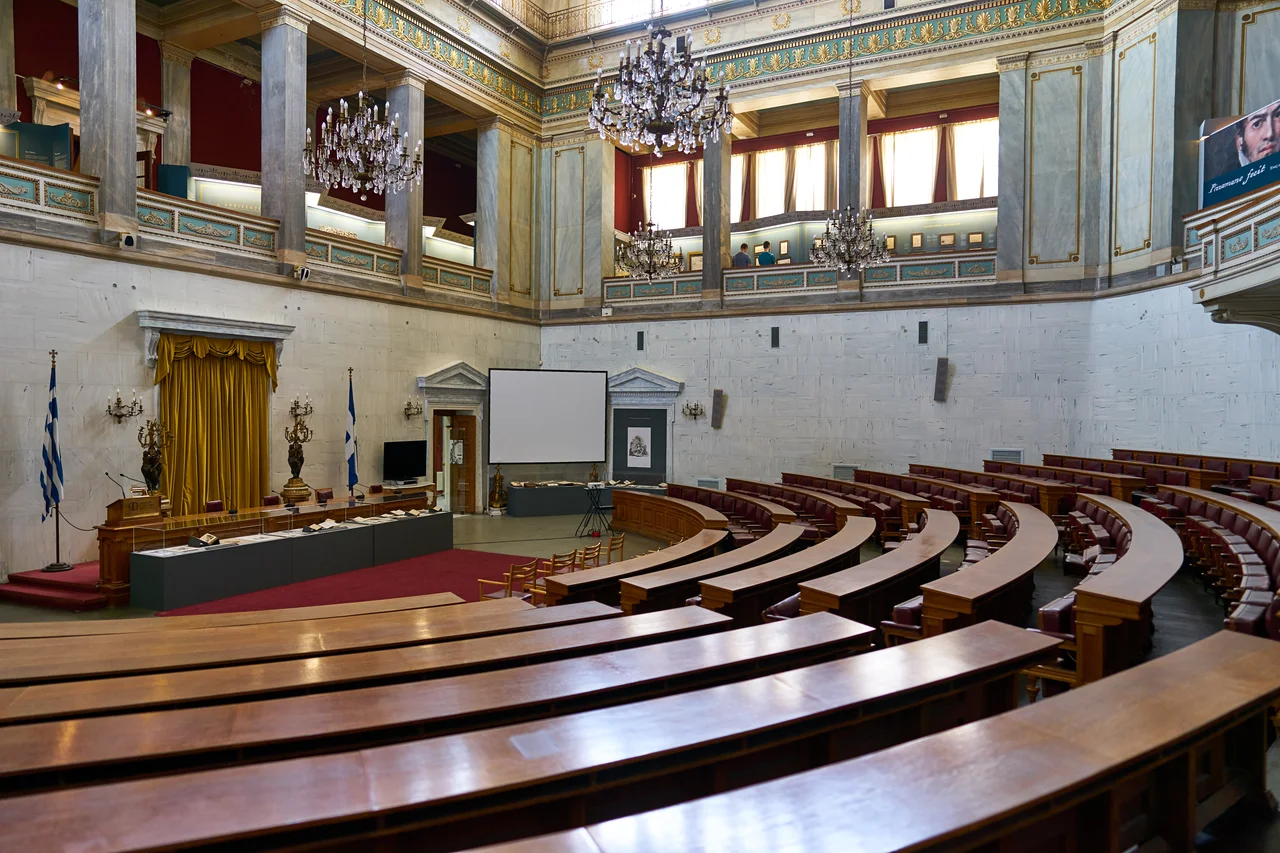

National Historical Museum, Athens
Lord Byron's sword rests in a glass case in central Athens, and the building around it once heard the speeches of a young nation. The National Historical Museum occupies the Old Parliament House on Stadiou Street, the chamber where the Hellenic Parliament met from 1875 until 1932. To walk its corridors is to move through two layers of history at once: the room where modern Greece was governed, now filled with the weapons, banners, and belongings of the men and women who fought to create it in the first place.
The Oldest of Its Kind
Founded in 1882, this is the oldest historical museum in Greece. Its collection belongs to the Historical and Ethnological Society of Greece, which assembled it to gather and preserve the relics of the country's modern history before they could be lost or scattered. For its first decades the collection lived inside the main building of the National Technical University. In 1960 the society finally settled into its grand permanent home, the former parliament, and opened the new exhibition to the public two years later - a fitting marriage of object and place, the nation's memory housed where the nation once made its laws.
From the Fall of a City to a World at War
The museum tells a long story, beginning with the fall of Constantinople to the Ottomans in 1453 and reaching all the way to the Second World War. Across that span it traces how a people held to their identity through four centuries of foreign rule and then fought their way to a state of their own. Among the displays are weapons and manuscripts, historical paintings by Greek and foreign artists, and a deep collection of traditional costumes from every corner of the country - the everyday fabric of a culture set beside the swords that defended it.
Heart of the Revolution
The museum beats hardest around the Greek War of Independence, the uprising that began in 1821. Here are the swords and pistols of the klephts and chieftains who led the fight, the painted portraits of Souliote and Roumeliote fighters, and the revolutionary flags raised over Laconia and beyond. Personal effects of the great commanders, among them Theodoros Kolokotronis, bring the rebellion down to human scale - not abstract history but the objects men carried into battle and somehow survived to leave behind.
Byron Among the Philhellenes
One section honors the foreigners who gave themselves to the Greek cause, the philhellenes who believed a free Greece worth fighting and dying for. Chief among them was the English poet Lord Byron, who came to Greece to support the revolution and died at Missolonghi in 1824, his death turning him into a martyr for the cause across Europe. His sword is among the museum's most cherished holdings, a slender blade that carries the weight of a continent's romantic imagination - proof that the struggle for Greek freedom was watched, and shared, far beyond Greece's borders.
The Chamber Itself
Do not overlook the building. The great central hall, where the National Assembly once debated the fate of the country, is now used for conferences and lectures, its tiered seats and high ceiling still charged with the gravity of decisions made here. The neoclassical facade on Stadiou Street, fronted by an equestrian statue, anchors one of Athens's busiest commercial streets. Step inside and the traffic falls away; in its place is the quiet of a place built for argument and now devoted to remembrance.
From the Air
Located at 37.978 N, 23.733 E on Stadiou Street in central Athens, midway between Syntagma and Omonia squares. The Old Parliament House is a compact neoclassical block fronted by an equestrian statue, set within the dense city grid - more easily found by reference to nearby Syntagma Square and the National Garden just to the southeast. Best viewed at lower altitudes in clear conditions. Nearest major airport: Athens International (LGAV), about 31 km east-southeast.
Nearby Stories
- Great Sand Beach 5 km away
- Battle of Delium 7.7 km away
- Tower of Aliartos 9 km away
- HMHS Britannic 10 km away
- Saronic Gulf 15 km away
- Sousaki Volcano 17 km away
- Sanctuary of Apollo Maleatas 24 km away
- Skyros 66 km away