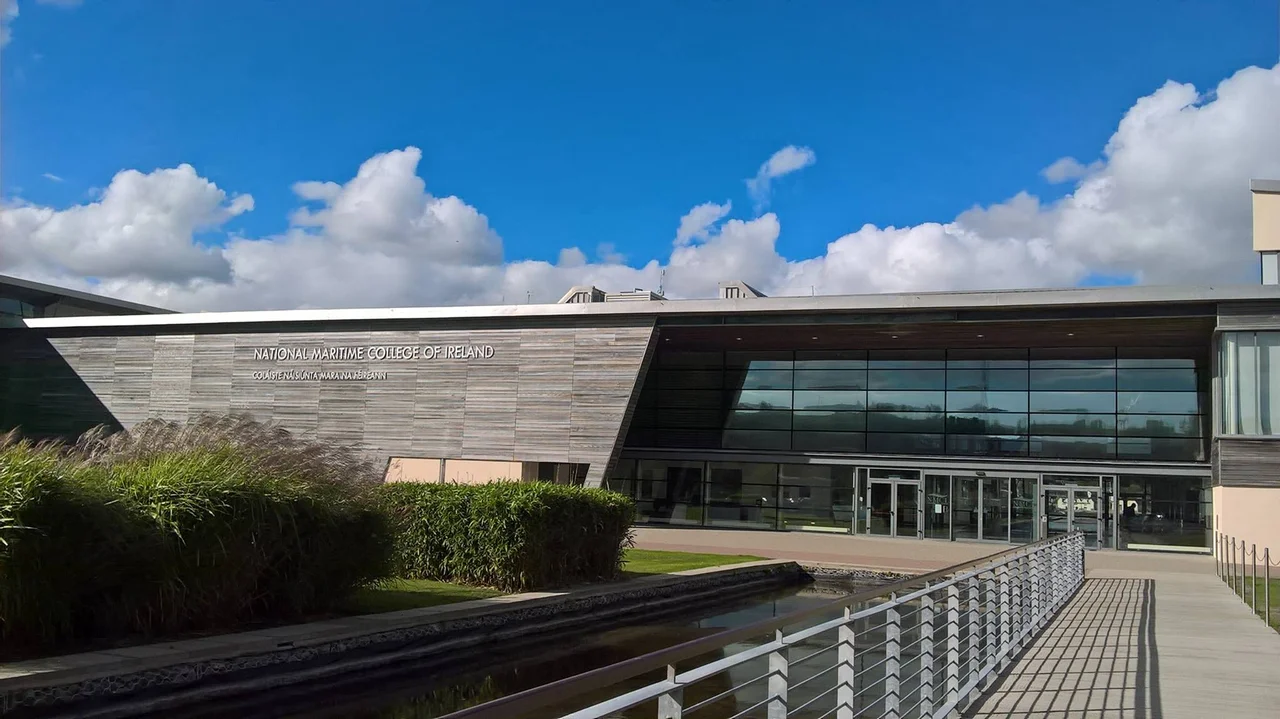

National Maritime College of Ireland
Step into the sea-survival pool here and the instructors will turn on the wave machine and the wind generators. They will dim the lights to simulate dusk in the North Atlantic. Then they will help you climb into a helicopter cabin suspended above the water, strap you in, and drop the cabin into the pool - inverted, so you have to find an exit while upside-down under a sinking aircraft. The 'helicopter dunker' is one of the more dramatic training devices at the National Maritime College of Ireland, but it is not the strangest. The college shares its 22-acre Ringaskiddy campus with the largest maritime energy research centre in the world, an artificial ocean inside a warehouse, and a European Space Agency business incubator. It is also the place where the Irish Naval Service trains. Most of this exists because in the 1990s a Cork institute and the navy realised they were both about to build the same expensive facility.
From Apprentice to Institute
For centuries, Irish seafarers learned their trade the way sailors everywhere learned: through apprenticeship aboard working ships. The first formal navigational training began in Dublin in the late 18th century at the Irish Nautical College, later moved to Dun Laoghaire. In 1975 the Department of Education consolidated all maritime training at the newly established Cork Regional Technical College (Cork RTC) in Bishopstown - the staff and equipment of the old Nautical College folded into a Department of Nautical Studies. By the late 1990s the Bishopstown campus was overcrowded, and the 1995 STCW Code - the International Maritime Organization's revised Standards of Training, Certification and Watchkeeping - imposed practical training requirements (sea-survival pools, fire-fighting simulators, bridge simulators) that the old campus simply could not fit. Compliance would have cost a fortune.
The Navy Needed the Same Things
Meanwhile a few kilometres south, the Irish Naval Service at Haulbowline had its own problem. The Naval College needed updated training facilities - particularly the same expensive things the civilian college needed. A series of informal conversations between college staff and naval officers led to a remarkable proposal: build a single facility together, on unused Department of Defence land in Ringaskiddy, sharing the costly simulators and pools and bridges. It would be built under the Irish Government's Public-Private Partnership scheme, with Cork Institute of Technology (the renamed Cork RTC) as academic lead, the Naval Service as primary military user, and private partners contributing capital. The campus opened in 2004 next door to the Haulbowline naval base. It was the first dedicated maritime college in the history of the Irish state.
What You Can Train On
The facilities list reads like a maritime safety catalogue: a sea-survival pool with wave machine and wind generators; the helicopter dunking trainer for crew escape from ditched aircraft; a lifeboat jetty with several types of lifeboat; a fire-fighting simulator designed to reproduce shipboard fires; GMDSS (Global Maritime Distress and Safety System) radio suites; a 360-degree bridge watchkeeping simulator that surrounds the trainee with projected horizons and other ships; full engine room simulators for marine engineering students. Three undergraduate degrees are offered: Nautical Science (BSc) for future deck officers, Marine and Plant Engineering (BEng) for engine officers, and Marine Electrotechnology (BEng) for electro-technical officers. The college also runs Chief Mate, Master and Chief Engineer courses for licensed seafarers and the STCW Convention safety courses required throughout the world's commercial fleet.
The Beaufort Lab and Lir
Next door to the maritime college is the Beaufort Maritime and Energy Research Laboratory, run by University College Cork. The site's own marketing - 'the largest maritime and energy research centre in the world' - is the kind of claim you usually check twice; in this case the size of the facility justifies it. Beaufort houses the MaREI Centre (Marine and Renewable Energy), and inside MaREI is Lir - the National Ocean Test Facility. Lir is, essentially, an indoor ocean: several large artificial wave basins where scaled models of ships, offshore wind turbines, tidal energy devices and floating structures can be tested under controlled wave and current conditions. The European Space Agency runs a business incubator on the same site, supporting startups that combine space-derived data with marine applications. The HALPIN Centre at the maritime college, meanwhile, runs maritime R&D projects including the development of a towed radar kite for the Naval Service - a small aerodynamic radar reflector trailed behind a ship to extend its detection range.
The High Court Goes to Brussels
Between 2016 and 2017 the college fought an unusual war with its own regulator. The Marine Survey Office - Ireland's maritime regulator - refused to accredit certain STCW refresher courses taught at NMCI, meaning maritime authorities could not recognise the qualifications. Mariners who had paid for and completed courses were left in limbo. The dispute dragged through 2017 with the Department of Transport issuing a Marine Notice reminding seafarers of the certification requirements. Eventually it reached the High Court. But the college had also received accreditation for the same courses from the UK's Maritime and Coastguard Agency, and EU law requires mutual recognition of professional qualifications between member states. The European Commission ordered the Irish Government to recognise the qualifications. The college won. In 2021 Cork Institute of Technology and IT Tralee merged to form Munster Technological University. The maritime college continues as a constituent college, 22 km from the main MTU campus at Bishopstown, served by Bus Eireann routes 223 and 225, training the next generation of officers for ships that will sail oceans the college's wave basins can model.
From the Air
The National Maritime College of Ireland sits at 51.833 degrees N, 8.305 degrees W in Ringaskiddy on the western shore of Cork Harbour, immediately adjacent to the Haulbowline naval base. From the air the campus is identifiable by its distinctive curved waterfront building and the Beaufort laboratory building, with the Haulbowline naval base island connected by road bridge just to the east. Spike Island lies further east in the harbour. Cork Airport (EICK) is 11 km northwest. Best viewed from 2,000 to 5,000 feet on a Cork Harbour approach. The college and naval base together dominate the western shore of the lower harbour.
Nearby Stories
- Walter Siepmann 6.3 km away
- Gaeltacht na nDéise 11 km away
- Fermoy 12 km away
- Canovee 14 km away
- Rathcoole Ambush 16 km away
- SS Folia (1907) 20 km away
- Cloghan Castle, Lough Hyne 35 km away
- SM U-27 91 km away