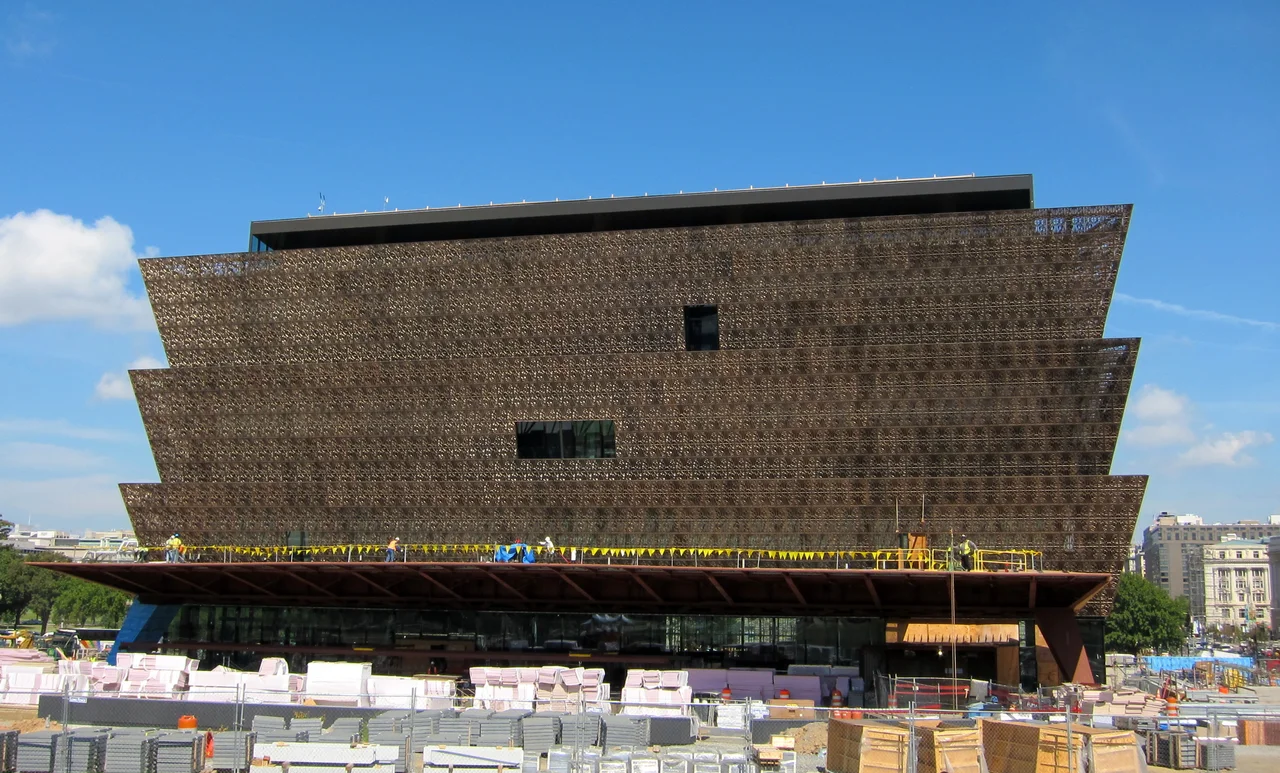

National Museum of African American History and Culture
In 1915, Black Union Army veterans gathered at the Nineteenth Street Baptist Church in Washington for a reunion and a parade. Fifty years after Appomattox, they had grown old in a country that still excluded them from much of its public life. The veterans wanted a memorial - some lasting acknowledgment, in the capital they had fought to preserve, of what they and other African Americans had achieved. They formed a committee. They wrote letters. In 1929, President Herbert Hoover finally appointed Mary Church Terrell, Mary McLeod Bethune, and ten others to a federal commission charged with building a National Memorial Building. Congress declined to fund it. Private fundraising failed. The idea did not die. It would take another 87 years - through World War II, the civil rights movement, the Great Society, and the Obama presidency - before the National Museum of African American History and Culture finally opened on the National Mall in September 2016.
A Hundred Years of Proposals
After Hoover's commission failed in the 1930s, proposals for a Black history museum surfaced in Congress repeatedly over the next four decades. None gained meaningful support. In 1981, Congress finally approved a federal charter for the National Afro-American Museum, but located it in Wilberforce, Ohio - far from the Mall, funded privately, opened in 1987. That same year, Representative Mickey Leland introduced a non-binding House resolution advocating for an African American museum on the National Mall. It passed the House in 1986. The Smithsonian responded by mounting a major exhibit at the National Museum of American History titled Field to Factory, on the Great Migration of Black Americans out of the Deep South. The exhibit did not satisfy the demand for a dedicated museum. It made the demand louder.
The Long Legislative Push
Throughout the late 1980s and 1990s, Black members of Congress - including Leland, John Lewis, and Eddie Bernice Johnson - kept introducing bills to authorize a national African American history museum. The bills stalled, sometimes over questions of jurisdiction within the Smithsonian, sometimes over questions of cost, sometimes simply because there was no political will to advance them. In 2001, John Lewis introduced legislation that would eventually become law. The bill passed in 2003 - 88 years after the Union veterans had first proposed it. President George W. Bush signed it. The National Museum of African American History and Culture was now legally chartered as a Smithsonian institution. The next questions were location, design, leadership, money, and content. Each took years.
Adjaye's Corona
In 2006, the Smithsonian selected a five-acre site on the National Mall just east of the Washington Monument - prime ground on the country's most prestigious public space. In 2009, after an international design competition, a joint team led by Ghanaian-British architect David Adjaye, with Phil Freelon, Davis Brody Bond, and SmithGroupJJR, won the commission. Adjaye's design centered on a bronze corona - three inverted tiered crowns made of 3,600 cast aluminum panels, finished in a bronze-colored lattice that filters light through the building's exterior. The form referenced the carved wooden columns and corona crowns of Yoruban art. The bronze color referenced ironwork done by enslaved African Americans in New Orleans and Charleston. The geometric pattern referenced the diaspora's grids of survival and dignity. The 350,000-square-foot building has ten stories - five above ground, five below - with the historical exhibitions descending into the lower floors so that visitors walk backward through time, from the present-day Black America at street level down to the African continent before 1619.
September 24, 2016
Construction began in 2012. The building was completed in 2016 at a cost of approximately $540 million, financed through a mix of federal appropriation and private philanthropy. Lonnie Bunch III, the museum's founding director, had been recruited from the Chicago Historical Society in 2005 and spent eleven years building the collection from nothing - more than 40,000 objects assembled through donations, purchases, and partnerships with African American families across the country. President Barack Obama, his wife Michelle Obama, and a crowd of dignitaries gathered on the Mall on September 24, 2016, for the formal opening. Obama rang a bell from the First Baptist Church in Williamsburg, Virginia - a congregation founded by enslaved people in 1776. The first Black president of the United States was opening the first national museum of Black history. Within weeks the museum was so heavily booked that timed-entry passes became required and remained necessary for years.
Forty Thousand Objects
The collection holds more than 40,000 objects, though only about 3,500 are displayed at any given time. Items range from a slave cabin from Edisto Island, South Carolina - relocated and reassembled inside the museum's basement - to Chuck Berry's red Cadillac, to a hymnal owned by Harriet Tubman, to Emmett Till's casket. The visual display includes performance footage of Marian Anderson at the Lincoln Memorial in 1939, archival film of the March on Washington in 1963, and footage of Obama's election night in 2008. The museum draws roughly a million visitors a year, making it one of the most visited Smithsonian museums and one of the most visited museums in the United States. The colloquial nickname has become the Blacksonian. The bronze corona on the Mall has become, within a decade of its opening, as recognizable a profile as the Washington Monument itself.
From the Air
The National Museum of African American History and Culture sits at 38.8911 N, 77.0328 W, on the south side of Constitution Avenue NW between 14th and 15th Streets, immediately east of the Washington Monument grounds. Best viewed from 1,500 to 2,500 feet AGL. The distinctive bronze-colored corona is unmistakable from the air and is one of the most recognizable post-2010 additions to the Mall's skyline. The Washington Monument rises immediately west. Reagan National (KDCA) lies two nautical miles south. The site sits inside the Washington Flight Restricted Zone; GA overflight prohibited. The bronze cladding glows particularly strongly in late-afternoon sun.
Nearby Stories
- Gunston Hall 1.1 km away
- 2023 Baltimore Shooting 4.9 km away
- Battle of Middleburg 6.6 km away
- Crownsville Hospital Center 10 km away
- Battle of Loudoun Heights 13 km away
- First Battle of Rappahannock Station 20 km away
- Howard County, Maryland 21 km away
- Harriet Tubman Underground Railroad 50 km away