
National Museum of American History
On the night of September 13, 1814, lawyer Francis Scott Key watched the bombardment of Fort McHenry from a British prisoner-exchange vessel in Baltimore Harbor and waited to see if an American flag would still be flying in the morning. The flag he saw at dawn - 30 by 42 feet, with 15 stars and 15 stripes, hand-sewn by Mary Pickersgill - now hangs in climate-controlled silence at the heart of the National Museum of American History. The Star-Spangled Banner is the museum's central artifact and the focal point of the entire institution. Visitors descend into a darkened chamber kept at low light to protect the wool fibers. The flag is laid almost flat, slightly angled. It is enormous, and weathered, and the only object in the room. Around it, in three floors of galleries, sit 1.7 million other objects that tell the rest of the country's story.
The Star-Spangled Banner
After Key wrote the poem that would become the national anthem, the flag itself passed through Major George Armistead's family for nearly a century before being donated to the Smithsonian in 1907. Years of poor display - the flag had hung exposed in the old Arts and Industries Building - left it deteriorating. A multi-year conservation project that wrapped up in 2008 culminated in the construction of the chamber that now holds the flag at a 10-degree angle, in low light, in a controlled environment. Adjacent to the flag is a full-size digital reproduction by Potion Design, a touch-screen surface that lets visitors zoom in on details, learn the names of the women who stitched it, and understand the scale of the original.
From Industry to History
The museum was established on July 1, 1957, as the Museum of History and Technology, but the building did not open to the public until January 1964. The collection had grown out of the Smithsonian's earlier consolidations of artifacts removed from the Patent Office and the original Smithsonian Castle. Frank A. Taylor became the first director in 1958, overseeing the building's construction and the hiring of staff. In 1969 the museum was renamed the National Museum of History and Technology. In 1980 it became the National Museum of American History. The original 1964 building - a marble box designed by McKim, Mead and White - was renovated for $85 million between September 2006 and November 2008, with Skidmore, Owings and Merrill designing a five-story sky-lit atrium and a new grand staircase. A second renovation cycle ran from 2012 through 2017, opening west-wing exhibition spaces with panoramic windows overlooking the National Mall.
Landmark Objects
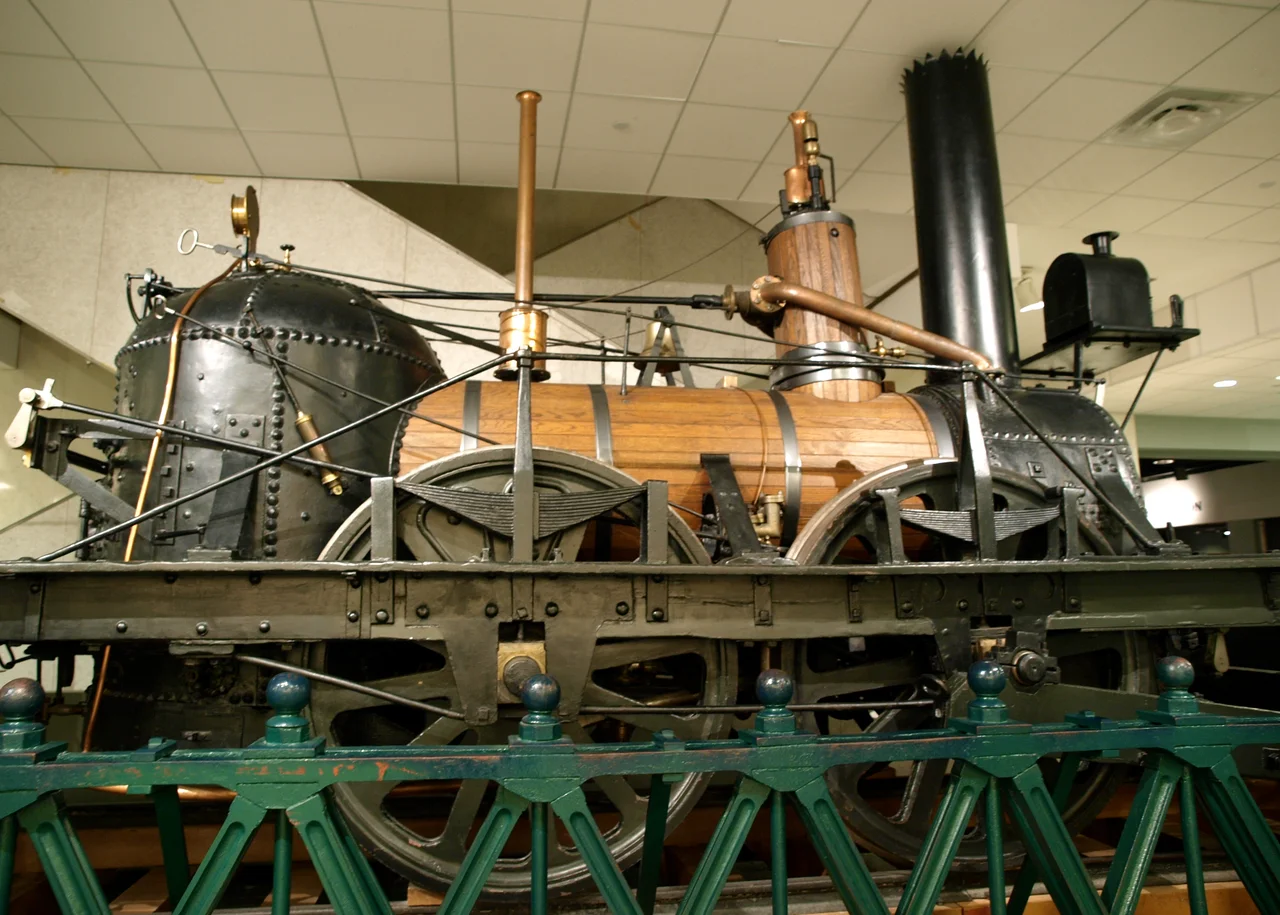
Each wing of each floor is anchored by what the curators call a landmark object - an artifact substantial enough in size or symbolic weight to ground an entire exhibition. The John Bull locomotive, built in England in 1831 and operated on the Camden and Amboy Railroad, sits at one ground-floor entrance. The Greensboro lunch counter - four chrome stools and a stretch of speckled Formica from the F.W. Woolworth's in Greensboro, North Carolina, where four Black college students sat down on February 1, 1960, and refused to leave - is the landmark for the second-floor east wing. The 1840 marble statue of George Washington by Horatio Greenough, originally carved for the Capitol Rotunda before being removed for showing the Founder bare-chested in classical Roman style, anchors the second-floor west. The Vassar College telescope from 1865 sits on the first floor. The gunboat Philadelphia, sunk in Lake Champlain in 1776 and raised in 1935, sits on the third floor.
Julia Child's Kitchen
In 2001, when chef Julia Child sold the Cambridge, Massachusetts house where she had filmed several of her cooking shows, she donated the entire kitchen to the Smithsonian. Custom counters, pegboard wall, copper pans, the wall-mounted electric range. The kitchen was disassembled, transported, and reassembled inside the museum as Bon Appétit! Julia Child's Kitchen - a complete period room where visitors can see exactly how Child cooked. It is one of the most popular exhibits in the museum. Other complete or partial buildings on display include the Choate-Caldwell House - an entire eighteenth-century colonial house from Ipswich, Massachusetts, the centerpiece of the Within These Walls exhibit on the second-floor west wing. The Stonewall Inn doorway sits in another permanent gallery. A car from the Dumbo Flying Elephant ride at Disneyland sits in the third-floor west wing. A Chico and the Man lowrider - the customized 1964 Impala Gypsy Rose - is featured in the 2025-2027 Corazón y Vida lowriding culture exhibit.
Presidents, First Ladies, and Disrupted Exhibits
The third floor center holds two of the museum's most heavily trafficked permanent exhibits: The American Presidency: A Glorious Burden and First Ladies of America. The latter displays inaugural gowns from Martha Washington through Jill Biden - silk damask, beadwork, every dress photographed for the press at presidential inaugurations. The museum's politics have not always been quiet. In 1973, representatives from the Committee to Re-elect the President forced the museum to temporarily close the Right to Vote exhibit, which had been designed by historian Edith Mayo, ahead of Richard Nixon's second inauguration. The exhibit reopened after the inauguration. The Lemelson Center for the Study of Invention and Innovation, founded with funding from the Lemelson Foundation in 1995, runs hands-on programs in the Spark!Lab on the first floor. The Archives Center houses 12,000 feet of shelving documenting advertising, broadcasting, music, technology, and the personal papers of inventors. The museum drew 2.1 million visitors in 2023 - the eighth most visited museum in the United States.
From the Air
The National Museum of American History sits at 38.8911 N, 77.0301 W, on Constitution Avenue NW between 12th and 14th Streets, on the north side of the National Mall. Best viewed from 1,500 to 2,500 feet AGL. The white marble box with its 1960s modernist proportions is one of the larger Mall buildings, situated between the National Museum of Natural History (to the east) and the National Museum of African American History and Culture (to the west). The Washington Monument rises immediately southwest. Reagan National (KDCA) lies two nautical miles south. The site is inside the Washington Flight Restricted Zone; GA overflight prohibited.
Nearby Stories
- Gunston Hall 1.1 km away
- 2023 Baltimore Shooting 4.9 km away
- Battle of Middleburg 6.6 km away
- Crownsville Hospital Center 10 km away
- Battle of Loudoun Heights 13 km away
- First Battle of Rappahannock Station 20 km away
- Howard County, Maryland 21 km away
- Harriet Tubman Underground Railroad 50 km away