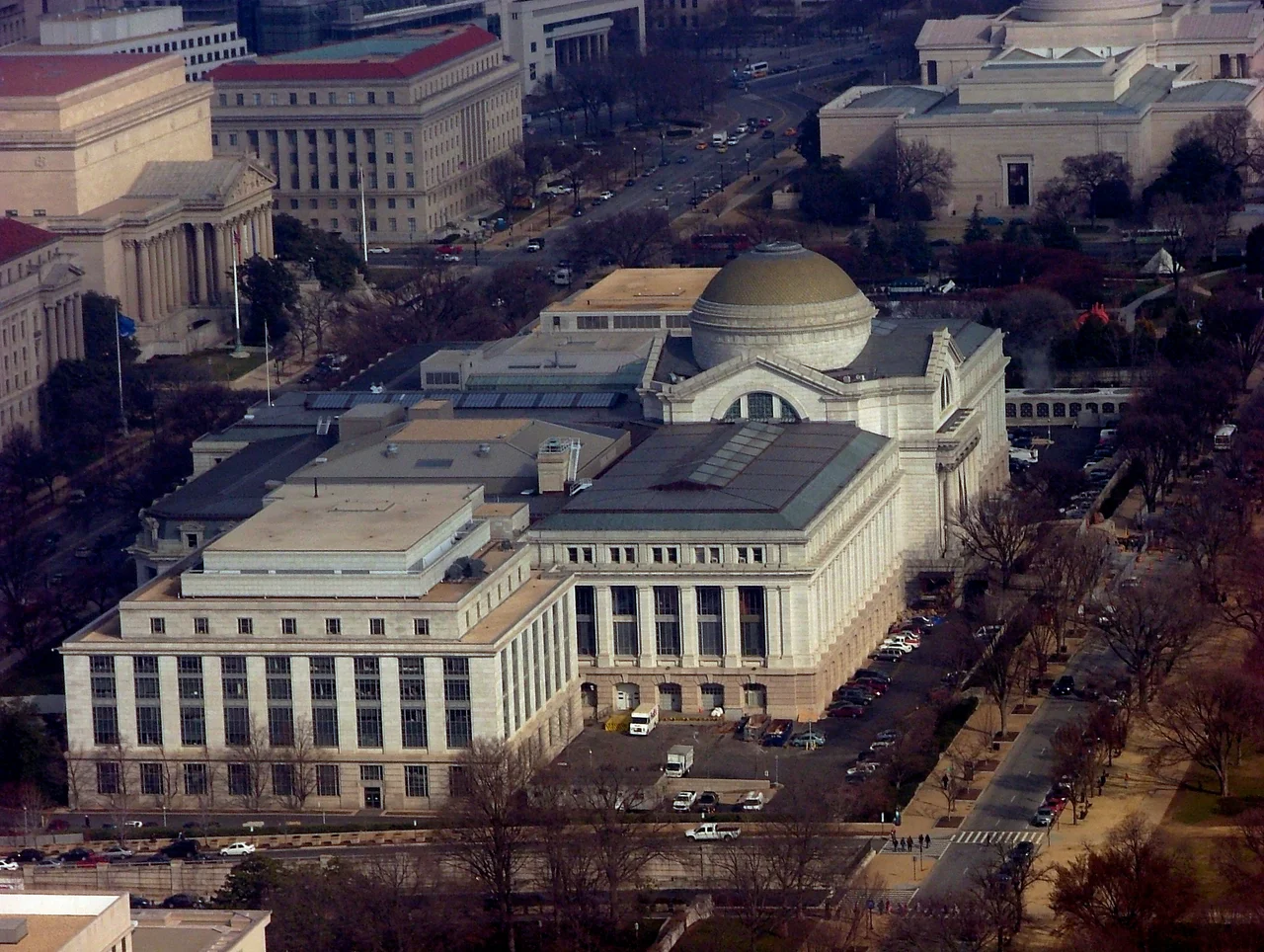

National Museum of Natural History
Walk through the brass-and-marble rotunda of the National Museum of Natural History and the first thing you see is an elephant. Twenty-four thousand pounds of taxidermied African bush elephant, standing on a circular plinth in the center of the rotunda, tusks raised, mounted in an aggressive defensive posture. The animal is named Henry. He was killed in Angola in 1955, donated to the Smithsonian, and has stood at the museum's center ever since. He weighs roughly as much as a small car. Behind him, the rotunda's marble dome rises 124 feet. Around the perimeter, four floors of galleries hold something on the order of 146 million specimens and cultural artifacts - the largest natural history collection in the world. Approximately 185 staff scientists make this also the largest assembly of natural-history researchers anywhere. And the Hope Diamond, fifteen feet from the entrance, sits in a corner case waiting for the next visitor to walk by.
The McMillan Plan's First Building
The U.S. National Museum was founded in 1846 as part of the original Smithsonian Institution. The collections grew quickly through the second half of the nineteenth century - donations from federal scientific expeditions, the U.S. Geological Survey, the Bureau of American Ethnology, and the various territorial surveys - until the Castle and the Arts and Industries Building could not hold them. Congress authorized a dedicated Natural History building on June 28, 1902. The 1901 McMillan Commission plan, which had reorganized the Mall into a coherent neoclassical landscape, identified the spot. Hornblower and Marshall, the same Washington firm that had designed Hubbard Hall for the National Geographic Society, won the design competition. Construction took eight years. The Natural History Building opened to the public on March 17, 1910. Final construction wrapped in June 1911 at a cost of $3.5 million - about $85 million in 2012 dollars. It was the first building constructed on the north side of the National Mall under the McMillan Plan. It also housed the Smithsonian's American history, art, and cultural collections until the 1950s, when those collections moved to their own buildings.
The Hope Diamond's Curse
The Hope Diamond - 45.52 carats, deep blue, set in a platinum pendant with white diamonds - arrived at the Smithsonian on November 10, 1958, as a gift from New York jeweler Harry Winston, who shipped it to the museum in a plain brown package by registered first-class mail. Winston had bought the stone in 1949 from the estate of Washington socialite Evalyn Walsh McLean. The diamond's earlier history runs through Jean-Baptiste Tavernier, who acquired it in India in 1666; Louis XIV, who had it recut as the Blue Diamond of the Crown; the French Revolution, when it was stolen; the London diamond merchant Daniel Eliason; Henry Philip Hope, who gave the stone its modern name; and various subsequent owners, several of whom suffered notable misfortunes that gave rise to the curse legend. The stone is displayed in a corner of the Janet Annenberg Hooker Hall of Geology, Gems, and Minerals, in a rotating circular case viewable from all sides. Visitors regularly form lines around it. The Smithsonian celebrated the 50th anniversary of acquiring the stone in 2009 by giving it a new setting and its own dedicated exhibit space.
Sixteen Thousand Specimens From a Bridge Builder
The museum's mineral and gem collection holds over 15,000 individual gems, 350,000 minerals, 300,000 rock and ore samples, and approximately 45,000 meteorites - the most comprehensive meteorite collection in the world. Some of the most significant donations came from unexpected donors. Washington Roebling, the engineer who finished the Brooklyn Bridge after his father's death, had assembled 16,000 mineral specimens over the course of his life - mineralogy had been his lifelong hobby. After Roebling died in 1926, his son John A. Roebling II donated the entire collection to the Smithsonian. Frederick A. Canfield donated 9,000 more. Isaac Lea contributed 1,312 gems and minerals that formed an early backbone of the collection. The Hooker Hall, named for major donor Janet Annenberg Hooker, displays the most spectacular specimens - a 330-carat star sapphire, the 138-carat Rosser Reeves Star Ruby, and various meteorites including a 4.5-billion-year-old fragment of the original solar nebula.
Seven Million Fish in Jars
Behind the public galleries, the museum holds collections most visitors never see: 30 million pinned insects in archival drawers, 4.5 million pressed plants in the herbarium, 7 million fish preserved in alcohol-filled jars, more than 580,000 amphibian and reptile specimens (up from 190,000 in 1970). The Biological Survey unit, transferred from the U.S. Geological Survey - originally an 1885 Agriculture Department economic ornithology unit where Clarence Birdseye and Clinton Hart Merriam worked - holds nearly a million bird, reptile, and mammal specimens. Approximately 3.5 million specimens go out on loan to researchers worldwide every year. The museum operates field stations in Belize, Alaska, and Kenya, and maintains the Smithsonian Marine Station in Fort Pierce, Florida.
Politics and Climate
In 2007, museum exhibits director Robert Sullivan publicly charged that director Cristián Samper and Smithsonian Undersecretary for Science David Evans had ordered last-minute changes to the exhibit Arctic: A Friend Acting Strangely, toning down language about human contributions to global warming. Samper denied political pressure had influenced the changes. In November 2007, The Washington Post reported that an interagency group of federal scientists from the Department of the Interior, NASA, NOAA, and the National Science Foundation believed the museum had acted to avoid criticism from congressional appropriators and global-warming skeptics in the Bush administration. The episode produced internal Smithsonian reforms regarding scientific independence in exhibit text. Kirk Johnson, vice president of research at the Denver Museum of Nature and Science, became Sant Director in October 2012 and has overseen the museum since, including a $35 million renovation of the dinosaur hall, the Sant Ocean Hall opening, the human evolution hall, and the museum's listing on the National Register of Historic Places in 2023. The museum drew 4.4 million visitors in 2023 - the third most visited museum in America and one of the busiest free public spaces in the country.
From the Air
The National Museum of Natural History sits at 38.8913 N, 77.0260 W, on Constitution Avenue NW between 9th and 12th Streets, on the north side of the National Mall. Best viewed from 1,500 to 2,500 feet AGL. The neoclassical dome over the central rotunda is the most distinctive visual feature from above. The National Museum of American History sits immediately west; the National Gallery of Art West Building lies to the east. The Washington Monument rises about a half mile southwest. Reagan National (KDCA) lies two nautical miles south. The site is inside the Washington Flight Restricted Zone; GA overflight prohibited.
Nearby Stories
- Gunston Hall 1.1 km away
- 2023 Baltimore Shooting 4.9 km away
- Battle of Middleburg 6.6 km away
- Crownsville Hospital Center 10 km away
- Battle of Loudoun Heights 13 km away
- First Battle of Rappahannock Station 20 km away
- Howard County, Maryland 21 km away
- Harriet Tubman Underground Railroad 50 km away