
National Museum of Rural Life
Ten generations. From 1567 to 1992, ten generations of one family - the Reids - worked the same Lanarkshire fields, kept the same farmhouse, walked the same boundaries. When Mrs. Margaret Reid finally gifted Wester Kittochside farm to the National Trust for Scotland in 1992, she was closing a 425-year continuity that almost no farm in Britain can match. Today the farm is the National Museum of Rural Life, a working dairy and museum hybrid that opened in 2001 between East Kilbride and Carmunnock. You can still watch the pedigree Ayrshire cattle being milked at three in the afternoon. You can still see the rig-and-furrow marks in the Buchans field, ploughed that way before enclosure changed everything in the 17th century. What the museum protects is rarer than buildings - it is the unbroken thread of a place being farmed by people who knew it.
Lairds of Kittochside
The Reid claim to these lands began with a lawsuit. John Reid, tenant of Kittochside, bought the land outright from Robert Mure of Caldwell in 1567. Mure tried to take it back by force and burned Kittochside down. The case went all the way to the Privy Council of James VI in 1600, where Mure was jailed for six months, released after paying a fine of 500 merks, and ordered to pay 1,015 merks more by 11 November of that year. The Reids stayed. During the Covenanting troubles, two Reid brothers fought against the king at the Battle of Bothwell Brig in 1679. James Reid tore the Kilbride Parish Flag from its pole when enemies seized it and wrapped it around his body as he escaped. His brother John was captured and would have been transported to the West Indies as an enslaved person - the king's standard punishment for Covenanter prisoners - if the Duke of Hamilton had not intervened. John spent about six years in jail instead, then returned home to manage the farm in quieter times.
The Laird's House
The Georgian dwelling at the heart of the farm was built between 1782 and 1784 at a cost of £45 12s 7d, an entirely precise figure that survives in the records. It is a near-miniature classical country house - dignified, balanced, modest. An extension came in 1906. Electricity replaced oil lamps and candles in the 1950s, and the interior has been kept in 1950s condition ever since, which makes a visit feel like stepping into a Scottish farm on the cusp of mechanisation. Ball finials carved on the gable ends served as lightning rods, but local folklore gave them another duty entirely: deterring witches on broomsticks from landing on the roof. The carved obstruction supposedly forced any approaching witch to sheer off and find another target.
Tools That Speak
The exhibition building, designed by Page\Park Architects and completed in 2001, looks deliberately like a wood-clad barn - sliding doors, whitewashed walls, the lower edge of one side left open to the ground outside. Inside, the museum holds the best collection of combine harvesters in Europe, the earliest surviving iron plough invented by James Small in the late 18th century, and the reaping machine designed by Patrick Bell (1799-1869). The oldest known surviving threshing mill in the world, the High Breck of Rendall Mill, lives here as a permanent exhibit. In the corn barn at Wester Kittochside, you can see how threshing worked before machines: a flail - a wood pole with a smaller pole linked at the end by chain or leather thong - swung by hand against grain heads on the threshing floor. A horse-driven gin took over the work between 1820 and 1840, replaced by a threshing mill in 1860, then made obsolete by travelling mills in 1870. Each tool tells the same story: human and animal labour slowly displaced by machines.
A Working Year
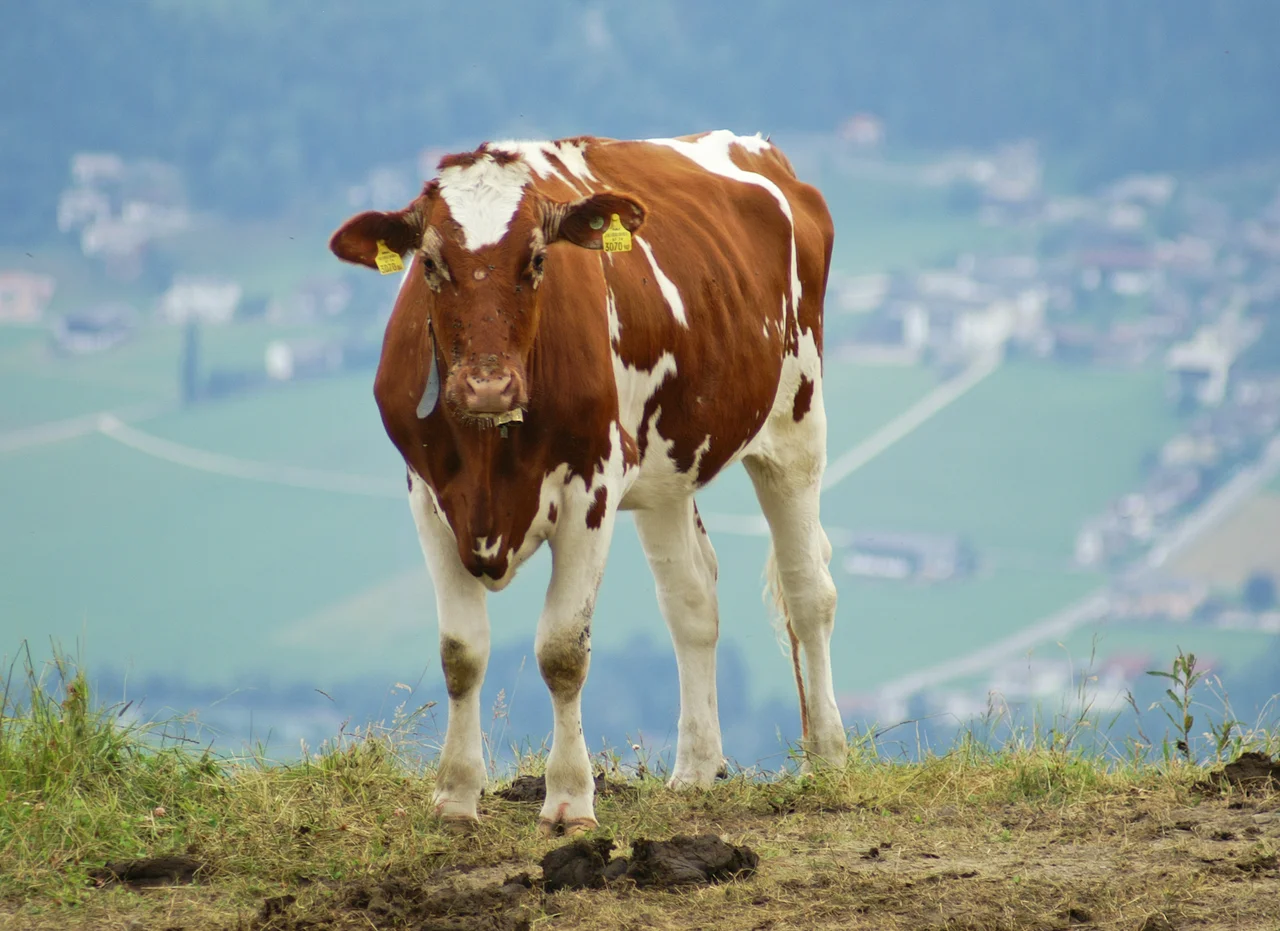
Wester Kittochside is not a museum frozen in glass. The Ayrshire cows calve between January and March, and they are milked daily. The Kittochside flock of Scottish blackface ewes lambs in early April. Ploughing, sowing, haymaking, harvesting - all happen on schedule. Visitors arrive by tractor ride from the exhibition building. The calendar fills with the heavy horse show, the tractor show, sheepdog trials, a horse-shoeing competition, the Kittochside Fair, Toytrac Scotland, Christmas at the Farm, the Halloween Party, and Willow Harvest. In 2019 the museum welcomed 113,525 visitors. One small detail captures the place: a bothy, the single-room quarters of a bachelor farm servant, became a tack room in the early 20th century and then, during the Second World War, housed a German prisoner of war named Heinrich Luckel. Heinrich stayed in touch with the Reid family for years after the war ended.
From the Air
Located at 55.7754 degrees N, 4.2213 degrees W, on a hilltop between East Kilbride (South Lanarkshire) and Carmunnock (Glasgow). Best viewed from 1,500-3,000 feet to see the well-preserved rig-and-furrow field patterns, mature trees screening the farmhouse, and the Kittoch Water glen below the exhibition building. Nearest ICAO airports: Glasgow International (EGPF) about 11 nm north and Glasgow Prestwick (EGPK) about 18 nm southwest. The 44-hectare farm sits within a 24-hectare events area and is bordered by hedgerows.
Nearby Stories
- Mauchline 3.6 km away
- Shotts 4.2 km away
- HMS Ulysses (1917) 7.7 km away
- Rothesay Castle 8.8 km away
- Inchcailloch 10 km away
- Strachur 14 km away
- Battle of Dollar 16 km away
- Crawford Castle 16 km away