.jpg)
National Museum of Sudan
The four-meter granite statue of Pharaoh Taharqa, broken by Egyptians at Napata in 591 BCE, buried by Kushite priests, dug out by George Reisner in 1916, stood at the entrance of the Sudan National Museum for more than five decades. When you walked in, he greeted you. He is one of the few objects that survived what happened to this museum between 2023 and 2025, because he was too heavy to move. The rest of the collection, roughly 100,000 pieces covering the Paleolithic through the Islamic period, is almost entirely gone.
What the Museum Was
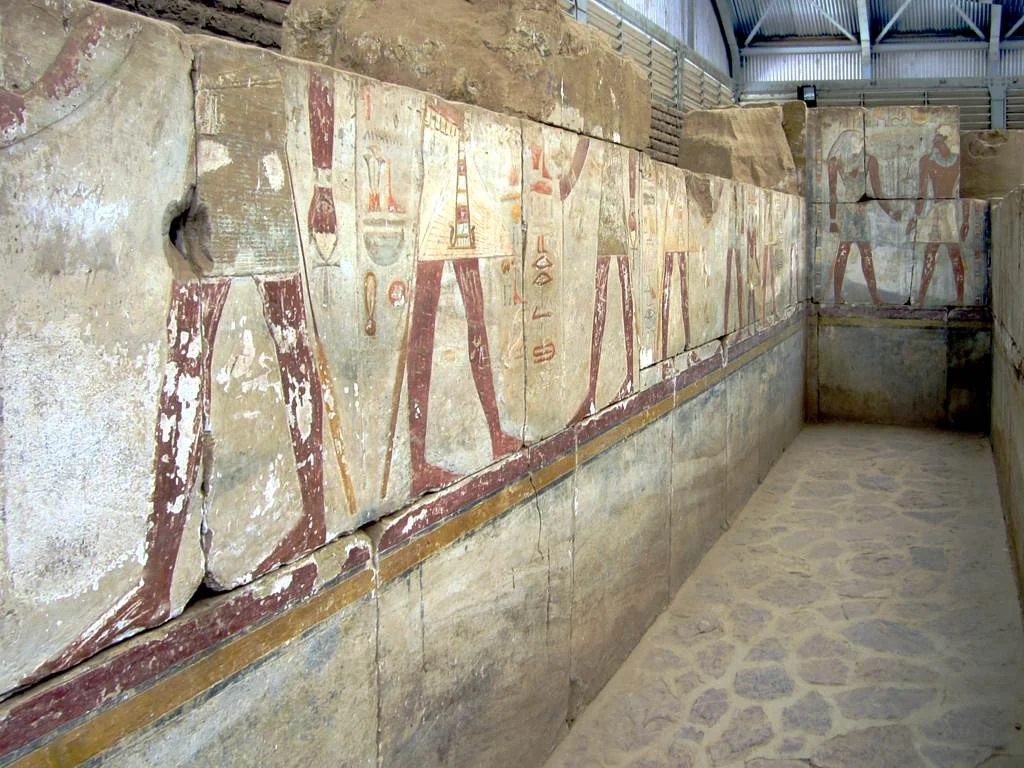
The building opened in 1955, the year before Sudanese independence, and became the National Museum in 1971. Its purpose was specific and enormous: to house the largest collection of Nubian archaeology in the world, including objects relocated during the 1960-1980 UNESCO Campaign to Save the Monuments of Nubia, when the Aswan High Dam flooded vast stretches of the Nile. Six Egyptian temples, rebuilt stone by stone in the museum garden, sat in their original orientations around an artificial stream meant to symbolize the Nile. The temple of Ramses II from Aksha. The temple of Hatshepsut from Buhen, with its falcon-headed Horus reliefs. The temple of Kumma dedicated to the ram-headed Khnum. The temple of Semna. A tomb of a Nubian prince from Debeira. They had been rescued from flooding. Then, half a century later, they were left to be looted by a paramilitary.
The Collection
Inside the building, galleries traced Sudan's history through ten thousand years. There were Neolithic ram statuettes from the C-Group culture, black-topped red burnished pottery from the same era, funerary goods from the Kerma kingdom. There was the strange bowlegged figurine of the goddess Beset, faced frontally rather than in profile (unusual in Egyptian art), grasping a snake in her three-fingered left hand, patron of mothers and newborn children. There was the bronze-and-gold statue of an unknown Meroitic king represented as an archer. There was the granite statue of King Aspelta. On the upper floor, the Faras Cathedral wall paintings, detached and rescued during the UNESCO Salvage Campaign, traced Christian Nubian art from the ninth through the thirteenth century. The colors were still vivid. The birth of Jesus, rendered in Nubian style. The story of Daniel in the furnace. Fourteen centuries of civilization assembled in two stories of exhibition space.
The Monumental Alley
The lane leading from the museum's parking area was lined with Meroitic sculptures. Two stone rams. Six dark sandstone lions, carved in the first century BCE with cartouches of King Amanikhabale on the first lion on the right. These lions had, in local tradition, a second name: man-eating lions, because of their open mouths and fierce mien. The Tabo colossal statues, two unfinished granite giants from Argo Island showing Roman stylistic influence, flanked the building's entrance. Even the path to the museum was a museum. Visitors walking to the front door passed through two millennia of Kushite and Meroitic art, heavy, weathered, unmistakably African in style.
What Was Taken
On June 2, 2023, in the early weeks of the Sudanese civil war, the Rapid Support Forces seized the museum. It sits on Nile Avenue in the al-Mugran area, near the confluence of the White and Blue Niles, surrounded by the government buildings that became the war's primary battlefields. Over the following 22 months, while fighting raged around it, the RSF methodically looted the collection. Mummies dating back to 2500 BC, among the oldest and most archaeologically significant in the world, were destroyed or taken. The archaeological gold collection was stripped. Reports later surfaced that truckloads of artifacts had been driven to western Sudan and the South Sudan border, to be sold. When the Sudanese Armed Forces expelled the RSF from Khartoum in March 2025, Ghalia Garelnabi, director of Sudan's National Corporation for Antiquities and Museums, walked through the wreckage and estimated that ninety percent of the museum's holdings were gone. The Guardian reported that almost all of the 100,000 objects had been looted, with only heavy artifacts like the Taharqa statue and the garden temples remaining.
What Survives
The Sudanese archaeologists who spent their careers building this museum include many young women trained at the University of Khartoum, part of a generation whose work The Guardian had profiled just months before the war began. Their knowledge, of every object, every provenance, every inscription, is now the museum's real collection. With support from the French Archaeological Unit for Sudanese Antiquities (SFDAS), the Louvre, and Durham University, they are building a virtual museum to display what has been lost and to document what may yet be recovered. Items have begun turning up on antiquities markets, and Sudanese archaeologists are working with Interpol and international colleagues to track them. The Continent magazine wrote that the war in Sudan is destroying not just the country's future, but also the country's past. The past can sometimes be partly recovered. The scholars who love it, and who are its custodians, have not given up.
From the Air
The National Museum of Sudan is located at 15.61°N, 32.51°E in central Khartoum, on Nile Avenue in the al-Mugran area, near the confluence of the Blue and White Niles. Elevation approximately 380 meters. Recommended viewing altitude: 3,500-5,500 feet for urban context and proximity to the Mogran confluence. Khartoum International Airport (HSSS) lies approximately 5 km to the southeast, though it suffered heavy damage during 2023-2025 and is recovering. Wadi Seidna Air Base (HSSW) serves as alternative. The Presidential Palace, old parliament, and other government buildings sit along the same Nile Avenue corridor; expect haboobs (dust storms) April-June with reduced visibility.
Nearby Stories
- Esh Shaheinab 27 km away
- Naqa 56 km away
- Mahdist War 65 km away
- Musawwarat es-Sufra 100 km away
- Gezira State 101 km away
- Northern Sudan 215 km away