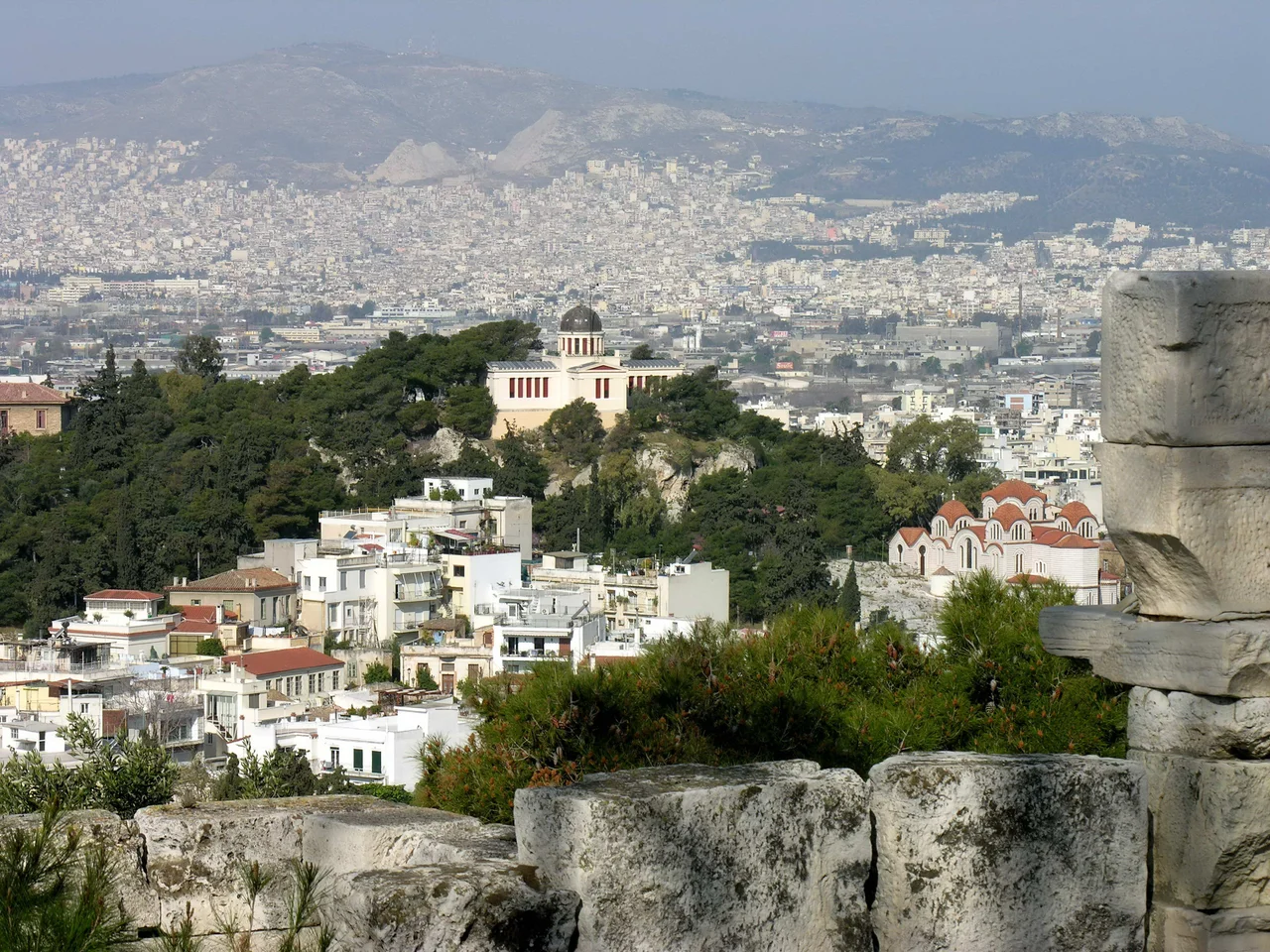

National Observatory of Athens
The foundation stone was laid in shadow. On June 26, 1842, as a partial solar eclipse dimmed the sky over Athens, the King of Greece, his ministers, and the Greek clergy gathered on the Hill of the Nymphs while a Danish frigate anchored off Piraeus fired its cannons in salute. The crowd that filled the slope could hardly have asked for a more fitting omen for an observatory than the moon passing across the sun. The building going up that day would become the oldest research institution in the entire Greek state - the first scientific foundation raised after the country won its independence in 1829.
A Banker, a Professor, and a King
The observatory exists because one determined astronomer would not let the idea die. Georgios Konstantinos Vouris had studied the stars at the Vienna Observatory before moving to the young University of Athens, and he was convinced his adopted country needed a place to watch the sky. Lacking funds, he turned to Baron Georgios Sinas, a wealthy Greek-Austrian banker, who agreed to pay for it. King Otto, himself born in Bavaria, was so pleased that he awarded Sinas's son the Order of the Redeemer. The cross-shaped neoclassical building that resulted was the first ever designed by the Danish architect Theophil Hansen, whose name would later grace landmarks across Vienna. Its four arms point to the cardinal directions, with a small telescope dome at the very center.
The Man Who Mapped the Moon
In 1858 the directorship passed to Johann Friedrich Julius Schmidt, a German-born astronomer who spent twenty-five extraordinary years on the hill. The clear Attic sky was his laboratory. He logged more than seventy thousand observations of variable stars, discovered a comet that still bears his name, and on a single night in January 1865 found five galaxies in the Fornax Cluster. His masterwork was a chart of the Moon two meters across, assembled in twenty-five panels and showing some thirty thousand craters as he saw them through the observatory's Plossl refractor. Schmidt's curiosity ranged far beyond the lunar surface. He recorded over three thousand earthquakes, traveled to study the volcanoes of Santorini, Etna, Vesuvius, and Stromboli, and even surveyed the ancient site of Troy.
Renaissance on the Hill
By 1884 the Sinas family endowment had run dry, and the new director, Demetrios Kokkidis, served without pay. Rescue came in 1890, when the Greek Parliament made the institution a national research facility - the moment it took the name it carries today, the National Observatory of Athens. Under Demetrios Eginitis the place was reborn. He raised donations from the Greek community, expanded the Thiseio site, ordered new instruments, and built a meteorological network of roughly a hundred stations. Eginitis was more than an astronomer; he twice served as Minister of Education, founded the Academy of Athens, and was the man who moved Greece from the Julian to the Gregorian calendar.
Looking Outward, Looking Up
As city lights crept over Athens, the work moved to darker skies. In 1936 Stavros Plakidis founded a station at Penteli in the northern suburbs; it now shelters the historic Newall refractor, a 62.5-centimeter telescope built in England in 1869 and donated to Athens in 1957. Today the observatory reaches far beyond the capital, with stations on Mount Kyllini and Mount Chelmos, the latter home to the 2.3-meter Aristarchos telescope. Yet the heart of it all remains the little domed building on the Hill of the Nymphs, where a meteorological station has recorded the weather of Athens from the same spot since September 1890 - one of the oldest continuous weather records in southern Europe.
A Crater Named for a Volunteer
Among the observatory's quieter legends is Jean Focas, who arrived as a twenty-two-year-old with no formal training in astronomy and was simply allowed to help. He stayed for years, earned his doctorate in Paris much later in life, and proved himself so capable that two craters now bear his name - one on the Moon, one on Mars. It is a small, human story that says something about the place: an institution that began under an eclipse and has spent nearly two centuries letting the curious look up.
From the Air
The central premises sit at 37.973 N, 23.718 E on the Hill of the Nymphs (Lofos Nymfon) at Thiseio, immediately west of the Acropolis and beside Philopappou Hill - a useful pairing for visual navigation over central Athens. The small white domed observatory crowns the wooded hilltop. Best viewed at lower altitudes in the clear, dry visibility for which Attica is known. Nearest major airport: Athens International (LGAV), about 33 km east-southeast.
Nearby Stories
- Great Sand Beach 5 km away
- Battle of Delium 7.7 km away
- Tower of Aliartos 9 km away
- HMHS Britannic 10 km away
- Saronic Gulf 15 km away
- Sousaki Volcano 17 km away
- Sanctuary of Apollo Maleatas 24 km away
- Skyros 66 km away