
National Palace of Culture
Bulgaria turned 1,300 years old in 1981, and Lyudmila Zhivkova decided the country needed a cultural palace big enough to hold the celebration. She was the daughter of Todor Zhivkov, the long-ruling Communist leader, and as Minister of Culture she pushed an unusual vision: a Bulgaria proud of its medieval kings and its folk traditions and its avant-garde painters all at once. The result, anchoring the south end of central Sofia, is a low octagonal mass of concrete and glass with thirteen halls inside, finished in marble, dressed in murals, and built to outlast the regime that conceived it. The regime is gone. The building is still here.
1300 Years
The anniversary was real and the numbers were ancient. In 681 CE, Khan Asparuh's Bulgars settled south of the Danube and founded what historians call the First Bulgarian Empire, making 1981 the 1,300th year of statehood. For a small country squeezed between Greater powers across most of those centuries, this was an enormous matter of pride. The Communist government wrapped itself in the celebration, commissioning monuments, exhibitions, and folk-music spectacles across the country. The National Palace of Culture, abbreviated everywhere as NDK, was the centerpiece. It opened on 31 March 1981, on time, on the cusp of the year-long jubilee.
A Daughter's Vision
Lyudmila Zhivkova was not a typical Communist functionary. She studied art history at Oxford, embraced theosophy and Eastern spirituality, and pushed Bulgarian culture toward an internationalism that her father's regime did not particularly believe in. She championed the NDK and shaped its programming until her sudden death in 1981, at age 38, just before the building she had pushed for opened its doors. The official cause was a brain hemorrhage; rumors of poisoning have followed her ever since. Her phoenix logo, designed by Stefan Kanchev, still marks the palace. So does a gilded bronze sculpture in the lobby called Revival, sometimes Mother Bulgaria, that welcomes visitors with the kind of swelling symbolism the era loved.
Inside the Octagon
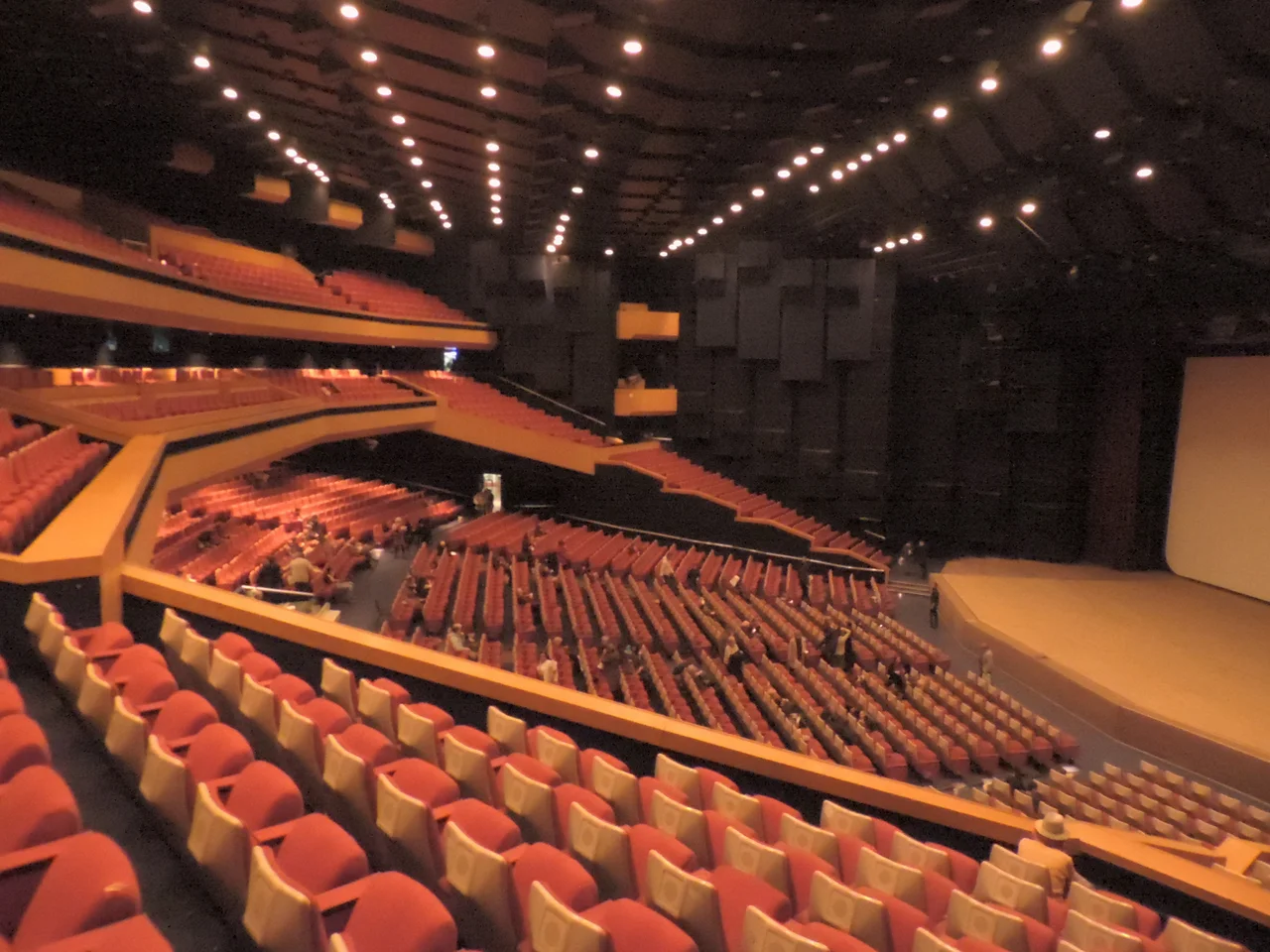
The interior commits to its octagonal motif with quiet ferocity. Dark woods and heavy colors give way, in the larger halls, to sweeping murals depicting Bulgarian history and mythology, painted by Dechko Uzunov, Svetlin Roussev, and other leading artists of the period. Hall 1, the main concert space, seats over 3,000. The total floor area runs to 123,000 square meters across eight floors, plus three underground levels and four panoramic terraces. There are 54 offices and seminar rooms, five restaurants, 17,000 square meters of lobbies. More than 80 monumental works of art, commissioned specifically for the building, are scattered through it. The bronze sun above the main entrance, by Georgi Chapkanov, is seven meters across, with stylized ears of corn radiating from its concave face.
What Comes After
When the Berlin Wall fell and Bulgaria's Communist government collapsed in late 1989, the NDK lost much of its property and most of its purpose. For a decade it drifted, underused and underfunded. Since 2011 it has been restructured as a state-owned commercial company that takes no subsidies and keeps itself running by hosting more than 300 events a year. Andrea Bocelli has sung here. So have Sting, Joe Cocker, Jose Carreras, Mark Knopfler, Hugh Laurie, and James Brown. The Vienna Philharmonic and the Bolshoi have performed. The Sofia International Film Festival uses the halls every March. In 2005, the International Organization of Congress Centres named NDK the best convention center in the world.
The Square Out Front
Walk up to the building from central Sofia and you cross Bulgaria Square, a wide expanse of concrete steps, fountains, and a 1300-Year monument designed for the same anniversary. The square has become the city's improvised gathering place: skateboarders in summer, anti-government protesters in winter, families on weekend afternoons. The 1300-Year monument itself is a controversial brutalist structure that many Sofians have wanted to demolish for years. The palace looms behind it, sphinx-like and unmistakable. Sofians have a complicated relationship with both. They are products of a system most do not miss, designed by architects who took their craft seriously, on a scale a small country could not realistically afford then or now. They are also part of how Sofia looks. They are home.
From the Air
NDK sits at 42.6847 N, 23.3189 E in central Sofia, at the south end of Vitosha Boulevard. From above, look for the broad octagonal roof and the long axis of Bulgaria Square running north-northeast toward the city center; the snow-capped Vitosha massif rises sharply to the south. Sofia International (LBSF) is 8 km east-southeast. Recommended viewing altitude 1,500 to 3,000 ft AGL; mountain effects make Sofia bowl turbulent in afternoon thermal conditions.
Nearby Stories
- Battle of the Gates of Trajan 1.3 km away
- Battle of Kresna Gorge 65 km away
- Battle of Plovdiv (1878) 70 km away
- Battle of Kosturino 114 km away
- New Europe Bridge 129 km away
- Old Bazaar, Skopje 136 km away
- Trapezitsa Fortress 142 km away
- Trajan's Bridge 193 km away