
National Portrait Gallery (United States)
The building that houses the National Portrait Gallery was originally something else entirely. The Old Patent Office Building, completed in 1867 after thirty years of intermittent construction, was where Thomas Jefferson's drawings of inventions were kept and where Civil War wounded were laid out in long rows during the spring of 1862. Walt Whitman walked these halls reading to dying soldiers. Clara Barton worked here as a nurse. The Patent Office continued operating in the building until 1932, the Civil Service Commission moved in afterwards, and by 1953 D.C. businessmen were lobbying to tear the whole thing down for a parking garage. President Eisenhower signed legislation in 1958 transferring the building to the Smithsonian for use as a national art museum. The National Portrait Gallery, established by Congress in 1962, opened inside on October 7, 1968. Through the Greek Revival sandstone porticos modeled on the Parthenon, visitors now walk past Gilbert Stuart's Lansdowne portrait of Washington and Kehinde Wiley's portrait of Barack Obama.
Eighty Years of Lobbying
The idea of a federal portrait gallery dates to 1886, when Robert Winthrop, president of the Massachusetts Historical Society, returned from a visit to London's National Portrait Gallery and began campaigning for an American equivalent. The campaign moved slowly. In 1919, the Smithsonian and the American Federation of Arts created a National Art Committee to commission portraits of the leaders of World War I. Those paintings, displayed at the Natural History Museum in 1921, formed an initial nucleus. In 1937, Andrew Mellon donated his vast art collection to the United States to found the National Gallery of Art, with the stipulation that any portraits be transferred to a future portrait gallery should one be created. David E. Finley, Mellon's friend and first director of the National Gallery, pushed for that gallery through the 1940s and 1950s. The Smithsonian Art Commission finally convened a committee in 1960 to plan the institution. Congress chartered the National Portrait Gallery in 1962. It took six more years to renovate the Patent Office Building and open the doors.
The Lansdowne Drama
Gilbert Stuart painted the Lansdowne portrait of George Washington in 1796 - an eight-foot canvas commissioned by Senator William Bingham as a gift to British Prime Minister William Petty FitzMaurice, the Marquess of Lansdowne. The painting passed through British noble families until 1968, when the Earl of Rosebery loaned it to the National Portrait Gallery's opening. The painting stayed on indefinite loan for 32 years. Then, in late 2000, Rosebery offered to sell - for $20 million, with a deadline of April 1, 2001. Three months of donor searches turned up nothing. The Smithsonian went public in February 2001 with a plea for a buyer. The Donald W. Reynolds Foundation answered. Fred W. Smith, the foundation chairman, had read about the failing search in the Wall Street Journal on February 26. The foundation approved a $30 million donation - $20 million for the painting, $6 million for a three-year national tour, and $4 million for a dedicated display area - on March 4, 2001, just three weeks before the deadline. The painting now anchors the Hall of Presidents.
The Cracked Plate
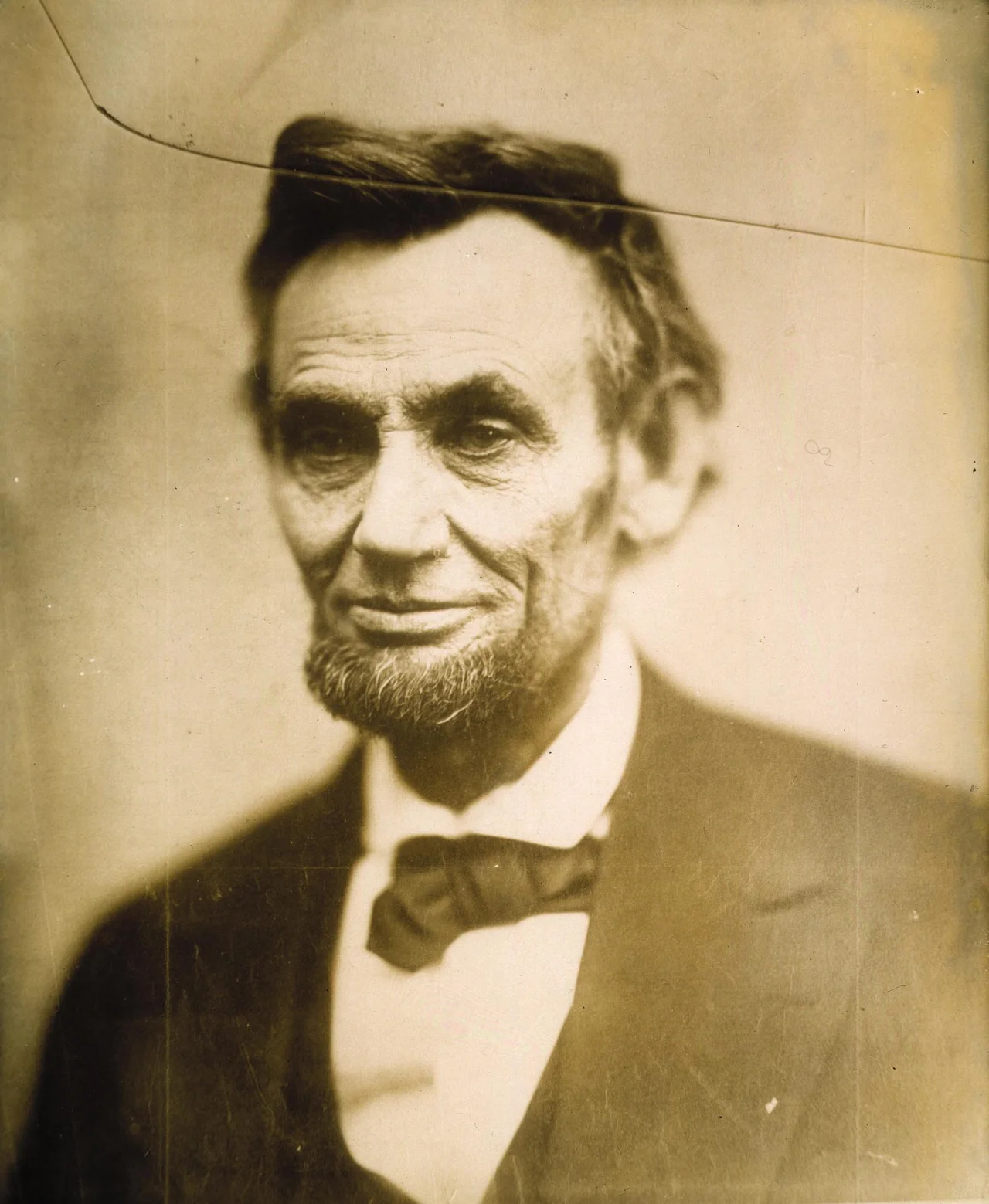
In February 1865, photographer Alexander Gardner photographed Abraham Lincoln in his studio at the corner of 7th and D Streets in Washington. The glass-plate negative cracked during development - a long horizontal fissure running across the top of Lincoln's head. Gardner made one print from the damaged plate before discarding the negative. Lincoln was assassinated two months later. The cracked-plate portrait is the last photographic portrait taken of him in life. The single surviving print came to the National Portrait Gallery in 1981, along with 5,400 other Civil War-era glass negatives that the museum purchased from the Meserve family. The acquisition made the NPG, in the words of The Washington Post, the epicenter for Brady scholarship - Mathew Brady having been Gardner's mentor and one of the chief documentary photographers of the war. The NPG also holds one of only four known daguerreotypes of Frederick Douglass, acquired in 1990, and the earliest known daguerreotype of John Brown - created in 1846-47 by African American photographer Augustus Washington - acquired in 1996 for $115,000.
Foster's Glass Canopy
The Old Patent Office Building closed for renovation in January 2000. The renovation was projected to take two years and cost $42 million. It took seven years and cost $283 million. The most prominent addition was a glass-roofed canopy by Norman Foster spanning the interior courtyard - the Robert and Arlene Kogod Courtyard, named for the donors whose $25 million in 2004 funded the canopy's construction. Foster's design, a billowing glass sky stretched over the courtyard between the Portrait Gallery and the American Art Museum, required two rounds of approval from the National Capital Planning Commission. The combined museum complex was rebranded the Donald W. Reynolds Center for American Art and Portraiture. The reopening on July 1, 2006 was an immediate success - 214,495 visitors in two months, against historical 12-month attendance of 450,000 across both museums. Some early visitors were not on their best behavior - spitting, touching, occasionally kissing the paintings - until security cameras were installed in September 2007.
The 2025 Removals
In July 2025, painter Amy Sherald withdrew her solo exhibition American Sublime from the National Portrait Gallery. The gallery had been in discussions with Sherald about possibly removing one piece - her portrait of the Statue of Liberty depicted as a Black transgender woman - after internal concerns about provoking President Donald Trump. The proposed compromise was to replace the painting with a video display of viewers reacting to it, but according to Sherald the proposed video included anti-trans rhetoric, and she rejected it. The withdrawal of the entire exhibition followed. Sherald is best known as the artist of Michelle Obama's official First Lady portrait, which hangs in the Gallery. In May 2025, President Trump had announced he was firing Director Kim Sajet via social media post; legal experts noted the president does not have authority over Smithsonian appointments because the institution is not an executive branch agency. Sajet had directed the museum since 2013. In January 2026, The Washington Post reported the gallery had updated the placard accompanying Trump's portrait in the America's Presidents exhibition - replacing the original caption mentioning his Supreme Court appointments, COVID vaccine efforts, impeachments, and other events with a brief notice of his years in office. The Lansdowne Washington continues to face the next person who walks through the door.
From the Air
The National Portrait Gallery shares the Old Patent Office Building with the Smithsonian American Art Museum at 38.8979 N, 77.0228 W, occupying the block bounded by 7th, 9th, F, and G Streets NW. Best viewed from 1,500 to 2,500 feet AGL. The Greek Revival sandstone-and-marble building is unmistakable, with the Norman Foster glass canopy spanning the central courtyard. The U.S. Capitol dome lies about a half mile southeast. Reagan National (KDCA) sits three nautical miles south. The site is inside the Washington Flight Restricted Zone; GA overflight prohibited. The glass canopy appears as a distinctive curving form in aerial photographs.
Nearby Stories
- Gunston Hall 1.1 km away
- 2023 Baltimore Shooting 4.9 km away
- Battle of Middleburg 6.6 km away
- Crownsville Hospital Center 10 km away
- Battle of Loudoun Heights 13 km away
- First Battle of Rappahannock Station 20 km away
- Howard County, Maryland 21 km away
- Harriet Tubman Underground Railroad 50 km away