.jpg)
National Taiwan Museum of Comics
Prison guards once practiced judo and kendo in the building where Taiwan's comics now live. That collision of past and present is exactly the kind of irony that manga and manhua artists would appreciate — the disciplined body giving way to the liberated imagination. The National Taiwan Museum of Comics opened on a former Taichung prison compound on December 23, 2023, occupying nineteen Japanese colonial-era structures whose original purposes ranged from martial training to officials' quarters. Getting here took six years and three false starts, which is perhaps fitting for a museum dedicated to an art form that thrives on plot twists.
A Museum That Almost Wasn't
The story of how this museum came to exist is almost as dramatic as any comic strip. Taichung Mayor Lin Chia-lung proposed the idea on September 1, 2017, and the Ministry of Culture quickly embraced it, announcing plans to build within the Taichung Shuinan Economic and Trade Park. Construction of the broader Central Taiwan Cinema Center — of which the museum was to be a part — broke ground in April 2018. Then, in May 2020, disputes over spacing arrangements within the Cinema Center prompted the Ministry to withdraw the museum entirely. Two alternative sites were considered that September: the Empire Sugar Factory Taichung Office and the Xinmin Street Railway Warehouses. A tentative plan moved forward, until a land ownership dispute halted progress again in early 2023. The Japanese-era Taichung Prison compound was chosen as the new home on April 1, 2023. Fittingly, the final site turned out to be the most resonant of all.
Nineteen Buildings, One Unlikely Legacy
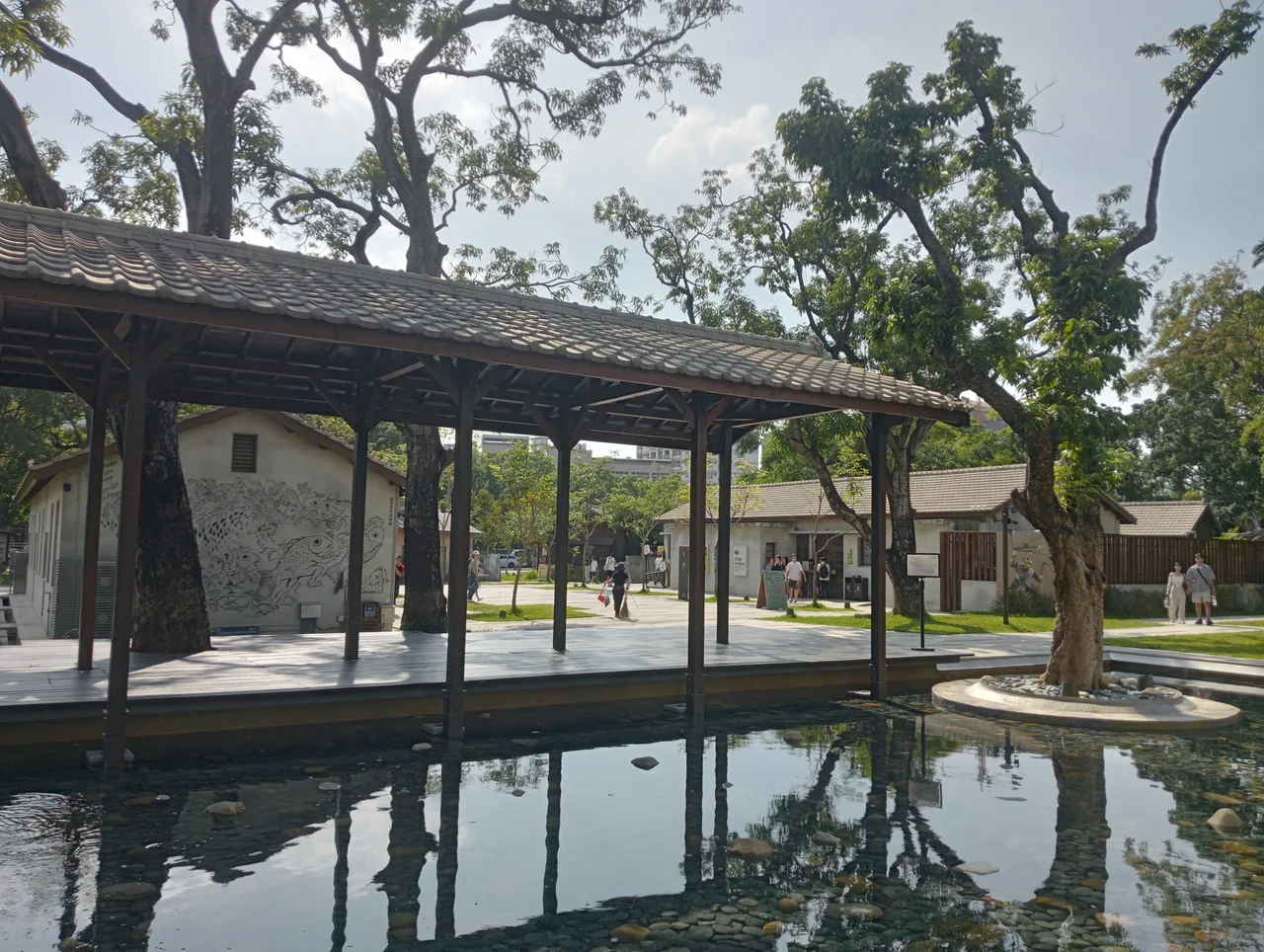
The campus the museum now inhabits sprawls across more than two hectares. Its oldest structure, the officials' quarters, dates to 1915. The centerpiece — the Budokan Martial Arts Hall — was built in 1937 to train prison guards in judo and kendo during Japan's colonial administration of Taiwan. After Taiwan's handover to the Republic of China in 1945, the complex became Taichung Prison, and the Budokan served whatever institutional purposes the new era required. Walking through it today, past exhibition panels celebrating the history of Taiwanese and Chinese-language comics, the building's martial geometry — high ceilings, solid columns, strict symmetry — creates an unexpectedly dramatic gallery space. A pond called Mirror Lake sits on the grounds, its surface reflecting the wooden eaves of structures that have outlasted every political order that built them.
Manhua, Comics, and a Culture That Never Stopped Drawing
Taiwan has a rich comics tradition that spans Japanese-influenced manga, local manhua, and generations of artists who worked under censorship, around it, and eventually free of it. The museum's collections and exhibitions trace this lineage — the postwar years when comics were strictly regulated, the underground circulation of material that bypassed official channels, and the flowering of contemporary Taiwanese graphic storytelling that followed. Children's literature occupies a dedicated wing. Themed exhibitions rotate through the complex's various buildings, each space carrying its own architectural personality. The partial opening in December 2023 marked the beginning of a phased opening; additional galleries and programming continue to expand as the campus comes fully to life.
Finding It
The museum sits in Taichung's West District, accessible from Wuquan Station on the Taiwan Railway — just a short walk northeast of the platform. The surrounding neighborhood still bears traces of its layered past: colonial street grids, postwar urban additions, and the quiet institutional presence of what was for decades a functioning prison. Standing at the museum's entrance, it is easy to understand why comics found a home here rather than in some purpose-built cultural complex. The stories that comics tell — of ordinary people navigating extraordinary circumstances, of identities under pressure, of imagination as a form of survival — feel entirely at home in buildings that have themselves survived so much change.
From the Air
The National Taiwan Museum of Comics sits at approximately 24.134°N, 120.674°E in Taichung's West District. Flying over central Taichung at 3,000 to 5,000 feet, you can trace the city's dense colonial-era grid below. The Taichung basin stretches between the Central Mountain Range to the east and the Taiwan Strait coastline to the west. Nearest major airport is RCMQ (Taichung International Airport / Ching Chuang Kang), located roughly 10 nautical miles to the north-northwest. Look for the compact historic core of Taichung Station and the grid streets of the West District to orient yourself over the museum's two-hectare campus.
Nearby Stories
- Taroko National Park 4.5 km away
- Jiji, Nantou 9 km away
- Miaoli Ceramics Museum 9.2 km away
- Smangus 17 km away
- Taixi, Yunlin 23 km away
- Lintianshan Forestry Culture Park 24 km away
- Taiwan Strait 52 km away
- China Airlines Flight 611 60 km away