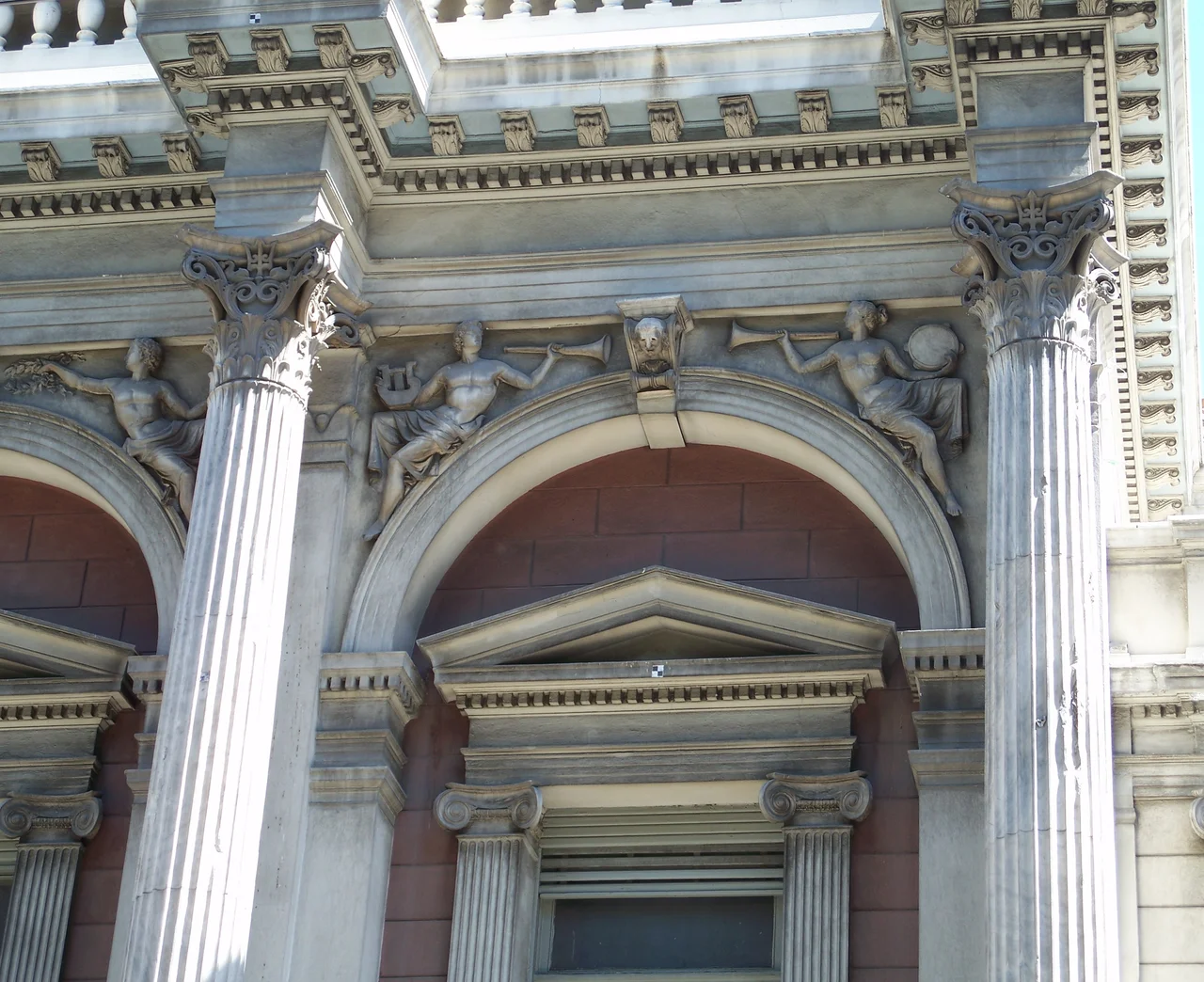

National Theatre of Greece
On the night of November 8, 1903, a riot broke out over a word. Students from the University of Athens, urged on by a classics professor who could not stomach hearing Aeschylus in everyday Greek, marched down Agiou Konstantinou Street to stop a performance. When the dust settled, one person was dead and ten were injured. The theatre at the center of it all was barely two years old. Behind its grand neoclassical facade, the National Theatre of Greece was already discovering that in this country, the stage and the street are never far apart.
A House for the Drama
Modern Greece had wanted a permanent theatre for decades. The Boukoura, dating to 1840, had limped along, standing empty for long stretches, never quite becoming the home that Athens deserved. The answer came in 1880, when King George I and the businessman Efstratios Rallis put up the funds to build something lasting. They handed the commission to Ernst Ziller, the Saxon-born architect whose buildings still define much of Athens' nineteenth-century grandeur. Construction dragged from 1895 into the new century, but in 1900 the doors finally opened on what was then called the Royal Theatre. For the first time, the capital had a stage built to endure.
The Language War on Stage
The Oresteiaka riot was not really about a play. It was about which Greek the nation should speak. The theatre had staged Aeschylus' ancient trilogy in a translation using Demotic, the living, spoken language of ordinary people. To defenders of katharevousa, the formal, archaizing tongue, this felt like sacrilege, a betrayal of the classical heritage itself. Professor Yorgos Mistriotis whipped his students into the streets. The clash that followed turned deadly. It seems almost absurd now that a question of grammar could cost a life, yet in a young nation still deciding what it meant to be Greek, the words on a stage carried the weight of identity.
Decline and Rebirth
Glory did not guarantee survival. The Royal Theatre went bankrupt and closed its building's doors in 1908, and the company drifted through years of decline, occasionally hosting visiting foreign troupes. When King George was assassinated in 1913, the theatre passed to his son, Prince Nicholas, a painter and playwright. Real revival came only in 1930, when an act of parliament signed by education minister Georgios Papandreou re-founded the institution as the National Theatre. It opened its doors to the public in 1932 with Aeschylus' Agamemnon and a company that read like a roll call of Greek stage royalty: Katina Paxinou, Aimilios Veakis, Eleni Papadaki, Alexis Minotis.
Roots That Spread
From this single institution, much of modern Greek performing arts grew outward. A drama school opened alongside the theatre, training generations of actors. In 1939 the Greek National Opera was founded as a branch of the National Theatre before going its own way. And in 1955, the company helped launch the Epidaurus Festival, carrying ancient tragedy back to the very stone amphitheatres for which it was written. Today the National Theatre operates across several stages, including ones named for Marika Kotopouli and Katina Paxinou, while its restored central building on Agiou Konstantinou, fully renovated in 2009, still anchors the company that survived bankruptcy, riots, and a century of Greek upheaval.
From the Air
The National Theatre stands at 37.985°N, 23.725°E in central Athens, just north of Omonoia Square on Agiou Konstantinou Street. The nearest airport is Athens International (LGAV), roughly 33 km to the east-southeast. From the air, the theatre sits within the dense neoclassical grid of central Athens; the Acropolis rises about 1.5 km to the south as the unmistakable visual anchor. Best viewed in the clear, dry light typical of an Attic summer afternoon.
Nearby Stories
- Great Sand Beach 5 km away
- Battle of Delium 7.7 km away
- Tower of Aliartos 9 km away
- HMHS Britannic 10 km away
- Saronic Gulf 15 km away
- Sousaki Volcano 17 km away
- Sanctuary of Apollo Maleatas 24 km away
- Skyros 66 km away