
National Waterways Museum
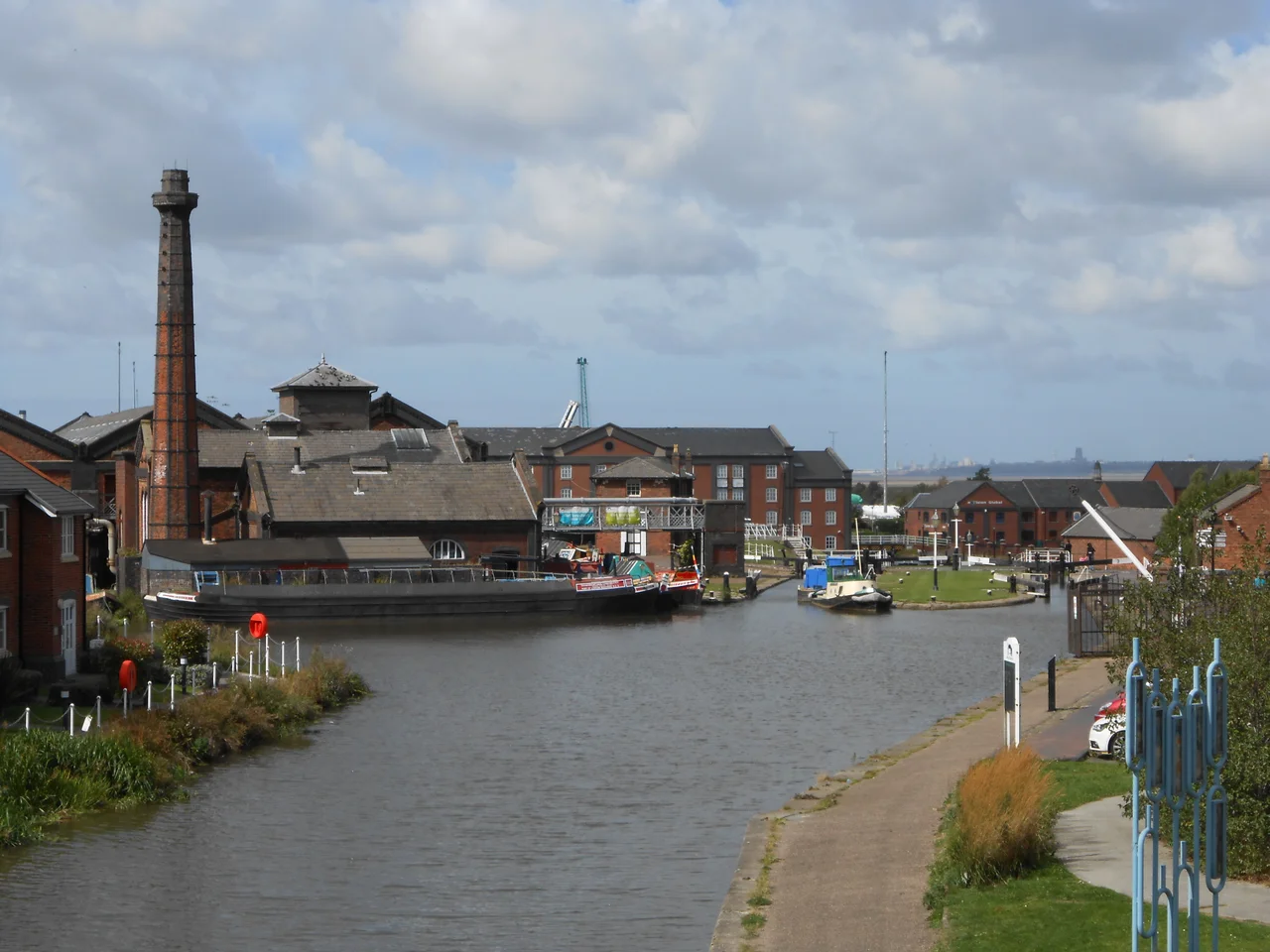
On a damp Cheshire morning, the clang of a blacksmith's hammer comes from the forge at Ellesmere Port and a black-and-red narrowboat rocks gently at the dockside while a volunteer paints roses and castles onto the side of a water can. This is the National Waterways Museum, on the seven-acre site where Thomas Telford -- the great engineer of the British canal age -- designed an inland port to transfer cargo between river craft and narrowboats in 1797. The port lasted into the 1950s. The museum took its place. Today it preserves Britain's largest collection of historic canal craft alongside the locks and warehouses and a terrace of dock workers' cottages furnished to represent each decade between the 1840s and the 1950s. It is, paradoxically, a national museum that has spent much of its life close to bankruptcy. The boats that sink in winter come back up in spring.
Telford's Inland Port
The Ellesmere Canal was one of the great unfinished projects of the British canal age. Conceived in the 1790s to carry goods between the rivers Mersey and Severn, it would have connected the industrial heart of England to two of its largest navigable estuaries — but the engineers ran out of money long before the canal ran out of obstacles. Thomas Telford, working under the supervision of William Jessop, designed the northern terminus of the proposed waterway at a place called Netherpool, where the Mersey met the flat Cheshire shore. The plan was to bring narrowboats down from Chester and the canal network, transfer their cargo to larger river craft inside the port basin, and send the goods down the Mersey to the Liverpool docks. Telford built a contour canal — a ten-mile sinuous waterway that followed the contours of the land to avoid the cost of locks — and linked it to the Chester Canal in 1797. By 1805 the rest of the Ellesmere project had stalled. The southern section was never built. The connection to the famous Pontcysyllte Aqueduct never came. But the port at Netherpool kept working, in a more modest way, for a century and a half.
Locks, Warehouses, and the Power Hall
The Shropshire Union Railways and Canal Company absorbed the orphan stretches of the Ellesmere Canal in 1845, consolidating them with the Chester, Montgomery, Shrewsbury, and Shropshire Canals into a single Shropshire Union Canal. The port at Netherpool kept transferring goods until the 1950s, when commercial canal traffic in Britain effectively ended. The seven-acre site survives largely intact. The locks where narrowboats once dropped from canal level to the Mersey are still here, Grade II listed. The toll house — built in 1805, the year the larger Ellesmere project effectively collapsed — still stands. The Island Warehouse, raised in 1871 to store grain, holds the museum's exhibitions on boat-building and the social history of the canals. The stables, where the horses that pulled narrowboats were rested, remain in their original arrangement. The Power Hall contains the pumps and engines that managed water levels and provided motive power. A blacksmith's forge — the genuine article from the canal era — is now manned by a resident blacksmith making the same ironwork that was made here a hundred and fifty years ago.
Porter's Row and the Living Past
Along one side of the site stands Porter's Row, a terrace of four dock-workers' cottages built to house canal labourers and their families. The museum has furnished each of the four houses to represent a different period: the 1840s when the canal was at its industrial peak, the 1880s when the railways were already taking traffic away, the 1900s when the trade was in slow decline, and the 1950s on the eve of closure. Walking the row is a compressed history of working-class life on the British canals — gaslight giving way to electric light, coal range to gas cooker, washboard to mangle. It is one of the museum's quietest exhibits and one of its strongest. The collection also includes more than seventy historic boats: long narrowboats, butty boats, ice-breakers, maintenance craft. Some are afloat. Some are kept afloat by automatic pumps. Some, on bad funding years, have been displayed half-sunken — the museum's most public symbol of its perpetual financial struggle.
Always Short of Money
Unlike the National Railway Museum at York, which receives direct funding from HM Government, the National Waterways Museum receives public money only through the Canal & River Trust, the charity that took over from British Waterways in 2012. The result has been an institution of national status without national-museum funding. During the winter of 2008-2009, opening hours at Ellesmere Port and the sister site at Gloucester were cut to just two days per week. Some boats were advertised for disposal in the Museums Journal early in 2009 because the trust could not afford to restore them. The waterways press was fierce about this — a designated collection, the body charged with preserving the inland-waterway heritage of the United Kingdom, was watching its boats sink because the money to pump them out had run out. A heritage boatyard project, funded partly by the Heritage Lottery Fund, has slowly turned the situation around. The boatyard now trains young people in the traditional skills of canal-boat construction and repair — riveting, caulking, ironwork — that would otherwise be lost. Two boats, the Ilkeston and the Ferret, are sponsored by the London Canal Museum, which contributes annually to their upkeep. The museum has remained open. It has appeared in three BBC documentaries since 2010, including the start of Robbie Cumming's Canal Boat Diaries in 2020 and Channel 4's Narrow Escapes in 2025. It survives the way the canal age survives: stubbornly, on dedicated volunteers and small grants, doing the work nobody else will.
Where Canal Meets Ship Canal
The museum sits at one of the great junctions of British inland navigation. To the south runs the Shropshire Union Canal, narrow and contour-following, sized for the seven-foot beam of a traditional narrowboat. To the north, immediately beyond the museum's lower locks, lies the Manchester Ship Canal — sixty miles long, opened in 1894, deep enough for sea-going freighters carrying timber to Manchester or grain to Liverpool. To watch a freighter pass on the Ship Canal from the deck of a narrowboat tied up in the museum basin is to see two completely different scales of British engineering side by side. The Mersey lies just beyond the Ship Canal. Across it, the Wirral and Liverpool. The lighthouse at the canal's entrance to the Mersey is Grade II listed, as is the lock keeper's hut. The entire site is a working monument to a vanished industrial logic — when goods moved by water, when a horse and a tow-rope could carry thirty tons of cargo, when the labour of the canals shaped the towns and lives of the Midlands and the North. It is, in 2026, more relevant than at any time since the railways took over: a reminder that there are slower ways to move heavy things, ways that the present age may yet find useful again.
From the Air
Located at 53.288N, 2.892W at Ellesmere Port, Cheshire, on the south bank of the Manchester Ship Canal where the Shropshire Union Canal joins it. The seven-acre site appears as a tight rectangle of historic buildings and waterways immediately south of the Ship Canal. The Mersey estuary is visible 1nm north. Nearest airport: Hawarden (EGNR) approximately 8nm west, Liverpool John Lennon (EGGP) approximately 11nm northeast across the Mersey. Best viewed from 1,500-3,000ft.
Nearby Stories
- RAF Wrexham 3.3 km away
- Birkdale Palace Hotel 3.7 km away
- Turton Tower 4.1 km away
- Tatton Park 5.6 km away
- Abergele Rail Disaster 9.6 km away
- Diglake Colliery Disaster 13 km away
- Ysbyty Ifan 16 km away
- Celtic Array 62 km away