
National Zoological Park (United States)
In 1889, the American bison was on the brink of extinction. Tens of millions of animals had been reduced to fewer than a thousand by industrial-scale hunting through the late nineteenth century. Smithsonian conservationist William Temple Hornaday, who had spent the previous decade campaigning for bison preservation, helped persuade Congress that the United States needed a national zoo - not as a menagerie of exotic curiosities, but as a refuge for the country's own rapidly disappearing wildlife. The National Zoo, chartered by act of Congress on March 2, 1889, opened with bison and beavers among its first inhabitants. Hornaday was the first director. Samuel Langley, the third Secretary of the Smithsonian, helped plan the institution. Frederick Law Olmsted, the most influential landscape architect of the nineteenth century, designed the layout. The 163-acre property along Rock Creek in Northwest Washington still carries the contours Olmsted drew. The zoo's free admission still draws around two million visitors a year. And the surviving descendants of those original bison live in herds across the West and on protected federal lands - thanks in significant part to what Hornaday and the zoo helped start.
Olmsted's Curves
Olmsted shaped the zoo's layout around the existing topography of Rock Creek - the deep ravine that bisects the property, the gentler ridges above it, the wooded stretches along the creek banks. He designed the walking paths to follow the contours of the land rather than imposing geometric grids over them, the same philosophy he had applied at Central Park in New York and Prospect Park in Brooklyn. The original zoo opened to the public with 185 animals collected from various sources - donations from collectors, transfers from circus retirees, gifts from foreign governments. William Temple Hornaday, who had been head of the Smithsonian's vertebrate division and was the country's most prominent bison advocate, served as the first director. His tenure was brief - he resigned within months over disagreements with the Smithsonian over policy and budget. Anthropologist Frank Baker actually managed the zoo through its first several decades, navigating its budget difficulties and its varied institutional partnerships.
Coolidge's Pets
Through the early twentieth century, the zoo's collection grew through a haphazard mix of presidential gifts and donations. Calvin Coolidge and First Lady Grace Coolidge accumulated a famously varied collection of exotic pets, several of which ended up at the National Zoo. The Coolidges' raccoon, Rebecca, was sometimes brought to the White House for state events; she eventually moved to the zoo. Other Coolidge animals included a pygmy hippopotamus, a wallaby, a black bear named Tiny Tim, and a lion cub. The 1899 acquisition of a bighorn sheep captured by Kansas frontiersman Charles Buffalo Jones became part of the zoo's early collecting story. The institution was funded through a peculiar arrangement: its budget was divided between Smithsonian appropriations and District of Columbia appropriations, an arrangement that made long-term planning impossible. In 1958, the Friends of the National Zoo persuaded Congress to fund the zoo entirely through the Smithsonian. The institution's first full-time veterinarian had been hired only a few years earlier.
Mei Xiang's Cubs
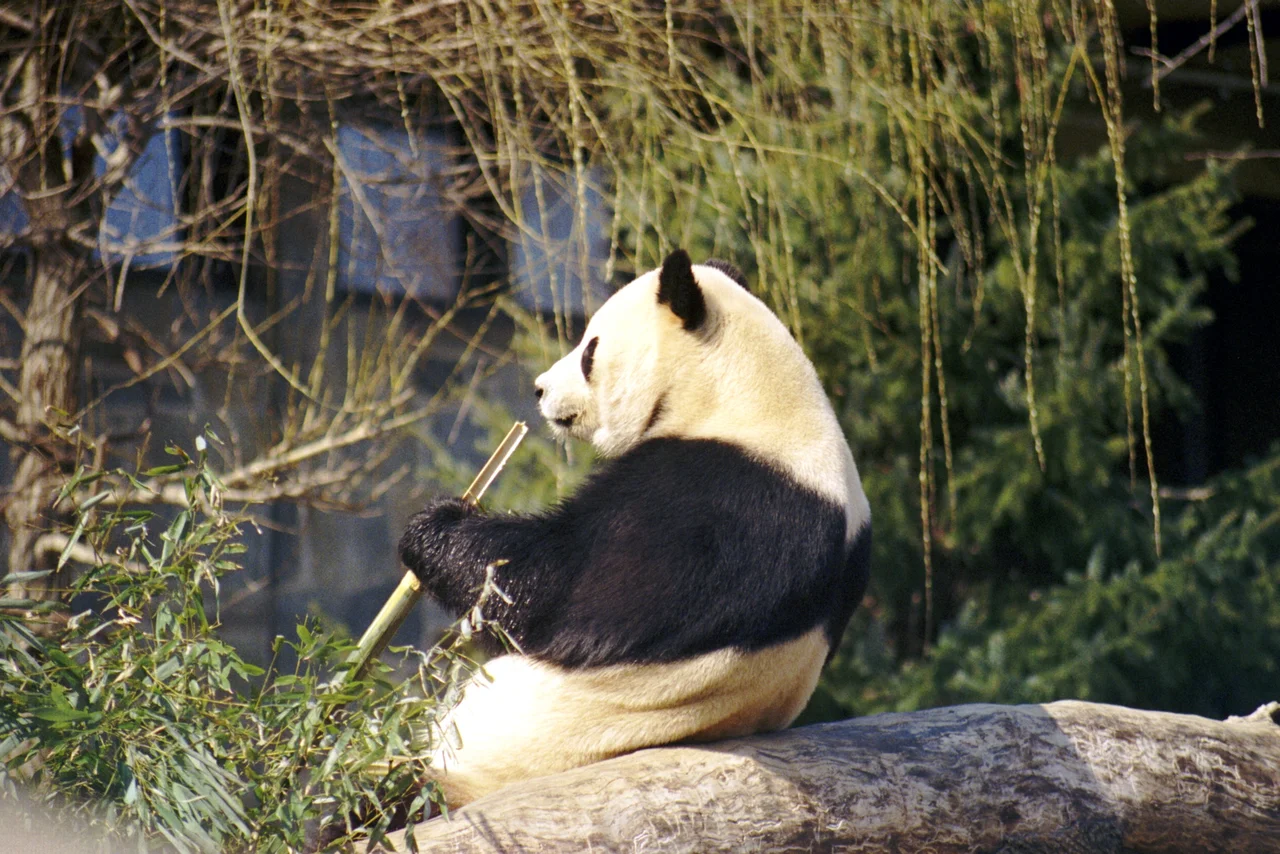
Giant pandas first arrived at the National Zoo on April 16, 1972 - Ling-Ling and Hsing-Hsing, gifts from China following President Nixon's diplomatic opening. The pandas became among the zoo's most popular attractions for the next thirty years. Hsing-Hsing died in 1999. Ling-Ling had died in 1992. Tian Tian and Mei Xiang arrived in December 2000 on loan from the China Wildlife Conservation Association. Their first surviving cub - Tai Shan, born July 9, 2005 - was conceived through artificial insemination after natural mating attempts failed. Tai Shan returned to China in 2010. Mei Xiang produced additional cubs: Bao Bao, born August 23, 2013; Bei Bei, born August 22, 2015; and Xiao Qi Ji, born August 21, 2020 - when Mei Xiang was 22 years old, making her the oldest giant panda to give birth in the United States. The pandas returned to China in 2023. New pandas - Bao Li and Qing Bao - arrived in late 2024 under a renewed lending agreement. The David M. Rubenstein Giant Panda Habitat, which has held the pandas since its 2006 opening, features three outdoor enclosures and an indoor area with a rocky outcrop and waterfall.
Elephant Trails
In spring 2008, the zoo began construction on Elephant Trails - a $52 million project to dramatically expand the Asian elephant habitat. The first phase opened in September 2010. The completed facility, finished in 2013, encompasses two acres of outdoor space with two yards (one with a pool), a quarter-mile woodland trail, a 5,700-square-foot barn, and indoor viewing areas. The exhibit currently houses six Asian elephants: a bull named Spike and five cows - Bozie, Swarna, Maharani, Trong Nhi, and Nhi Linh. The Asia Trail, opened in October 2006, presents Asian wildlife in addition to the pandas - sloth bears, fishing cats, red pandas, northern snakeheads, clouded leopards, and Asian small-clawed otters. Many of the species on the Asia Trail are endangered in their native habitats. The Amazonia Rainforest exhibit, opened in 1992, presents a tropical Amazonian ecosystem under glass.
The Conservation Campus
Beyond the Rock Creek campus, the National Zoo operates the Smithsonian Conservation Biology Institute on 3,200 acres outside Front Royal, Virginia. The SCBI - formerly known as the Conservation and Research Center - is not open to the public. It houses between 30 and 40 endangered species at any given time for breeding, behavioral research, and assisted reproduction work. The institute trains wildlife professionals in conservation biology and supports the propagation of rare species. The Front Royal grounds support 180 species of trees, 850 species of woody shrubs and herbaceous plants, 40 species of grasses, and 36 species of bamboo - the bamboo crop providing forage for the zoo's pandas. The combined facilities host approximately 2,700 animals across 390 species, about one-fifth of which are endangered or threatened in the wild. Brandie Smith was appointed director in November 2021 - only the second woman to hold the position in the zoo's 132-year history. The National Zoological Park Police, established in 1889 as one of the original five police agencies in the District, still patrols both campuses. Admission, by long-standing tradition, remains free.
From the Air
The National Zoological Park sits at approximately 38.9296 N, 77.0497 W, in Rock Creek Park in the Woodley Park neighborhood of Northwest Washington. Best viewed from 1,500 to 3,000 feet AGL. The 163-acre site follows the curving topography of Rock Creek with wooded ravines, the panda habitat near the Connecticut Avenue entrance, and the Elephant Trails complex below. The Washington Cathedral lies a half mile west. Reagan National (KDCA) sits four nautical miles south. The site is inside the Washington Flight Restricted Zone; GA overflight prohibited. The Smithsonian Conservation Biology Institute is at Front Royal, Virginia - 69 miles west of Washington, near KFRR (Front Royal-Warren County Airport).
Nearby Stories
- Gunston Hall 1.1 km away
- 2023 Baltimore Shooting 4.9 km away
- Battle of Middleburg 6.6 km away
- Crownsville Hospital Center 10 km away
- Battle of Loudoun Heights 13 km away
- First Battle of Rappahannock Station 20 km away
- Howard County, Maryland 21 km away
- Harriet Tubman Underground Railroad 50 km away