
Nemea
Inside the vaulted tunnel that leads to the Nemean stadium, carved into the stone walls, are the names of athletes who competed here more than two thousand years ago. The name 'Telestas' — a known ancient victor — is among them. The tunnel itself dates to around 320 BC, built to carry competitors from the preparation room to the track in a procession that must have felt theatrical, emerging from shadow into the open air of the valley. Today, during the revived Nemean Games held every four years, people walk through that same tunnel before running barefoot on the ancient track. The graffiti is still there.
The Lion and the Infant
Nemea carries two origin myths, and they sit uneasily beside each other. In one, Heracles came to this valley to kill the Nemean Lion — a creature whose hide was impervious to weapons — as the first of his twelve labors. In the other, the Nemean Games were founded not to celebrate Heracles but to mourn an infant named Opheltes, who was killed by a serpent while his nurse briefly set him on the ground.
The infant's story won out in the ritual record. The judges at the Nemean Games wore black robes in mourning. Victors received crowns of wild celery — the plant on which Opheltes lay when the serpent found him — rather than the olive or laurel of other games. The grave of Opheltes, known after his death as Archemorus, 'Forerunner of Death,' was enclosed within a stone wall at the sanctuary's sacred precinct. Ancient sources document the games from 573 BC, held every two years at the sanctuary of Zeus here in the valley.
Three Columns Still Standing
The Temple of Zeus at Nemea dates to approximately 330 BC, built on the foundations of an earlier Archaic-period temple that was destroyed by fire. It used all three classical architectural orders simultaneously: Doric columns on the exterior, Corinthian columns for the inner colonnade, Ionic for the second story — an ambitious synthesis that places it at the cusp between Classical and Hellenistic design. Archaeologists note that the Doric columns are unusually slender, with a height of 6.34 column diameters, foreshadowing the more attenuated proportions of the Hellenistic era.
Of the original 32 columns around the temple's perimeter, only three remain standing. Six others have been re-erected by excavators to help visitors grasp the building's scale. The limestone temple had no sculpted decoration on its exterior — its appeal was structural, the precision of its proportions rather than the richness of its ornament. It stands in a valley that is greener than the surrounding limestone hills, watered by the Nemea river, the columns visible for some distance across the flat ground.
Through the Tunnel
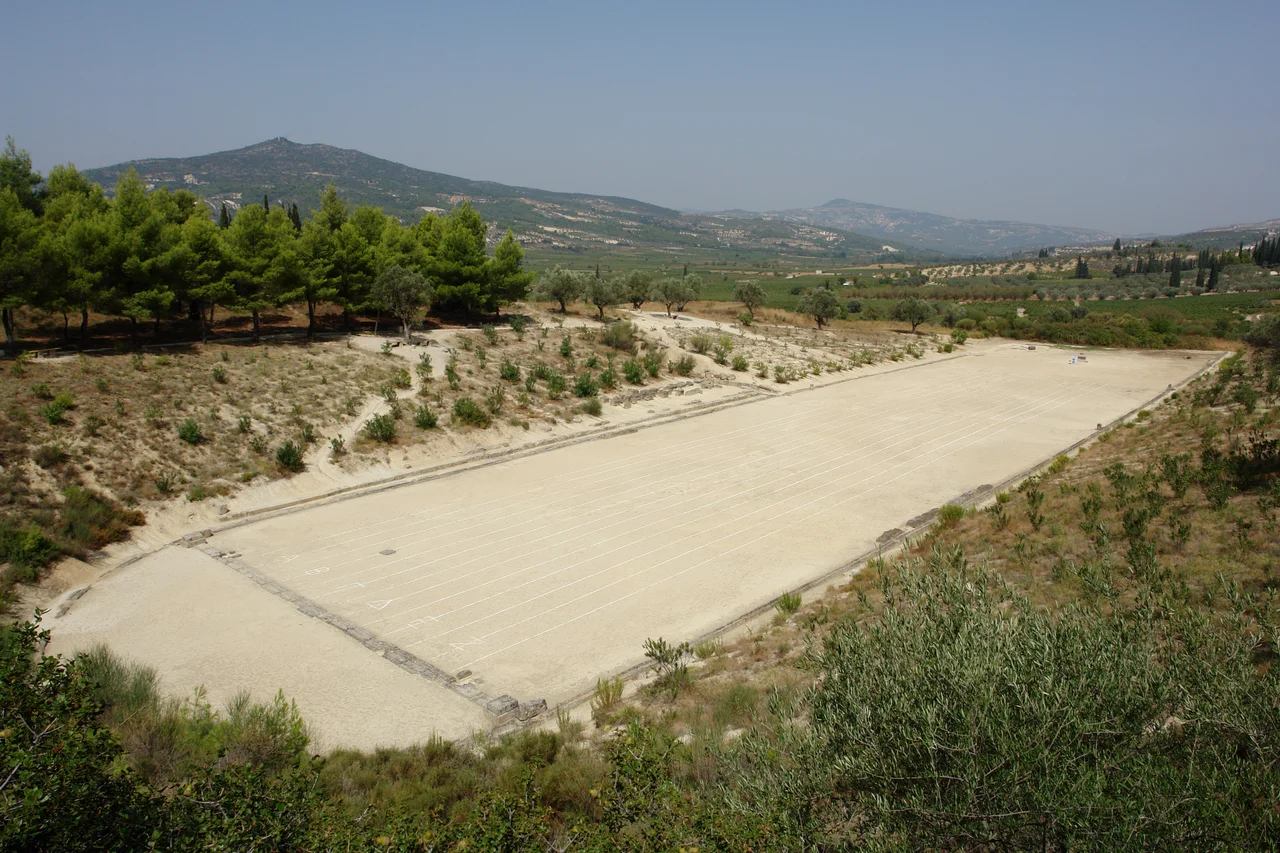
The Nemean stadium was excavated between 1974 and 1981. Its natural setting is inherently theatrical: two ridges extending north from Evangelistria Hill created a natural bowl, and the ancient builders leveled and banked the earth to form a track originally 600 feet long. The preparation room — the apodyterion — still exists, its roof tiles stamped with the name of the architect, Sosikles. Athletes stripped here and rubbed their bodies with olive oil before competition.
The tunnel linking the preparation room to the track is 36 meters long and vaulted, a sophisticated piece of engineering. It was this passage that athletes walked through to enter the stadium, and it is lined with the names they scratched into the stone — names of competitors, perhaps wishes, perhaps records of victory. A sacred truce suspended all wars during the games, allowing athletes and spectators from across the Greek world to gather here safely. Every two years, the track was dug up, leveled, and re-packed to keep it below the water channels on either side.
Where Sparta Had Its Last Good Day
In 394 BC, a large battle was fought along the Nemea river. The forces of Sparta and her Peloponnesian allies faced a coalition of Boeotians, Euboeans, Athenians, Corinthians, and Argives. It was the kind of engagement that decided regional dominance in classical Greece — thousands of armored men, arrayed in tight formations, pushing against each other across level ground.
The Spartans won, exploiting a rightward drift that exposed the Athenians on the coalition's left. It was, historians have noted, the last clear-cut military victory Sparta ever achieved. The battle's association with Nemea is incidental — the sanctuary and games were not the reason armies gathered here, only the geography was — but it ties the valley to one of the pivotal moments in the decline of Spartan power.
The Ongoing Excavation
Annual excavations at Nemea have continued since 1974, led by the University of California. The work has uncovered the great open-air altar, ancient baths, and accommodations for visitors — infrastructure for the thousands of people who attended the games. In 2018, archaeologists discovered a large intact tomb dating to the early Mycenaean era, between 1650 and 1400 BC, pushing the human story at Nemea further back still.
The finds are displayed in the on-site Archaeological Museum, which the University of California built and handed to the Greek state in 1984. Outside the museum, the three standing columns of the Temple of Zeus mark the valley's skyline. The tunnel waits below, cool and dim, its ancient names still legible on the walls. The revived Nemean Games have been held here periodically since 1996, bringing runners — some of them traveling specifically for this — to strip off their shoes and race barefoot as the ancient athletes did, through the summer heat, across the leveled ground of the valley where the lion was killed and the infant was mourned.
From the Air
Nemea is located at approximately 37.809°N, 22.710°E in the northeastern Peloponnese, in a well-watered valley surrounded by limestone hills. The three standing columns of the Temple of Zeus are the primary visual landmark from the air. Approach from the northeast at 4,000–6,000 feet to see the valley and stadium site. The nearest major airport is Athens International Eleftherios Venizelos (LGAV), approximately 80 km northeast. The village of Archaia Nemea lies immediately southwest of the archaeological site; the modern town of Nemea is further west. The valley is noticeably greener than the surrounding terrain.
Nearby Stories
- Aigosthena 2.2 km away
- Kefalari (Argolis) 2.4 km away
- Cleitor 4.2 km away
- Helike 8.7 km away
- Stemnitsa 9.1 km away
- Methana Volcano 12 km away
- Megara 18 km away
- 1981 Gulf of Corinth Earthquakes 24 km away