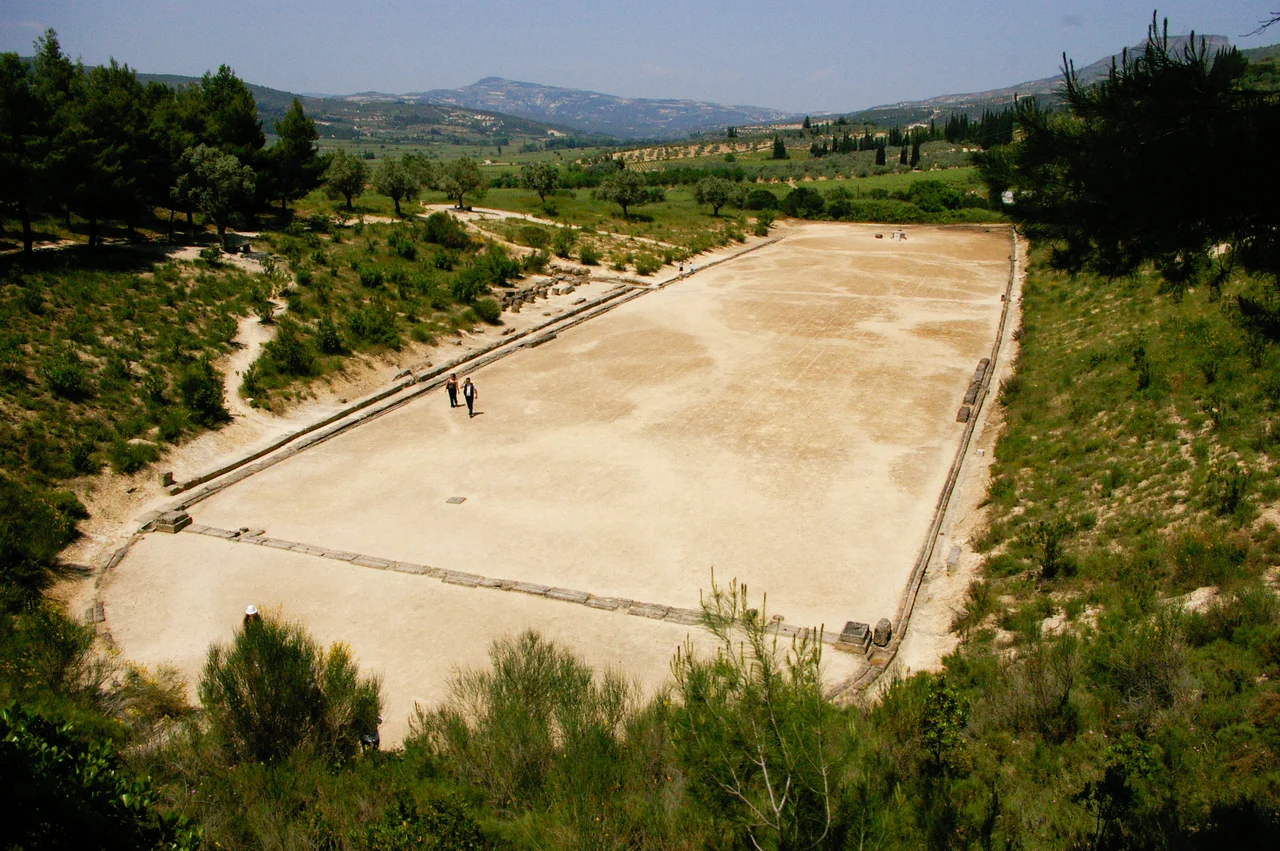

Nemean Games
A child died in a meadow, and the games were born. That is one origin story for the Nemean Games — one of the four great Panhellenic festivals of ancient Greece, held in the valley of Nemea in honour of Zeus. The legend says that the Seven against Thebes, marching through the region and desperately thirsty, met a nurse named Hypsipyle carrying the infant Opheltes, son of Zeus's priest. She set the child down in the grass to show the warriors the way to a well. By the time she returned, a serpent had killed him. The heroes slew the serpent, buried the boy — renamed Archemorus, meaning 'forerunner of death' — and instituted funeral games in his memory. Whether or not you believe the myth, the ceremony it inspired lasted a thousand years.
Born from Grief, Sanctified by Zeus
The earliest historical record of the Nemean Games places their revival at 573 BC, from which time the ancient chronicler Eusebius dates the first Nemead. But the festival almost certainly predates this, rooted in an older tradition of sacred contest. Like the Olympic Games at Olympia and the Pythian Games at Delphi, the Nemean Games were celebrated in honour of Zeus — the supreme deity whose sanctuary at Nemea became the festival's spiritual heart. The games were slotted into the Olympiad cycle, held both the year before and the year after the Olympics, which meant Greeks who followed the full circuit of Panhellenic competition were almost never far from a festival. Pindar, who immortalised athletic victory in verse, wrote odes for Nemean victors. The judges who presided over the competitions wore black robes — a reminder that these games, unlike others, began as funeral rites. The winners received no gold, no silver. They were crowned with a wreath of wild celery, cut from the fields around Nemea.
What They Competed In
The programme was vast and physically brutal. Male competitors in the gymnastic events — running, wrestling, boxing, pankration — competed in the nude, as was the Greek custom. The foot races ranged from the stadion (178 metres at Nemea) to the dolichos, a long-distance run that might have been 24 laps of the track. The hoplitodromos was the most visually striking: men in helmets and carrying a bronze-covered shield sprinted twice the length of the stadium, armour clanking with every stride. The pankration was the most savage — a blend of boxing and wrestling with almost no rules, ending only when one man was knocked out or submitted. The pentathlon combined the stadion, wrestling, javelin, discus, and long jump. The equestrian events were the only contests where women could participate — not as riders, but as owners. Because victory was attributed to the horse's owner rather than the charioteer, wealthy women and even entire city-states could enter by funding a team. No ancient hippodrome from Nemea has been found, so the race distances remain estimates.
Politics and the Prize
The festival was not immune to politics. Its location shifted over the centuries among Nemea, Cleonae, Argos, and Corinth, depending on which power was dominant in the region. In 208 BC, Philip of Macedonia was honoured by the Argives with the presidency of the games — a diplomatic gesture as meaningful as any military alliance. In 194 BC, the Roman general Titus Quinctius Flamininus used the Nemean Games to proclaim the freedom of the Argives from Macedonian control, turning a religious festival into a stage for Roman foreign policy. The emperor Hadrian later restored the boys' horse-racing, which had fallen into disuse — a small act of antiquarian interest from a ruler who loved Greek culture. After Hadrian's time, the sources go quiet. The games seem to have faded, squeezed out by the growing dominance of Rome and the slow erosion of the old Panhellenic world. The Hellenistic stadium — with its vaulted entrance tunnel, dated to around 320 BC — was eventually buried and forgotten.
Barefoot on Ancient Stone
The Society for the Revival of the Nemean Games was founded in 1994, after more than twenty years of archaeological excavation at the site under Stephen G. Miller of the University of California, Berkeley. The contemporary games, held every four years since 1996, are deliberately modest. No medals are awarded — only crowns of palm branches and wild celery, just as in antiquity. Races are organised by age and gender, open to international participants. In 2008, some 600 people dressed in tunics raced barefoot through the ruins of the ancient stadium on 21 June, running either 100 metres or 7.5 kilometres. The most resonant event was the revival of the hoplitodromos — participants in replica armour passing through the tunnel entrance intact, its stone threshold worn smooth by two millennia of waiting feet. The last Nemead was held on 11 and 12 June 2016. Standing in that valley, with the Temple of Zeus on one side and the pale limestone hills on the other, the distance between past and present collapses in a way that no museum case can replicate.
From the Air
The Nemean Games site lies at approximately 37.81°N, 22.71°E in the valley of Nemea, in the northeastern Peloponnese. From the air, the site is tucked into a shallow upland basin surrounded by gentle ridgelines, with the Temple of Zeus visible as a cluster of pale columns among olive groves. The nearest major airport is Athens International (LGAV / Eleftherios Venizelos), approximately 90 km to the northeast. Approach from the east reveals the broader Argolid plain before the terrain rises toward the Nemean valley. Recommended viewing altitude: 2,000–4,000 feet AGL for a good sense of the valley's enclosed geography and the surrounding agricultural landscape.
Nearby Stories
- Aigosthena 2.2 km away
- Kefalari (Argolis) 2.4 km away
- Cleitor 4.2 km away
- Helike 8.7 km away
- Stemnitsa 9.1 km away
- Methana Volcano 12 km away
- Megara 18 km away
- 1981 Gulf of Corinth Earthquakes 24 km away