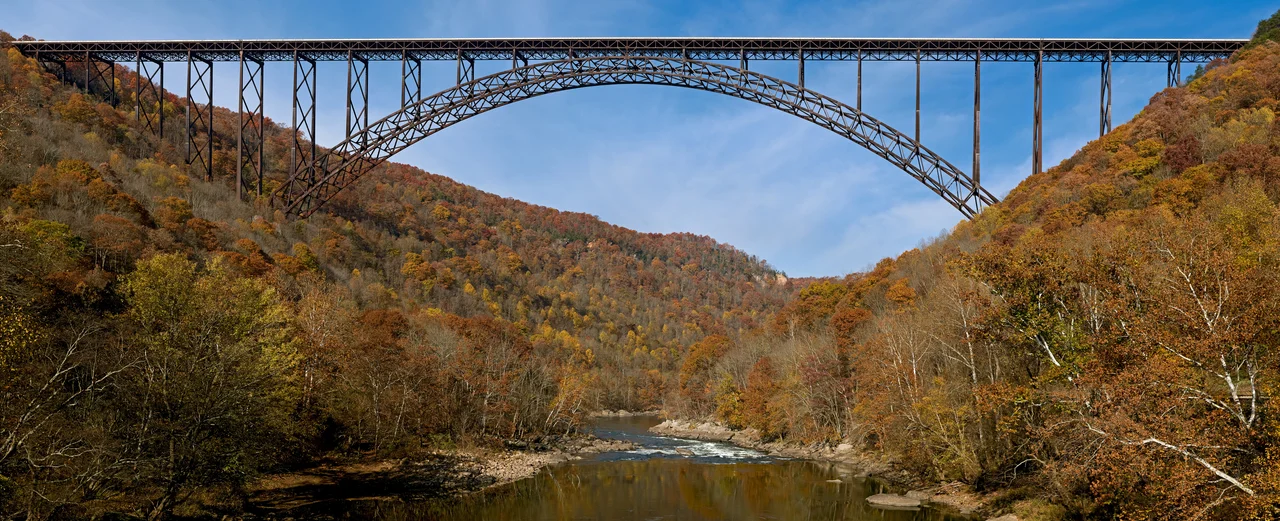

New River Gorge Bridge
Before the bridge opened on October 22, 1977, getting across the New River Gorge by road meant winding down 800 feet of switchbacks to a small bridge at the river, then climbing 800 feet of switchbacks back up the other side. The trip took 45 minutes. When the New River Gorge Bridge opened, the same crossing took 45 seconds. The change was so abrupt that locals still describe it as the day West Virginia got bigger. The bridge that did it is 3,030 feet long with a steel arch spanning 1,700 feet. The roadway sits 876 feet above the river - third-highest bridge in the United States. For 26 years it held the world record for the longest single-span arch bridge. It is now seventh, the longest outside of China, and unambiguously the most iconic engineering structure in West Virginia.
Corridor L
The bridge exists because of a federal program. In the 1960s, the Appalachian Regional Commission was established to attack the region's chronic poverty by building modern infrastructure. One product of the commission's work was the Appalachian Development Highway System, a network of roads connecting Appalachia to the interstate grid. Corridor L was the West Virginia portion: a new four-lane US Route 19 running from Charleston south to Beckley. The hardest problem in the corridor was the New River Gorge itself. State and federal engineers ultimately chose a steel arch design - the proven approach for spanning a wide canyon at speed - and the West Virginia Department of Highways began construction in 1974. The federal government covered 70 percent of the cost. At the time, it was the largest project the West Virginia Department of Highways had ever undertaken.
Building the Arch
Steel arch bridges go up in halves. Construction crews erected cable towers at either end of the gorge and ran a network of high cables across the canyon. The half-arches were built outward from each rim, supported by the cables, until the two halves met at the center high above the river. The work was dangerous. One construction worker was killed when a cable tower collapsed; others were seriously injured. When the two arch halves finally joined - precisely centered, perfectly aligned - the bridge could be completed. The roadway was added on top, the approaches paved, and on October 22, 1977, the New River Gorge Bridge opened to traffic. About 16,200 vehicles cross it each day, traveling at highway speed above a forest that once felt impossibly remote. The travel time across the gorge dropped from 45 minutes to 45 seconds.
An Icon and Its Costs
The bridge has become the visual signature of West Virginia. The U.S. Mint chose it for the reverse of the state's quarter, released in 2005. It appears on tourism advertising, in the video game Fallout 76, in the 2002 film Steal, and on countless postcards. On August 14, 2013, while still well short of the usual 50-year threshold, it was listed on the National Register of Historic Places for its exceptional engineering significance. Every third Saturday of October, it hosts Bridge Day, when the four lanes are closed to cars and reopened to about 100,000 pedestrians and several hundred BASE jumpers. The first BASE jump from the bridge was on August 17, 1979, by Burton Ervin, a coal mine foreman from Cowen, using a conventional parachute. Four BASE jumpers have died at the bridge over the years, three of them during Bridge Day. The bridge has also attracted suicide jumpers, drawn by the height and the lack of barriers - a sober dimension of its iconography that local communities continue to grapple with.
The Gorge Beneath
While the bridge was being designed, there was a parallel argument about what should happen to the gorge it spanned. Some local boosters wanted big resorts and intensive development to follow the new highway. Environmentalists fought back, and on November 10, 1978, just a year after the bridge opened, Congress designated the gorge as the New River Gorge National River, protecting most of the canyon from major construction. In December 2020, the area was redesignated as New River Gorge National Park and Preserve - the country's 63rd national park. The bridge is now both the front gate and a feature of one of the most photographed protected landscapes in the eastern United States. Stand at the Canyon Rim Visitors' Center boardwalk on a fall morning, looking south at the 1,700-foot arch holding the highway above the green canyon, and the engineering and the wilderness make a single argument together.
From the Air
The New River Gorge Bridge sits at 38.07 N, 81.08 W, carrying US Route 19 across the gorge in northern Fayette County, West Virginia. Recommended viewing altitude is 2,500 to 4,500 feet AGL; the bridge deck itself is at 876 feet above the river. Note that airspace over the bridge during Bridge Day (third Saturday in October) is heavily restricted; check NOTAMs. The Canyon Rim Visitors' Center is at the north end of the bridge. Nearest airports are Raleigh County Memorial (KBKW) in Beckley about 15 miles south and Yeager (KCRW) in Charleston about 40 miles northwest. Best views are from the south approach at dawn.
Nearby Stories
- West Virginia State Capitol 4.7 km away
- Greenbrier County, West Virginia 13 km away
- Beckley, West Virginia 13 km away
- Clay, West Virginia 16 km away
- The Greenbrier 18 km away
- Webster Sycamore 26 km away
- Kanawha State Forest 26 km away
- Welch, West Virginia 40 km away