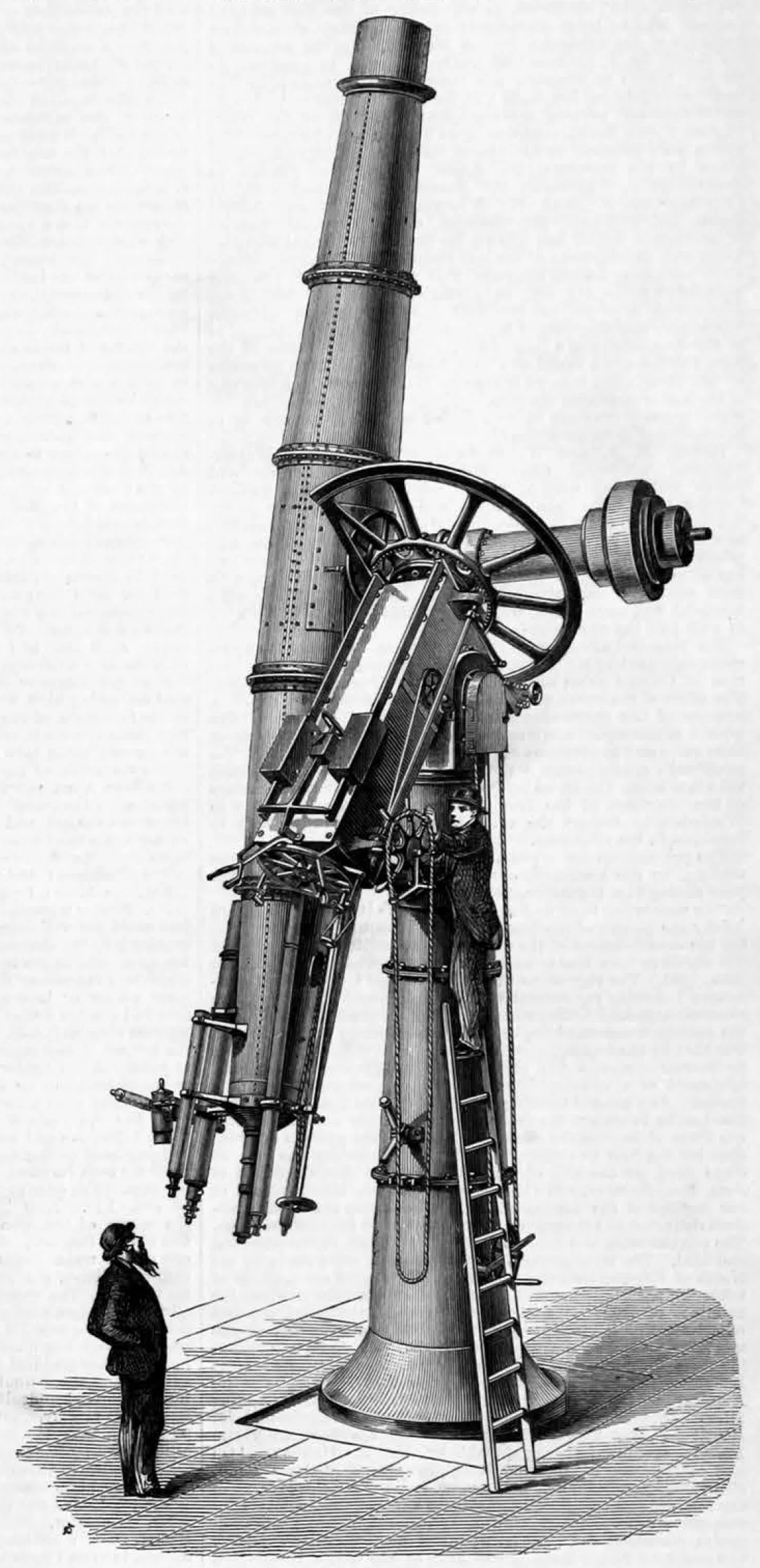
.jpg)
Newall Telescope
It began with two slabs of glass and an act of faith. In 1862, a Scottish cable engineer named Robert Stirling Newall paid 500 pounds apiece for two enormous crown and flint glass crystals from the Chance works in Birmingham, then handed them to the instrument maker Thomas Cooke with a single instruction: build the largest telescope in the world. Cooke promised it inside a year. It took six. He died one year before it was finished. But in 1869, the Newall Telescope was completed, and for a brief moment its 62.5-centimeter lens made it the greatest refractor on the planet.
A Giant in the Wrong Place
The triumph was almost comic in its bad luck. Newall installed the instrument at Ferndene, his home in Gateshead, in the industrial northeast of England, a place of coal smoke, gloom, and skies that rarely cleared. A telescope built to pierce the heavens spent its early life squinting through soot. Within four years, Alvan Clark's 26-inch refractor for the United States Naval Observatory stole the title of world's largest. Newall, hampered by light pollution and weather, made almost no significant observations. His one noteworthy achievement was a set of meticulous drawings of Comet Coggia in 1874, a flicker of brilliance from an instrument that deserved far darker skies.
The Long Journey South
After Newall's lifetime the telescope moved to the Cambridge Observatory in 1891, where it served for decades. Then, in 1959, it embarked on the strangest leg of its journey. The National Observatory of Athens accepted the donation of the great Victorian refractor and shipped it to Greece. There was a logic to the choice beyond simple generosity: the observatory's central premises at Thiseio sat in the brightening heart of Athens, useless for serious astronomy. The Newall would become the largest telescope in Greece, and it needed dark skies the capital could no longer offer.
Marble and Machinery
Its new home rose on the Koufos hill at Penteli, about 18 kilometers from central Athens, at an altitude of 500 meters. The dedicated building, begun in 1957, was raised from Pentelic marble, the same luminous stone the ancient Athenians quarried from this very mountain to build the Parthenon. Beneath a dome 14 meters across, the telescope is a monster of Victorian engineering: nine meters long, weighing 16,000 kilograms, mounted on a German equatorial frame. The whole observatory floor can rise and fall nearly five meters to meet the eyepiece. Astronomers had been watching the heavens from this hilltop since Stavros Plakidis set up shop here in 1936.
A Teacher, Not a Researcher
Even Penteli could not stay dark forever. By 1980, the relentless spread of Athens and its lights ended the telescope's career as a research instrument, the same fate that had dogged it in smoky Gateshead more than a century before. Yet the Newall Telescope did not fall silent. It remains operational, turned now toward education, letting visitors and students press an eye to a lens that was the finest in the world when Victoria ruled and Cooke's workshop labored over two precious slabs of glass. The giant that never found its sky finally found a purpose: showing the heavens to anyone willing to climb the marble hill.
From the Air
The Newall Telescope is housed at the Penteli Observatory at 38.048°N, 23.864°E, atop the Koufos hill at roughly 500 m elevation on Mount Penteli, about 18 km northeast of central Athens. The nearest airport is Athens International (LGAV), some 20 km to the southeast. From the air, the white marble dome stands out against the wooded slopes of Penteli; the city sprawl of Athens fills the basin to the southwest, with the Acropolis visible on clear days. Mountain haze and occasional fire-season smoke can reduce visibility in late summer.
Nearby Stories
- Great Sand Beach 5 km away
- Battle of Delium 7.7 km away
- Tower of Aliartos 9 km away
- HMHS Britannic 10 km away
- Saronic Gulf 15 km away
- Sousaki Volcano 17 km away
- Sanctuary of Apollo Maleatas 24 km away
- Skyros 66 km away