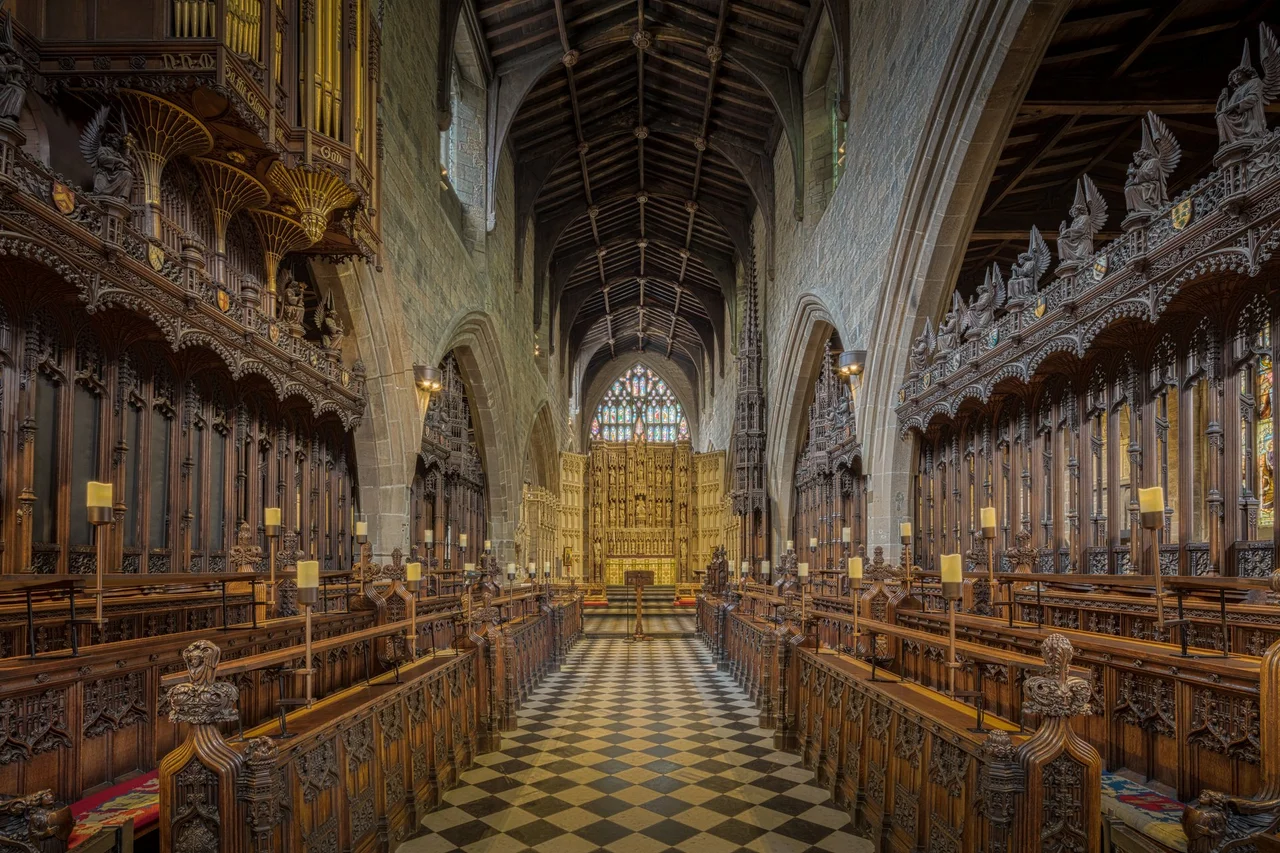

Newcastle Cathedral
In 1644 the Scottish army threatened to bomb the tower. The cathedral's lantern spire, built in 1448, was the prize: knock it down and Newcastle would lose both a landmark and a piece of its pride. The mayor, Sir John Marley, did something cold and clever. He had Scottish prisoners hauled up inside the lantern and made it clear they would be the first to die. The cannons stayed quiet. The spire still stands, still tilted slightly because the stone settled in the 1860s and the wooden font cover hangs a few degrees off true to this day.
The Lantern on the Tyne
The cathedral is dedicated to St Nicholas, patron saint of sailors. From its position on the northern heights above the River Tyne the dedication makes geographic sense. The church was founded in 1091 alongside the Norman castle that gave the city its name; that castle stood on the site of the Roman fort of Pons Aelius at the foot of Hadrian's Wall, which probably ran through what is now the churchyard. The Norman church burned in 1216 and was rebuilt by 1350 in the Perpendicular style of the 14th century. The lantern spire that came a century later is what made this church essential to the river. At its base the tower measures 36 by 35 feet, and the steeple rises 194 feet from the ground. For hundreds of years its silhouette was a main navigation point for ships entering the Tyne. On each corner of the lantern stand gilded statues of Adam eating the apple, Eve holding it out, Aaron dressed as a bishop, and David with his harp.
Collingwood and the Turbinia
A marble monument inside commemorates Admiral Lord Collingwood, born just south of the cathedral in a house in The Side in 1748. He was baptised and married in St Nicholas's. On 21 October 1805 at the Battle of Trafalgar, he took command of the British fleet after Nelson was shot. Each year on that date a wreath is laid at the monument, though Collingwood's body lies near Nelson's in St Paul's Cathedral in London. The cathedral's stained glass tells the story of an industrial city that knew its own importance. The Charles Parsons window depicts Turbinia, the first turbine-driven steam yacht. In 1897 Parsons used Turbinia to crash uninvited through the Spithead naval review, outrunning every ship the Royal Navy sent after it, and persuaded the Admiralty by sheer audacity that turbines would change naval warfare. Sixteen further windows commemorate battalions of the Northumberland Fusiliers, including the Tyneside Scottish and Tyneside Irish.
From Parish Church to Cathedral
For most of its life this was a parish church. The most famous person to serve it was the Scottish reformer John Knox, who was minister here from late 1550 until February 1553. In the mid-19th century Newcastle's population exploded, twenty new churches were built in the suburbs, and the case for a separate diocese became unanswerable. In 1882 the Diocese of Newcastle was carved out of Durham, and St Nicholas's became its cathedral. The diocese it now serves is the most northerly in the Anglican Church in England, stretching from the Tyne all the way to Berwick-upon-Tweed in the north and Alston in Cumbria to the west. The cathedral closed during the COVID-19 pandemic and reopened in August 2021 after the Common Ground in Sacred Space project removed the Victorian pews, installed underfloor heating, and re-laid up to 130 ledger gravestones from the floor.
Flight Context
Coordinates 54.97 N, 1.61 W in central Newcastle upon Tyne, just north of the castle keep and the Tyne Bridge. Recommended viewing altitude 1,500 to 3,000 feet. The lantern spire is the visual signature: an octagonal stone crown carried on flying buttresses above a square tower, unique among English cathedrals. The River Tyne runs east-west immediately south. Nearest ICAO airport Newcastle International (EGNT) is 4 nautical miles north-west. Durham Tees Valley (EGNV) is 24 nautical miles south.
From the Air
Coordinates 54.97 N, 1.61 W in central Newcastle just north of the castle keep and Tyne Bridge. Viewing altitude 1,500 to 3,000 feet AGL. Nearest ICAO airport Newcastle International (EGNT) is 4 nautical miles north-west; Durham Tees Valley (EGNV) is 24 nautical miles south. Distinctive lantern spire on a square tower is the visual signature.
Nearby Stories
- Cresswell Lifeboat Station 5.2 km away
- Auckland Castle 5.7 km away
- Battle of Otterburn 7.1 km away
- Saltburn Pier 11 km away
- Hadrian's Wall Path 11 km away
- Battle of Stainmore 18 km away
- Saltburn-by-the-Sea 39 km away
- Alexander L. Kielland (Platform) 296 km away