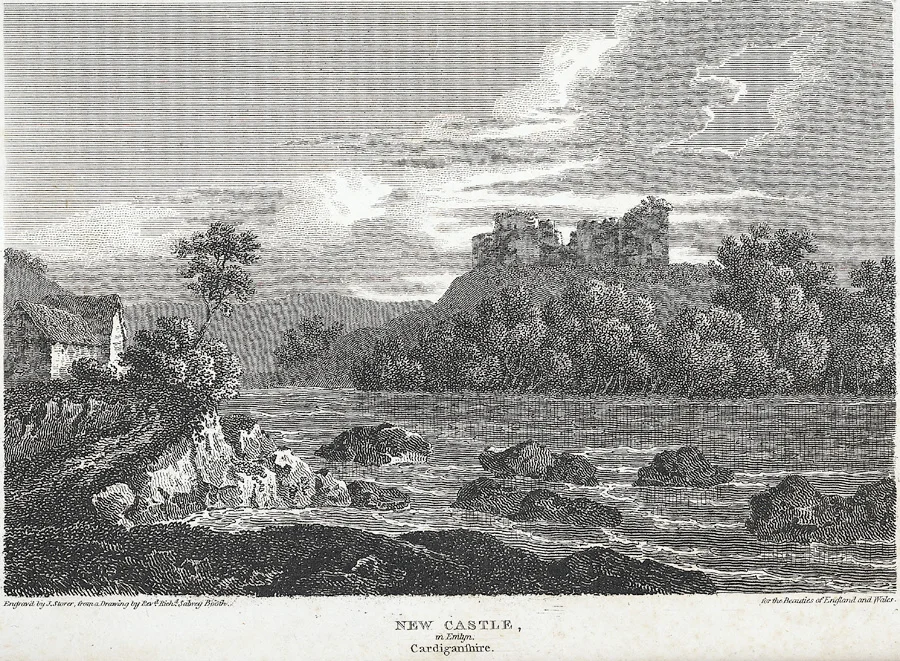

Newcastle Emlyn Castle
Sixty oxen. That was the count of beasts required to haul a single siege engine up the Teifi valley to the gates of Newcastle Emlyn in the summer of 1287. Forty had been enough to drag it from Dryslwyn to Cardigan; the climb into the hills above the river demanded twenty more. Somewhere on the curtain wall, on a narrow promontory looped almost completely by the river, Rhys ap Maredudd watched the slow approach of his own end. His father had built this castle, in stone, out of stone, when most Welsh lords still made do with timber. Now the English king's men were dragging stones of a different sort to break it down.
A Welsh Stone Castle
Maredudd ap Rhys raised the castle around 1240, on a tongue of land that the Teifi all but encircles. Approachable only from the west, the site was a defender's dream: water on three flanks, a single narrow neck to fortify. What makes Newcastle Emlyn unusual is not the geography but the construction. Most castles in West Wales were built by Anglo-Norman incomers, not by native Welsh lords. To build in stone was to declare permanence in a way that timber palisades never did. Maredudd ap Rhys made that declaration in masonry. The twin-towered gatehouse, semi-octagonal on the outside and rectangular within, still bears its vaulted cellar beneath the north tower, the only space of the castle interior to survive substantially intact.
The Revolt of Rhys ap Maredudd
By 1287, Maredudd was long dead and his son Rhys ap Maredudd had taken up the family quarrel with the English crown. The Welsh wars of Edward I were over in name but their grievances were not. When Rhys rebelled, the king's forces drove him from his main stronghold at Dryslwyn and chased him up the Teifi to Newcastle Emlyn. The siege engine that crossed Cardiganshire behind those forty, then sixty oxen was the period's heaviest weapon, a stone-throwing trebuchet or a great catapult, the kind of slow machine that decided sieges by patience as much as power. The castle held out for a time. Eventually it fell. Rhys ap Maredudd's revolt fell with it, and the Welsh stone castle passed into English hands, which it would change again and again for the next four centuries.
The Black Prince's Long Quiet
In 1343, Edward of Woodstock, soon to be called the Black Prince, was made Prince of Wales. With the title came a portfolio of twenty-six castles spread across his new principality, and Newcastle Emlyn was one of them. Under his ownership the place enjoyed something it had rarely known: stability. One constable, Richard de la Bere, held the castle for nineteen unbroken years, a quiet tenure made possible by the simple fact that nobody was attacking. The reprieve did not last forever. In 1403, the followers of Owain Glyndwr swept up from the south and took the castle back for Wales during the great rising that briefly seemed to promise an independent Welsh kingdom. Around 1500, Sir Rhys ap Thomas put larger windows into the gatehouse, the marks of a building turning from fortress to residence.
What Remains, and What Was Lost
The English Civil War found the castle still standing and still useful. In 1645 it was besieged by Parliamentary troops, and changed hands several times before the fighting moved on. Whatever the seventeenth century left behind was further dismantled or reclaimed by the river valley. Today the gatehouse and its towers, with fragments of curtain wall, are essentially all that the eye can read. The great hall, the chapel, the kitchens and the larder, the lord's chambers, are gone above ground. The first accurate plan of the site was not produced until 1985, an oddity for a castle that has stood here for nearly eight hundred years and changed nations sixteen times. The promontory and its river still do most of the storytelling. Walk to the gatehouse, look down into the loop of the Teifi, and you understand why somebody chose this spot, and why somebody else, with sixty oxen and a stone-thrower, decided he had to take it.
From the Air
Located at 52.04N, 4.46W, on a promontory in a loop of the River Teifi at the market town of Newcastle Emlyn. The ruined gatehouse is visible from low level along the Teifi valley between Cardigan and Lampeter. Nearest aerodrome is Haverfordwest (EGFE) about 24 nm south; Swansea (EGFH) and Pembrey (EGFP) lie further south on the South Wales coast.
Nearby Stories
- RAF Haverfordwest 3.7 km away
- Great Western Railway in West Wales 7.7 km away
- West Wales 9.9 km away
- Fishguard Lifeboat Station 13 km away
- Battle of Mynydd Hyddgen 15 km away
- Strata Florida Abbey 18 km away
- Neath and Tennant Canal 21 km away
- HMS Tyler 44 km away