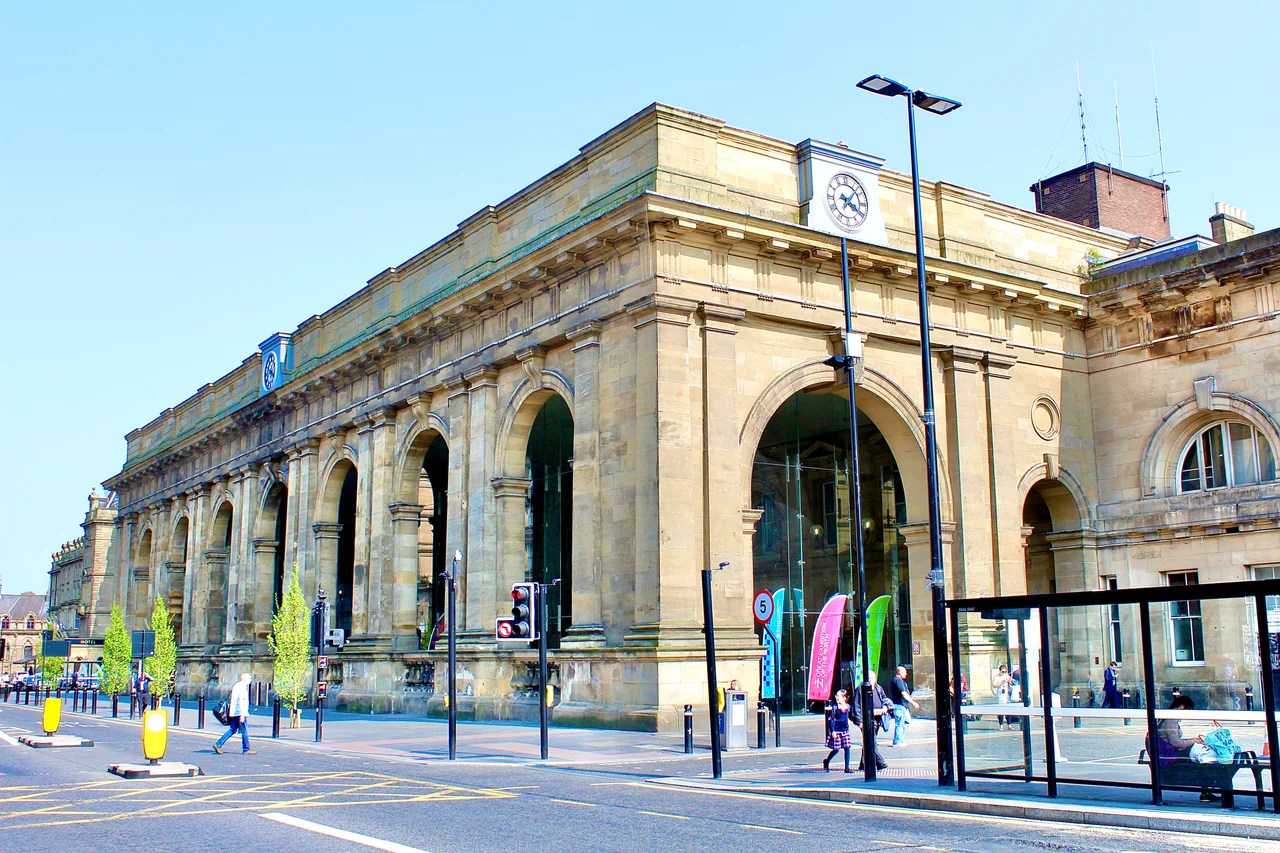

Newcastle upon Tyne
Around 200 AD the Roman army stationed at the fort here recruited so many soldiers from what is now Iraq and Syria that the supply depot picked up a nickname: Arbeia, the Arab place. The soldiers' job was to haul provisions from the river wharves up to the fort of Pons Aelius, then west along Hadrian's Wall or north into the territory the Romans considered bandit country. Newcastle has been a logistical city ever since. The castle that gave it its name came in 1080, the coal monopoly in 1290, the turbine engines in the 1890s, and the world's richest football club in 2021.
The New Castle
Robert Curthose, eldest son of William the Conqueror and a man who would spend his last twenty years in his brother's dungeons, built the original wooden Novum Castellum in 1080 to deter Scots and rebels. A stone replacement followed in 1172, and that ruin is what visitors see today. The walls were eventually extended to enclose the whole town. Newcastle held out against the Scots more than once. It held out against Oliver Cromwell for several months in the Civil War before falling to assault. Industry came early. By the Middle Ages the town was prospering on salt panning, easily mined shallow coal, limestone quarried for masonry, and produce from a fertile hinterland. In 1290 the burgesses won a Royal monopoly on coal mining and export across the Tyne. The cartel was so lucrative that they once set fire to the rival port at North Shields. It took until 1750 for the monopoly to be broken.
Grainger Town and Grey Street
The elegant central district is the work of one builder. Richard Grainger laid out Grey Street, Grainger Street, Clayton Street and the indoor Grainger Market between 1835 and 1842. Grey Street, a curving classical facade following the line of a culverted stream, is one of the finest urban set pieces in Britain. It is named for Charles Grey, the 2nd Earl Grey, whose Whig government passed the Great Reform Act of 1832. He also gives his name to the tea. The 135-foot Grey's Monument at the top of the street was erected in 1838. In 1941 a bolt of lightning shattered the statue's head; a replica was added in 1947. Below the column runs Monument Metro station, where the Green Line meets the loop of the Yellow Line. The Yellow Line is a single track that crosses itself at Monument, an elegant solution to serving both the airport in the north-west and the seaside resort of Whitley Bay in the north-east.
Geordie
The dialect is called Geordie, said to derive from George or Geordie as a common name among local pitmen. Its pronunciation sits closer to Anglo-Saxon than most English varieties. The one essential vocabulary item is the all-purpose exclamation Howay. Beyond that, comprehension depends on whether the speaker wants you to comprehend, which means anyone reliant on your tourist money will make themselves understood. The flagship ale is Newcastle Brown, brewed locally until 2005 and now made in Tadcaster for the British market and in Zoeterwoude in the Netherlands for export. It pours quietly, fills a glass to the brim without spilling, and arrives in pint clear bottles served cold but not chilled. On a dreary day with North Sea drizzle blowing in horizontally, it pairs well with a meat pie.
Twentieth-Century Reinvention
The 20th century brought the miners' strikes, the Depression, and wartime bombing. The city held on through diversification, growing its public sector and adding two universities and a startling amount of new architecture. The Tyne Bridge, completed in 1928, gave the river the steel arch that locals would later see echoed in Sydney Harbour. The Gateshead Millennium Bridge opened in 2001, a tilting pedestrian arch nicknamed the Blinking Bridge or Winking Bridge for the way its deck rotates to let river traffic through. Across the river in Gateshead stand the BALTIC Centre for Contemporary Art and the Sage Music Centre, both visible from Newcastle's Quayside. The Angel of the North, Antony Gormley's 20-metre winged steel figure with a wingspan of 54 metres, stands at the southern edge of Gateshead and serves as the city's gateway.
Flight Context
Coordinates 54.98 N, 1.61 W on the north bank of the Tyne. Recommended viewing altitude 2,500 to 5,000 feet for the city centre, 5,000 to 8,000 feet for the wider conurbation. The seven Tyne crossings between Newcastle and Gateshead are the unmistakable visual fingerprint. The Tyne Bridge arch is darkest and largest; the Millennium Bridge to the east is white and curving. Nearest ICAO airport Newcastle International (EGNT) is 4 nautical miles north-west. Durham Tees Valley (EGNV) lies 26 nautical miles south.
From the Air
Coordinates 54.98 N, 1.61 W on the north bank of the Tyne. Viewing altitude 2,500 to 5,000 feet AGL for city centre. Nearest ICAO airport Newcastle International (EGNT) is 4 nautical miles north-west; Durham Tees Valley (EGNV) is 26 nautical miles south. The cluster of Tyne bridges between Newcastle and Gateshead is the unmistakable visual fingerprint.
Nearby Stories
- Cresswell Lifeboat Station 5.2 km away
- Auckland Castle 5.7 km away
- Battle of Otterburn 7.1 km away
- Saltburn Pier 11 km away
- Hadrian's Wall Path 11 km away
- Battle of Stainmore 18 km away
- Saltburn-by-the-Sea 39 km away
- Alexander L. Kielland (Platform) 296 km away