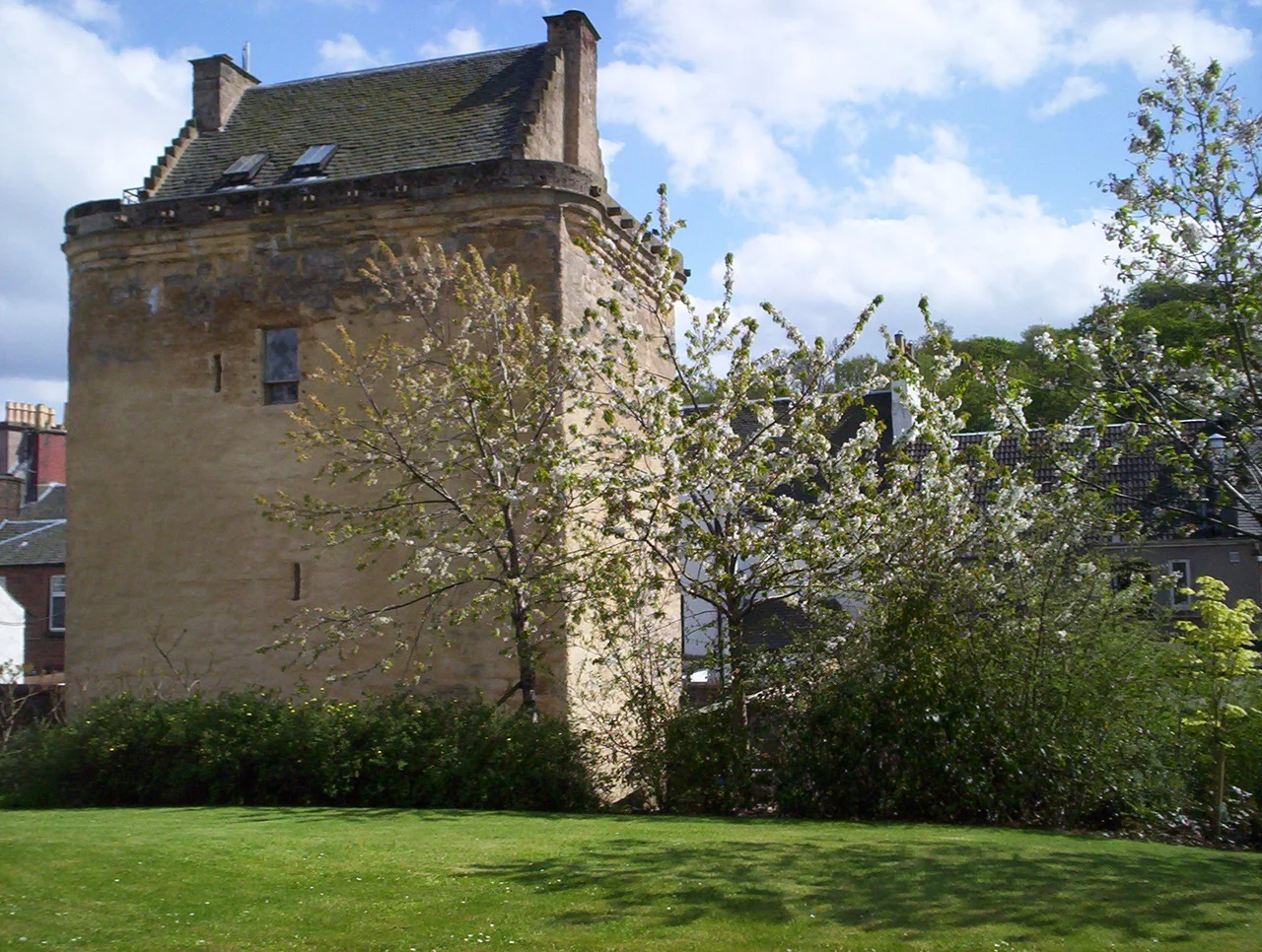

Newmilns
In 1891, a Newmilns lace firm called Johnstone Shields and Co opened a factory in Gothenburg, sending its weavers across the North Sea to set up the machines. The Scottish workers, finding themselves with evenings to fill, started a football team. That club, Örgryte Idrottsällskap, played in Sweden's first ever football match. A village of three thousand people in East Ayrshire helped invent football for an entire country. It is the kind of fact that gets passed down, and in Newmilns, it has been.
Mills, Old and Vanished
The name appears to come from Old English niwe and mylen - new mill - placing the village's origins in the early medieval period. The earliest recorded form is Nawemeln, in 1126, and the plural s was already attached by the fifteenth century. Of the mills themselves, almost nothing survives. Pate's Mill, on Brown Street opposite the railway station, was the last in operation and was demolished in 1977; a fragment of exterior wall is all that remains. Allan Ramsay's poem "The Lass o Pate's Mill" once made it famous. Loudoun Mill at the foot of Ladeside, the former Meal Mill of Newmilns, operated continuously from 1593 until it stopped producing meal in the 1960s and is now housing. A Neolithic stone circle once stood east of Loudoun Gowf Course, and a burial mound from the same period lies beneath the approach to the seventh green.
The Covenanters
Few Scottish places carry the Covenanter past more visibly than Newmilns. A memorial stone in the grounds of Loudoun Church records the names of village men killed for their religious convictions in the seventeenth century. Matthew Paton was captured during the Pentland Rising and executed in Glasgow on 19 December 1666. David Findlay was shot in Newmilns by order of General Dalziel that same year. James Wood was captured at the Battle of Bothwell Brig and executed at Magus Muir on 25 November 1679. John Nisbet, who had fought at Pentland, Drumclog and Bothwell Brig, was caught at a service in Fenwick and executed at Kilmarnock Cross on 14 April 1683. These were neighbours, brothers, sons - real people who paid with their lives for refusing to abandon their churches, and the stone remembers them by name.
The Battle of the Lime Road
Some battles do not need armies. The Lime Road on the western edge of Newmilns had long been a popular walk. Between 1878 and 1893, Baron Donington of Loudoun Castle began erecting barriers to block public access, in a campaign to enclose the route as private estate land. Local residents took him to court. They won. The Lime Road remained a public right of way, and the village had successfully defended a piece of common ground against an aristocratic landlord. It is a small story in the long history of Scottish land rights but a telling one - and the path is still walked today. The wider Lanfine Estate to the south of the village expanded from four hundred acres to over ten thousand under the Brown family from 1769, with Lanfine Wood, three gatehouses, and Browns Road all dating to their tenure.
Robert Burns and Mrs Lawrie
Reverend Lawrie of Loudoun Manse received Robert Burns several times as a guest. The poet's brother Gilbert later wrote that the visits were a delightful family scene for our poet, then lately introduced to the world, with Burns's mind so roused to poetic enthusiasm that he left stanzas in the room where he slept. Burns also wrote verses for Lawrie's daughters describing his visits, and on one window pane in the manse he scratched a line with his diamond ring: Lovely Mrs Lawrie, she is all charms. The graffiti has not survived. The verses have. It is a window into how a great Scottish poet moved through this small Ayrshire valley, leaving traces of charm wherever he found a welcome.
Gala Day and the Skiing Hill
Newmilns holds an annual gala day that begins with a brass-band parade from Gilfoot east along Loudoun Road, Kilnholm Street and Main Street, before turning right onto Union Street and disbanding at Greenside Park. The afternoon brings bands, battle reenactments, races, beat-the-goalie competitions and tug-of-war, ending with the crowning of the gala queen. Less expected in these low moist hills: a working ski slope. Newmilns Snow and Sports Complex runs a 110-metre artificial slope, just off the A71. The village's railway station closed in the 1960s as part of Richard Beeching's Reshaping of British Railways, and the site is now occupied by the Vesuvius building. The Irvine Valley Walking Festival, which began in 2003 with four hundred attendees, has become an annual fixture.
From the Air
Newmilns sits at 55.61°N, 4.33°W, seven miles east of Kilmarnock and twenty-five miles southwest of Glasgow, in the Irvine Valley. Recommended viewing altitude 2,500-3,500 feet. The River Irvine traces a path along the valley floor with Newmilns north of the river and Greenholm south. Nearest airports: Glasgow Prestwick (EGPK) about 15 nm southwest and Glasgow (EGPF) about 22 nm north-northwest. Loudoun Hill, three miles to the southeast, is a useful navigational reference.
Nearby Stories
- Clydebank 0.4 km away
- Dunoon 5.5 km away
- HMS Dasher (D37) 6.1 km away
- New Lanark 6.3 km away
- Falkirk Wheel 11 km away
- Drumlanrig Castle 11 km away
- Ailsa Craig 18 km away
- Maybole Castle 18 km away