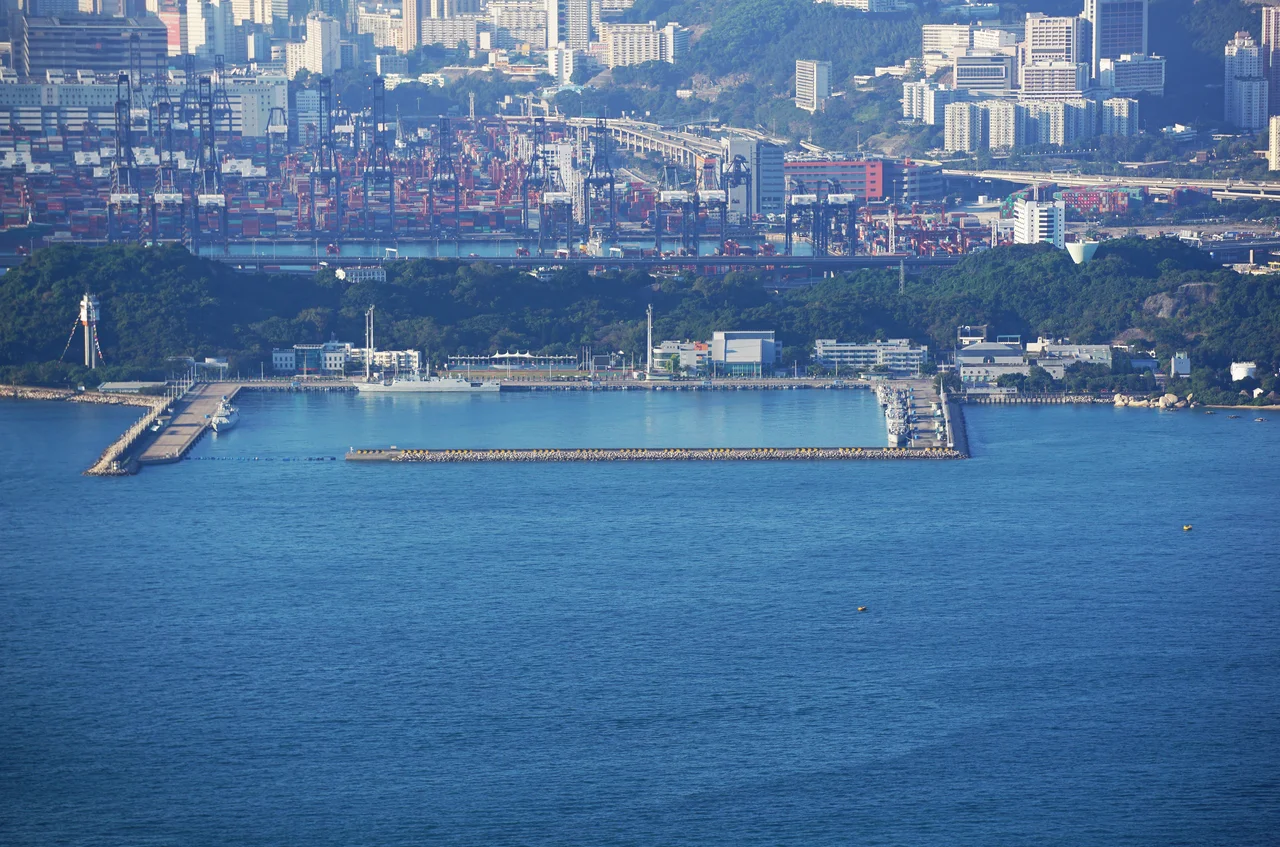

Ngong Shuen Chau Naval Base
The island changed hands without ceremony. On the first of July 1997, the People's Liberation Army garrison took possession of Stonecutters Island — known in Cantonese as Ngong Shuen Chau, meaning 'Raised Boat Island' — and the Union Jack came down for the last time over a site that British forces had occupied since the 1840s. What the PLA inherited was not a modern military facility but a layered archaeological record of colonial defence: watch towers dating to 1870, Victorian gun batteries, a curry house, and a small garrison church dedicated to Saint Barbara, patron saint of artillerymen. They kept nearly all of it.
Built on Reclaimed Ground
The naval base that exists today was not simply inherited from the British — most of it was built new. In the early 1990s, years before the handover, dredges and landfill crews were already reshaping the south shore of Stonecutters Island in anticipation of what was coming. The PLA needed a facility suited to modern naval operations. When the naval base was constructed in 1996 and 1997, it was one of the few military installations created specifically for the incoming garrison rather than transferred wholesale from British hands. The basin, the concrete berthing facilities, the barracks buildings in their neat rows — all were purpose-built, even as older structures from a previous era stood alongside them. Today access reaches the base via Chi Ngong Road, though the naval yard itself is fenced off and the surrounding waters are restricted to civilian ship traffic. A heavily wooded area screens the north side from casual observation, giving the base a quality of studied seclusion that belies its proximity to one of the world's busiest harbours.
Victorian Walls, New Flags
The older parts of the base tell a different story. Several buildings date to the 1930s; the oldest surviving structures go back to the 1870s. A watch tower from that decade still stands. St Barbara's Garrison Church, the Officers' Mess, the old fire station at Building 23, and the curiously named 'Wuthering Heights Quarters' all survive as working parts of the facility. The roads that once bore English names — Colchester Road, Didcot Road, evoking garrison towns in middle England — have been quietly retired, though the roads themselves remain. Even Shaffies Curry House, the South Shore recreation canteen with its very British name, reportedly survived into the PLA era. The building the source material calls the 'Upside-Down House' carries the number 24 South Shore and no further explanation. Some buildings simply resist categorization; a century and a half of military occupancy tends to produce curiosities. The Navy, Army and Air Force Institutes building, the Lido pool, the ammunition depots and bunkers — these too form part of what the PLA inherited from the Hong Kong Military Service Corps.
A Sub-Base of the South Sea Fleet
Administratively, the Ngong Shuen Chau Naval Base functions as a sub-base of the PLA Navy's Southern Theatre Command (formerly the South Sea Fleet), and houses a naval squadron of the Hong Kong Garrison, designated MUCD 38081. In practice it operates with the quiet restraint that characterises the entire PLA presence in Hong Kong — visible from the water, largely closed to civilian access, and deliberately low-key. The most prominent visitor the base has received in the post-handover era was President Hu Jintao, who arrived in 2007. For much of the year the facility is closed to the public; during summer months, access is occasionally permitted. The base theatre — the Ngong Shuen Chau Naval Base Theatre — survives as one of those inherited amenities that suggests continuity outlasting the change of flags. Sailors still need somewhere to watch a film.
Island of Contested Memory
Stonecutters Island itself has a longer history than any of its military installations. The British seized it, like Hong Kong Island proper, in the early nineteenth century, and used it variously as a quarantine station, an ammunition depot, and a garrison. The eastern battery, the western battery, the central battery — these names survive on maps of the current base, marking positions that once guarded the approaches to Victoria Harbour. The armament depot and the old military prison add their own weight to the record. Stonecutters Island is no longer truly an island: the land reclamation projects of the late twentieth century connected it to the mainland of Kowloon, swallowing the channel that once separated it. The base today occupies ground that is partly Victorian landfill, partly 1990s dredge-fill, and partly original island bedrock — geology reflecting the same layering as its history.
From the Air
Ngong Shuen Chau Naval Base sits on Stonecutters Island at approximately 22.322°N, 114.136°E, in the western approach to Victoria Harbour. The island is visible from low altitude as a wooded landmass now connected to the Kowloon mainland by reclaimed land. Inbound to Hong Kong International Airport (VHHH, 18 nm to the west-northwest), flights on easterly approaches pass almost directly overhead. The Rambler Channel lies immediately to the north; Tsing Yi Island is visible beyond. Recommended viewing altitude: 1,500–3,000 ft for a clear view of the island's relationship to the harbour. Note that the naval perimeter is restricted airspace — maintain standard traffic patterns and do not loiter over the base.
Nearby Stories
- Lok Ma Chau Loop 2.3 km away
- Portas do Cerco 2.3 km away
- Kweilin Incident 17 km away
- Wanshan Archipelago Campaign 34 km away
- Nanxiong Formation 115 km away
- Battle of Nanpeng Island 148 km away
- Heyuan 169 km away
- Cape Maobitou 632 km away