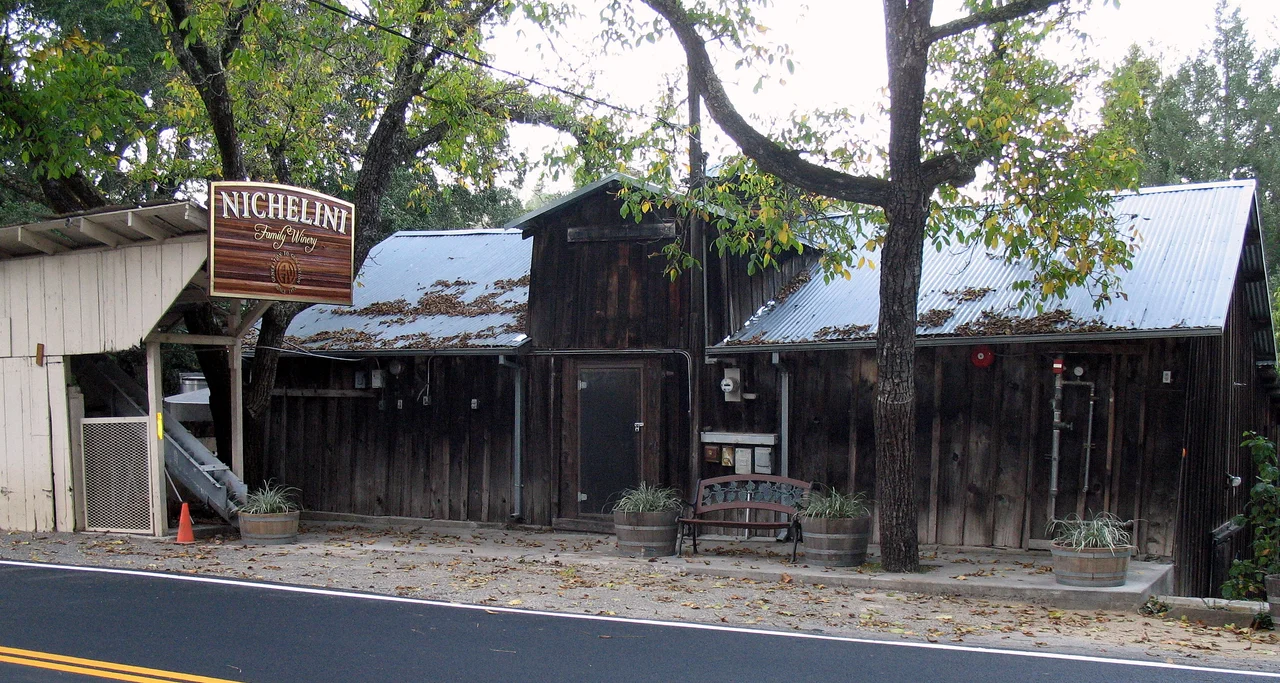

Nichelini Winery: Bootleggers, Miners, and Seven Generations of Wine
In 1920, a man named Clifford Clark wrote an indignant letter to the sheriff about the rowdy drunks in nearby Monticello. The locals were having "good times, drinking wine," Clark complained, and there was "no question, but what the wine comes from Nichelini's." He was almost certainly right. The Nichelini family had been making wine in Chiles Valley since 1890, and a little thing like the Eighteenth Amendment was not about to change that. Anton Nichelini's winery "officially" closed during Prohibition. Unofficially, it supplied the governor's household, kept local miners in good spirits, and once ran a sacramental wine delivery service as cover. Today, more than 130 years later, the winery is still in the family's hands - the oldest such arrangement in Napa Valley - and the current head winemaker is the seventh in an unbroken line.
From Ticino to Chiles Valley
Anton Nichelini emigrated from the Swiss canton of Ticino and homesteaded a 160-acre tract of rugged wilderness in Chiles Valley, converting about 30 acres to vineyards. He was the first Swiss settler in the area, but he would not be the last. In 1890, he married Caterina Corda, another Swiss immigrant from Ticino, and the partnership that followed was as productive in family as it was in wine. Between 1891 and 1916, Anton and Caterina had twelve children, all of whom attended the Chiles Valley one-room schoolhouse. Anton built a Greek Revival house on top of his stone winery - a practical arrangement that kept the living quarters cool in summer and made checking on the barrels a matter of walking downstairs. He was also a skilled miner who patented new smelting techniques, working the chromium and magnesite deposits that his property happened to sit on. Rancher, vintner, miner, father of twelve: the man stayed busy.
The Prohibition Hustle
When Prohibition arrived in 1920, the Nichelini Winery shut its doors in the way that a theater goes dark between acts - technically closed, still very much in business. The family's bootlegging was an open secret in the valley. Beyond Clifford Clark's letter, the winery was well known as a source of wine for anyone who knew where to look, which in a rural valley was essentially everyone. A warning fine came in 1923. Anton was arrested on January 8, 1924, and taken to the St. Helena jail. The arrest did not meaningfully alter operations. The Nichelini family continued to supply wine to local miners and Bay Area residents, sometimes disguising deliveries as sacramental wine. When the Volstead Act was finally repealed, Anton's son William reopened the winery officially, restoring a legality that had been more theoretical than practical for over a decade.
A House Built on a Winery
The physical property tells Nichelini's story as clearly as any archive. The 1886 Homestead Cabin, recently restored, is believed to be the only structure of its kind remaining in Napa County, earning a place on the Napa Valley Historical Society's "10 Treasures" list. The stone winery that Anton built in the hillside, with his Greek Revival home constructed directly above it, stands as a monument to immigrant pragmatism: one structure serving both domestic and commercial purposes, the weight of family life literally resting on the foundation of their livelihood. The entire property is listed on the National Register of Historic Places. In an era when Napa Valley wineries compete to build the most striking architectural statements, Nichelini's buildings make their case through survival rather than spectacle.
Seven Winemakers, One Family
The succession reads like a family tree because it is one. After Anton, his son William took over. Then James Nichelini. Then Jo-Ann Nichelini Meyer. Then Gregory Boeger, followed by Justin Boeger, and now Aimee Sunseri, who was named Woman Winemaker of the Year at the 2017 International Women's Wine Competition. Sunseri is the seventh family winemaker in this unbroken chain. The winery produces only about 2,500 cases a year - a fraction of what the valley's larger operations turn out, but enough to maintain the tradition that Anton started with his 30 acres of vines. The winery today is collectively owned and operated by the descendants of Anton and Caterina's twelve children, a corporate structure that is less a board of directors than a family reunion with legal standing.
Outlasting Everything
Nichelini Family Winery has survived Mexican land grants giving way to American settlement, the temperance movement, Prohibition and its federal agents, the consolidation of Napa Valley by corporate wine interests, and the transformation of wine country from agricultural region to luxury tourism destination. Through all of it, the family kept making wine. They never sold. They never merged. They never hired a celebrity architect to redesign the tasting room. The homestead cabin still stands. The stone winery still holds barrels. The family still owns the land that Anton homesteaded when Chiles Valley was rugged wilderness and the nearest town was Monticello - a town that no longer exists, drowned beneath Lake Berryessa in the 1950s. The Nichelinis outlasted their neighbors, outlasted Prohibition, and show every sign of outlasting whatever comes next.
From the Air
Located at approximately 38.50°N, 122.29°W in the Chiles Valley District of Napa Valley, nestled in rugged terrain east of the main valley floor. From the air, Chiles Valley appears as a smaller side valley branching east from the primary Napa corridor. The winery is in hilly, vine-covered terrain at moderate elevation. The closest airports are Napa County Airport (KAPC) about 15 miles southwest and Nut Tree Airport (KVCB) about 18 miles southeast. Lake Berryessa is visible to the east. The winery buildings are small-scale and may not be individually distinguishable from altitude, but the vineyard rows on the hillsides mark the area.
Nearby Stories
- Yolo Causeway 2.3 km away
- Eight Acres for a Plant That Exists Almost Nowhere 2.9 km away
- The Stone Chapel That Survived Everything 9 km away
- Where Carlin Took His Last Bow 11 km away
- Locke: The Town They Built But Could Not Own 14 km away
- Rico Harris 14 km away
- The Fence That Ran to the Sea 20 km away
- Sutter Hock Farm 22 km away