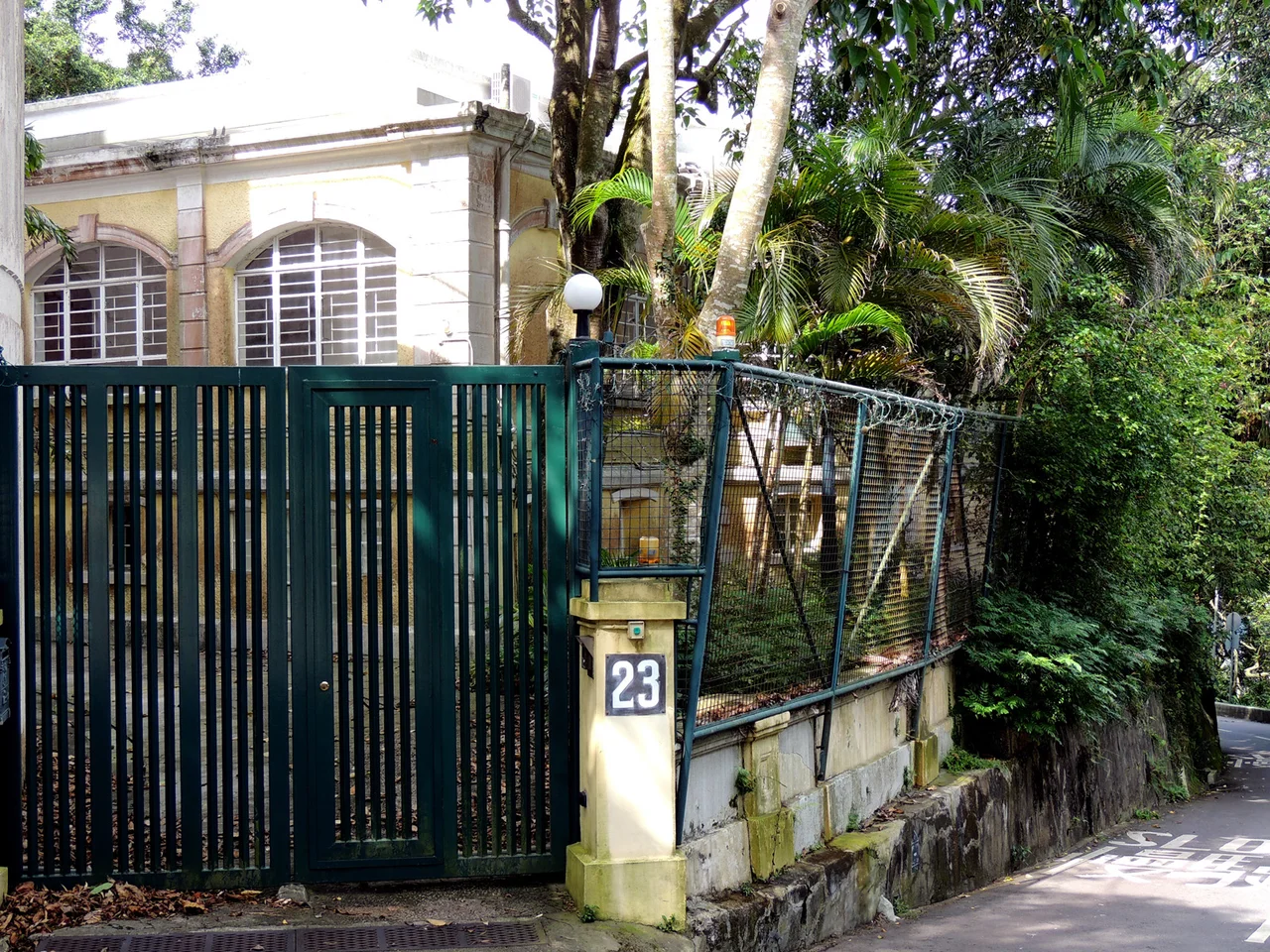

No. 23 Coombe Road
J. J. Francis built his house on The Peak and named it after the Lancashire school where he had studied and — not quite — prepared to enter the Roman Catholic priesthood. Stonyhurst College gave the house its first name; the man himself would own it for fifteen years, until his death in 1901. The house has since been called Glen Iris and, since the early 1970s, Carrick. It sits at 22.267°N on Coombe Road, one of the oldest surviving European houses on Hong Kong's highest ground, still wearing the Palladian face that an architectural firm gave it in the 1890s. The address is Grade I Historic Building since 2011. The name on the gate has changed three times. The rusticated pilasters have not changed once.
A House Carried Up on Shoulders
When J. J. Francis purchased his plot in March 1886, The Peak was barely inhabited. The Peak Tramway had not yet opened to the public. May Road was a footpath. Caine Road was considered quite high up. To build on Coombe Road required not only money but logistics that the modern resident cannot easily picture: every brick, every stone, every timber, and every piece of furniture had to be carried up by workers on their shoulders, across distances of one to two miles and to heights between 1,100 and 1,600 feet above sea level. Governor Sir William Des Voeux recorded exactly this in 1889, two years after Stonyhurst was completed — a description that bears witness to the human labour behind the colonial domestic ideal. Those workers were called 'coolies' in the language of the era, a term that marked their labour as cheap and their persons as unremarkable. They were neither. They were the men whose effort made Stonyhurst possible, and the house stands partly as a monument to work that history has not otherwise commemorated.
Palladian on the Peak
The architectural firm Danby & Leigh remodelled the house in a classical style, and the result is something of an anomaly — Palladianism had been losing favour in Europe for generations by the time it was applied here, but in the British colonies it was experiencing a revival. The two-storey house follows the traditional piano nobile arrangement: a service floor at ground level and the principal rooms above, reached by an external staircase flanked by stepped planters. The portico at the top of the steps is formal enough to signal ambition while remaining modest enough not to shout it. Rusticated piers divide the elevations into bays; moulded stucco bands run the perimeter; the ground floor windows have curved heads and deep reveals; the first floor windows carry segmental arches with keystones. A moulded cornice completes the composition at eaves level. Danby & Leigh became Leigh & Orange in 1894 — the successor firm later left its mark across Hong Kong — and Stonyhurst remains among their early surviving works.
Many Owners, One Address
After Francis died in 1901, the house began its passage through a long succession of owners whose variety says something about how colonial Hong Kong worked. The China Fire Insurance Company held it briefly, then sold to Ahmet Rumjahn — a name that carries its own history, as Rumjahn was one of the most prominent members of Hong Kong's Arab merchant community. The Hongkong Electric Company owned the property from 1921 to 1976, a span of fifty-five years that included the Japanese occupation and the postwar rebuilding of the city. The electric company was not the only institution to leave its name on the surrounding streets: the power station the company operated at North Point gave Electric Road its name, and the company's long tenure at this house suggests a different kind of institutional presence — the executive residence rather than the industrial plant. Cavendish Property Development then Juli May Ltd completed the ownership chain into the twenty-first century.
Three Names, One Character
The house was Stonyhurst from 1887, the name Francis brought from his English schooling. It became Glen Iris in 1919 — a softer name, suggesting a Victorian taste for botanical romanticism — and carried that name until 1972 or 1973, when it was rechristened Carrick, the name it still bears. Each renaming represents a new owner's desire to mark their possession, but the house itself has been more stubborn than any of its owners. Its classical facade, its retaining wall, its platform and parapet have changed less than the signage at the gate. In 2000, the film Double Tap used the house as a location, playing the role of detective Miu's home in a thriller set in contemporary Hong Kong. The production crew presumably found what visitors always find at Carrick: a house that looks like it has been standing there forever and intends to continue.
From the Air
No. 23 Coombe Road sits on The Peak at approximately 22.267°N, 114.168°E, at an elevation of roughly 350 metres above sea level. From the air, The Peak is the dominant topographic feature of Hong Kong Island — a rounded summit rising steeply from Victoria Harbour. Coombe Road runs along the southern flank of the peak, below the summit. Hong Kong International Airport (VHHH) lies approximately 25 nm to the west-northwest. Inbound flights on easterly approaches pass south of The Peak; the summit itself reaches 552 metres and is an active terrain obstacle. Recommended viewing altitude: maintain 3,500 ft or above to see The Peak in context against the harbour and the Kowloon hills beyond.
Nearby Stories
- Lok Ma Chau Loop 2.3 km away
- Portas do Cerco 2.3 km away
- Kweilin Incident 17 km away
- Wanshan Archipelago Campaign 34 km away
- Nanxiong Formation 115 km away
- Battle of Nanpeng Island 148 km away
- Heyuan 169 km away
- Cape Maobitou 632 km away