
Nordic Library at Athens
Four countries, one library. In 1995, the Danish, Finnish, Norwegian, and Swedish institutes at Athens — each with its own director, its own research programme, its own national scholarly tradition — decided they needed a single shared resource rather than four separate, duplicated collections. The result was the Nordic Library at Athens, housed in the Makrigianni neighbourhood just south of the Acropolis. It is a small institution in physical terms, but it carries within it the concentrated scholarship of four Nordic nations focused on the ancient and modern world they find here in Greece.
Four Nations, One Reading Room
The Makrigianni district sits directly south of the Acropolis, between the Acropolis Museum and Hadrian's Arch — a neighbourhood defined by the layered presence of antiquity and the scholarly apparatus that studies it. The Nordic Library opened here in 1995, a cooperative venture that pooled the resources of the Danish Institute at Athens, the Finnish Institute at Athens, the Norwegian Institute at Athens, and the Swedish Institute at Athens. It now holds approximately 40,000 volumes, a collection built around archaeology, classical studies, Byzantine history, modern Greek scholarship, and the regions each Nordic country has focused on in its Greek research. The library is not a grand institution — there are no monumental columns, no famous facade — but its collection is deep, and its users are specialists who know exactly what they're looking for.
The Surrealists in the Archive
In 1999, the Nordic Library received an unusual inheritance. The Nicolas and Elena Calas Archive — material collected around Nikos Kalamaris, the Greek-American poet and art historian who published under the name Nicolas Calas, and his wife Elena — was handed over via the Danish Institute at Athens for safekeeping and scholarly access. The archive had been held by the Louisiana Museum of Modern Art before its transfer. Calas was a significant figure in the international Surrealist movement, a close associate of André Breton who brought Surrealist ideas into dialogue with Greek literary and artistic culture. The archive includes letters, essays, articles, and photographs, the kind of primary material that art historians and literary scholars need to reconstruct intellectual networks. In a library otherwise focused on archaeology and classical antiquity, the Calas archive represents a different dimension of Greek cultural life: the modernist and avant-garde thread that ran through the twentieth century alongside the ancient one.
Cavafy Under Northern Skies
Six years after the Calas archive arrived, another literary collection enriched the Nordic Library's holdings. In 2005, Finn Ståhl — a Swedish philhellene and consul in Crete — donated approximately 250 works related to Constantine P. Cavafy, the Alexandrian Greek poet whose verse about memory, desire, and Hellenistic history made him one of the most celebrated poets of the twentieth century. The donation included poetry collections and critical literature about Cavafy's work in Greek and other languages. The choice of the Nordic Library as the home for this collection speaks to the institution's reputation: it has become a place where scholars know that donated material will be properly catalogued and made available to researchers. All archive materials held by the library are accessible to interested scholars.
Beneath the Rock
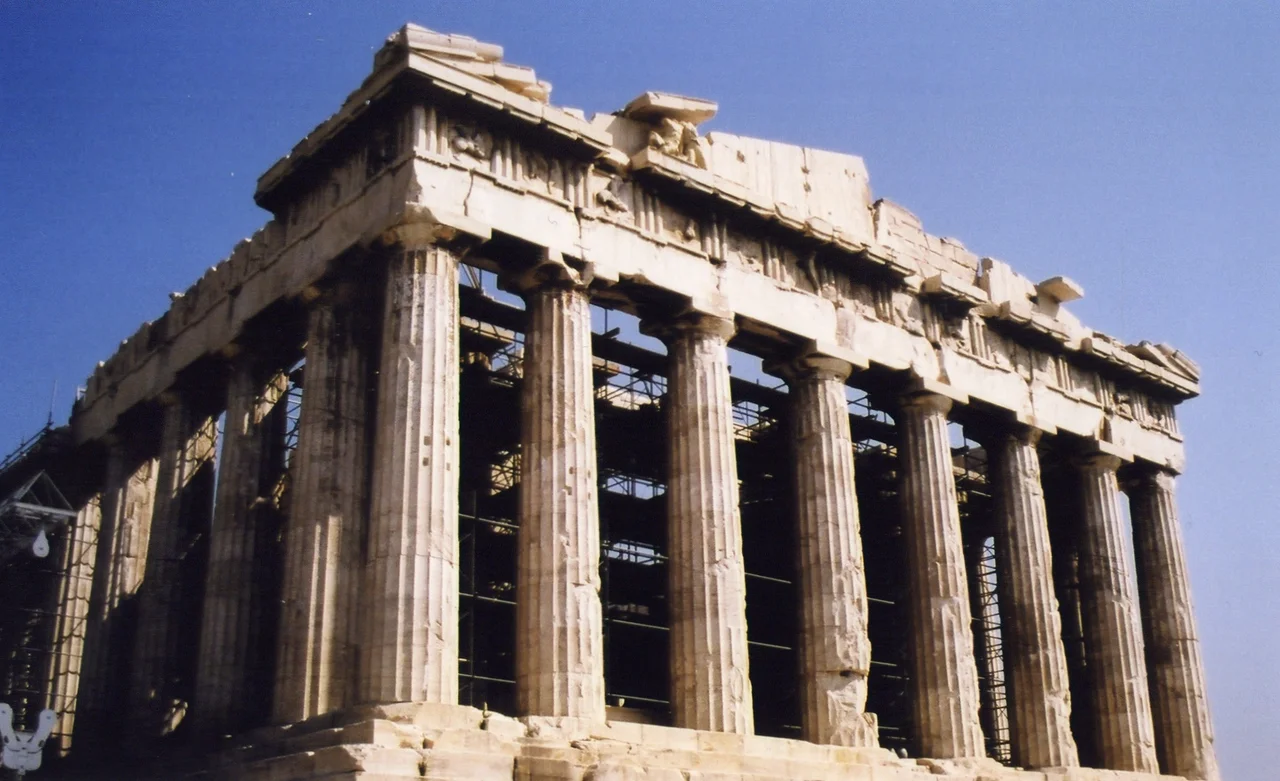
What makes the Nordic Library's location unusual — and quietly remarkable — is what it can see from its windows. The Acropolis rises directly to the north, the limestone and marble of the Parthenon visible above the rooflines of Makrigianni. For the archaeologists and classical scholars who use the library's collection, this is not merely a pleasant view. It is the object of study, rendered visible. Nordic researchers have been conducting fieldwork in Greece since the nineteenth century; the institutes that now share this library represent more than a century of Scandinavian engagement with Greek antiquity. The library in Makrigianni is, in some sense, where that long conversation between the North and the ancient Mediterranean keeps its notes.
From the Air
The Nordic Library sits at approximately 37.97°N, 23.73°E in the Makrigianni district of Athens, within 500 metres of the Acropolis Museum. From the air at 2,500 feet, the Acropolis is the dominant landmark: the flat-topped limestone outcrop rising sharply from the surrounding urban fabric, with the Parthenon visible on its summit. Athens International Eleftherios Venizelos (LGAV) lies approximately 25 km to the northeast. The approach to Athens from the west offers a clear view of the Acropolis long before the aircraft descends into the basin — it is often the first landmark of consequence that appears.
Nearby Stories
- Parnitha 3.4 km away
- Kea (island) 7.3 km away
- Sanctuary of Apollo Maleatas 11 km away
- Sousaki Volcano 12 km away
- Battle of Leuctra 14 km away
- Great Sand Beach 18 km away
- Agios Georgios (island) 23 km away
- Skyros 84 km away