.jpg)
Normanton Gaol
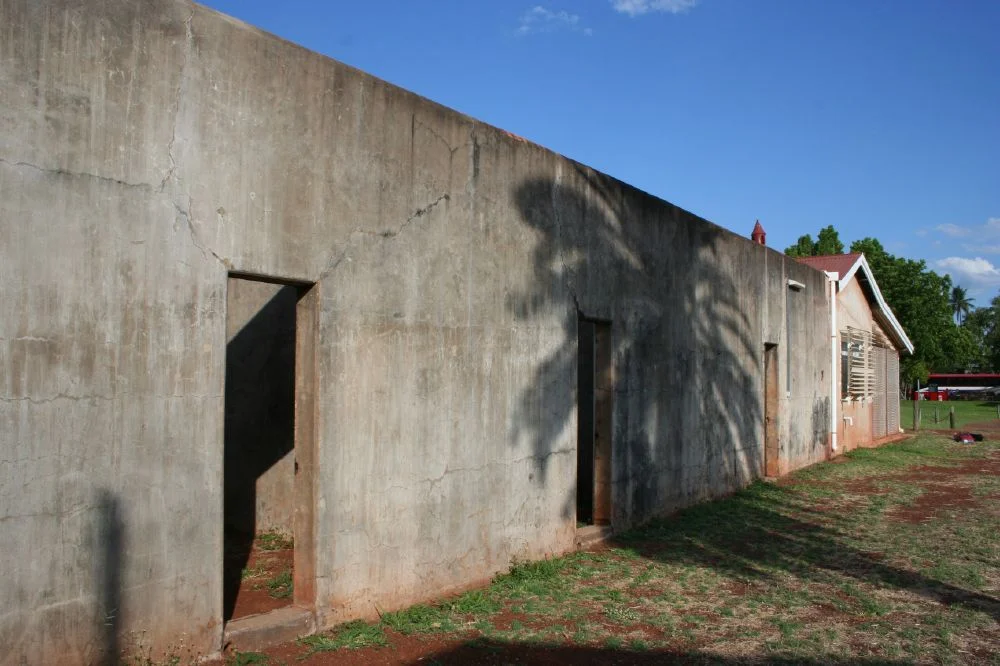
In a town built almost entirely of timber and corrugated iron, the gaol was the odd one out: heavy, grey, and made of concrete. That difference was the point. Concrete kept out the white ants that devoured every other building in the Gulf, and it kept in the prisoners - an earlier timber lock-up had failed when an inmate simply broke through the floor and walked away. So when the government finally built a proper gaol in Normanton between 1892 and 1899, it poured concrete walls and stiffened them with iron railway rails, salvaged from the brand-new line to Croydon. The cells are small and unadorned. The exercise yards are walled three and a half metres high. And tucked behind it all sits a tiny two-room hut that tells a harder story than the prison itself.
A Gaol for a Gold Town
Normanton existed to be a port, gazetted in 1868 to give the Gulf a better outlet to Brisbane than Burketown. But it was gold that made it boom. The discovery at Croydon in 1885 sent fortune-seekers pouring through, and by 1888 Normanton had become the administrative centre of the whole police and court district. A town with money, miners, and isolation needed somewhere to hold those it arrested. The first attempt was a flimsy timber lock-up; the failure of that building, and an order of as many as twenty-four prisoners crammed into just four cells, pushed the Department of Public Works toward something permanent. Foreman William Taylor Jack drew the plans, and the gaol rose at the centre of town - close to the police barracks, the stables, and the courthouse, so that justice and punishment sat almost within sight of one another.
Rails in the Walls
The cleverness is in the details you have to look for. In each of the four original 1892 cells, lengths of railway iron are embedded horizontally in the concrete piers between the wall-top and the ceiling, doubling as both reinforcement and ventilation in the brutal Gulf heat. The remand cell goes further: rails span the full width of the room near the ceiling, spaced just twenty-five centimetres apart, their ends sunk into the concrete - a ceiling you cannot climb through. Overcrowding forced two extensions, three more cells in 1895 and a seventh in 1899, along with a kitchen and a stockade fence. As a district gaol it served Croydon, Georgetown, Cloncurry and Burketown - an enormous reach across the Cook and Burke country - holding the short-sentenced, the long-sentenced, and the merely accused all together within the same walls.
The Smallest Building
Behind the cell block stands a plain weatherboard hut of just two rooms. This was the trackers' quarters, home to the Aboriginal men the police force relied on but never treated as equals. Their bushcraft was prized - they tracked escaped prisoners, found lost children, and read the country in ways the constables could not - yet they were also expected to work as stable hands, cleaners, and handymen. The hut's position says everything the records leave unspoken: it is smaller and barer than any accommodation built for the white constables and inspectors, closer in form to the cells than to the officers' residence. The men who lived here held the lowest rung of a hierarchy that the colony built into timber and stone. It is the only surviving building of the larger police reserve, and it survives as evidence of exactly how that ranking worked.
Closing the Door
The Gulf region's Aboriginal communities knew this place from the other side of the iron doors, as a site of incarceration and punishment from the late nineteenth century onward - the same decades when fringe-camp families were being removed to distant reserves on Mornington Island and at Doomadgee. The gaol closed in 1945 and reverted to the police, who kept using it as a watch house until late 1992. What finally ended that was the 1991 Royal Commission into Aboriginal Deaths in Custody: its recommendations set standards the old cells could not meet, and the watch house was shut for good. Today the concrete shell still stands, its finials venting the roof, its yards silent - a rare and intact survivor of a network of regional Queensland gaols, most of which have long since vanished from towns like Roma, Cooktown and Thursday Island.
From the Air
Normanton Gaol sits at 17.668°S, 141.080°E, on Haig Street in the heart of Normanton, on the ironstone ridge that keeps the town above the wet-season floods. The low concrete cell block and its corrugated-iron roof are hard to pick out from altitude against the surrounding rooftops - use the larger Burns Philp Building and the railway terminus as visual anchors and look toward the town centre. Best appreciated from low and slow, 1,000-2,000 ft AGL. Nearest aerodrome: Normanton Airport (ICAO YNTN), about 3 km north. Karumba (YKMB) is roughly 70 km north-west; Mount Isa (YBMA), the nearest major airport, lies about 370 km south. The dry season (May-October) offers reliable clear visibility over the flat Gulf savannah.
Nearby Stories
- Flinders River 7.8 km away
- Delta Downs Station 49 km away
- Normanton to Croydon Railway Line 53 km away
- Golden Gate: The Richest Reef on the Field, Now a Field Again 61 km away
- 2000 Australia Beechcraft King Air Crash 65 km away
- Croydon Station: End of the Line That Floods on Purpose 84 km away
- Sweers Island 112 km away
- Aboriginal Shire of Kowanyama 214 km away