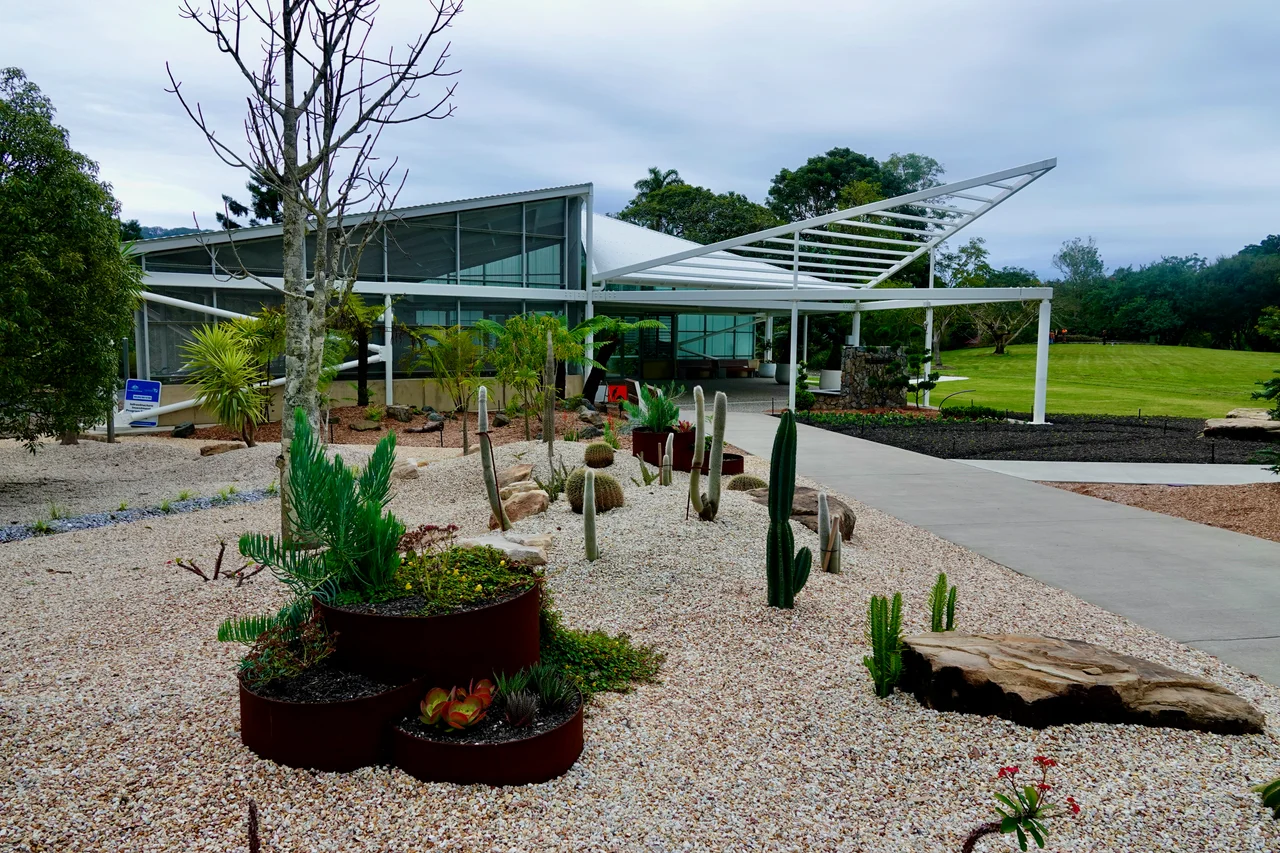

North Coast Regional Botanic Garden
Some trees flower from their bare trunks. The Coolamon, Syzygium moorei, does exactly that: in summer, masses of fluffy pink stamens burst straight out of the old wood and leafless branches, a habit botanists call cauliflory. It is one of the rarest rainforest trees on the New South Wales north coast, listed as vulnerable, and a specimen of it grows here, a kilometre from the centre of Coffs Harbour, in a garden that asks nothing at the gate. The North Coast Regional Botanic Garden is twenty hectares of coastal forest, mangrove, lawn and curated planting, open every day of the year, free to enter. It is part botanic showcase and part quiet rescue operation.
An Ark for the Endangered
The numbers are sobering: the north coast region of New South Wales holds seventeen of the twenty most endangered plant species in the entire state. Concentrating that much fragility in one corner of the country gives this garden an unusual mandate. It is not only somewhere pleasant to walk; it is a refuge, a place that deliberately grows the plants that are vanishing from the wild around it. Among them is the swamp orchid, Phaius australis, itself among the most endangered plants in the state, holding on in a managed bed where it can be watched and protected. Walking the Rare and Endangered section, you are looking at a living list of species that might not otherwise survive the century. The garden does the unglamorous work of keeping them alive, one specimen at a time, against the slow attrition of clearing and climate.
Where the Mangroves Begin
Roughly half the garden is not planted at all. It is the original vegetation of the site, native coastal forest and mangrove left to be itself, threaded with discovery walks and boardwalks. The mangroves are the surprise. Their pale, knotted roots rise from the tidal mud, and a boardwalk runs out over them so you can stand in the middle of an ecosystem most people only glimpse from a car window. Mangroves are nurseries for fish, filters for the water, and buffers against storm surge, and here they are close enough to read the labels. The contrast is the point: a few steps separate manicured display beds from genuine wild estuary. You move from a garden somebody designed to a forest nobody did, and back again, without leaving the block.
The Glasshouse and the Friendship Garden
In June 2022 a new glasshouse opened, its tropical house held at around 32 degrees for orchids, bromeliads, anthuriums and taro, with a shade house alongside for ferns. Step inside on a cool morning and the air turns thick and warm and green. Elsewhere the garden gathers plants by climate rather than country: eastern Australian natives from heathland and coastal New South Wales, and an exotic collection drawn from regions roughly thirty degrees north or south of the equator, the same latitude band that gives Coffs its mild, humid climate. There is a Japanese friendship garden too, built with advice from gardeners in Sasebo, Coffs Harbour's sister city, where a red bridge arches over a still lake. The rainforest plot, planted back in 1987, has matured into some 350 species of canopy and understorey.
The Quiet Hour
This is a garden built for lingering. The Leaf and Bean cafe sits by the entrance lawn, and grassy clearings open between the beds for a picnic or simply a long sit in the shade. Paths are sealed and wheelchair-accessible, and the sensory garden near the entrance is planted for fragrance, a bed of aromatic plants meant to be smelled as much as seen. The genius of the place is its layering. In an hour you can pass a flowering tropical orchid, a stand of endangered rainforest trees found almost nowhere else, a tidal mangrove forest, and a Japanese pond, then sit with a coffee while lorikeets argue overhead. For free, a kilometre from a city centre, it is an unreasonable amount of world to fit on twenty hectares.
From the Air
The North Coast Regional Botanic Garden lies at 30.30°S, 153.12°E on Hardacre Street, about one kilometre west of the Coffs Harbour CBD and the harbour. From the air it reads as a block of dense green against the urban grid, with the tidal mangrove and estuary system marking its eastern edge near Coffs Creek. The nearest airport is Coffs Harbour Airport (ICAO YCFS / IATA CFS), roughly 3 km south on Hogbin Drive, served by Qantas, Rex and Link Airways. Recommended viewing altitude 2,000–3,000 ft to pick out the garden's canopy against surrounding streets. The site is too small to be a navigation landmark in its own right; use the harbour breakwater and jetty just east as the visual anchor. Calm mornings offer the clearest air before sea-breeze haze builds.
Nearby Stories
- New England National Park 21 km away
- Guy Fawkes River National Park 27 km away
- Yuraygir National Park 31 km away
- Trial Bay Gaol 33 km away
- Apsley Falls 93 km away
- Cape Byron Marine Park 153 km away
- Cape Byron Light 187 km away
- SS Elingamite: Gold, Fog, and a Captain Wrongly Blamed 1771 km away