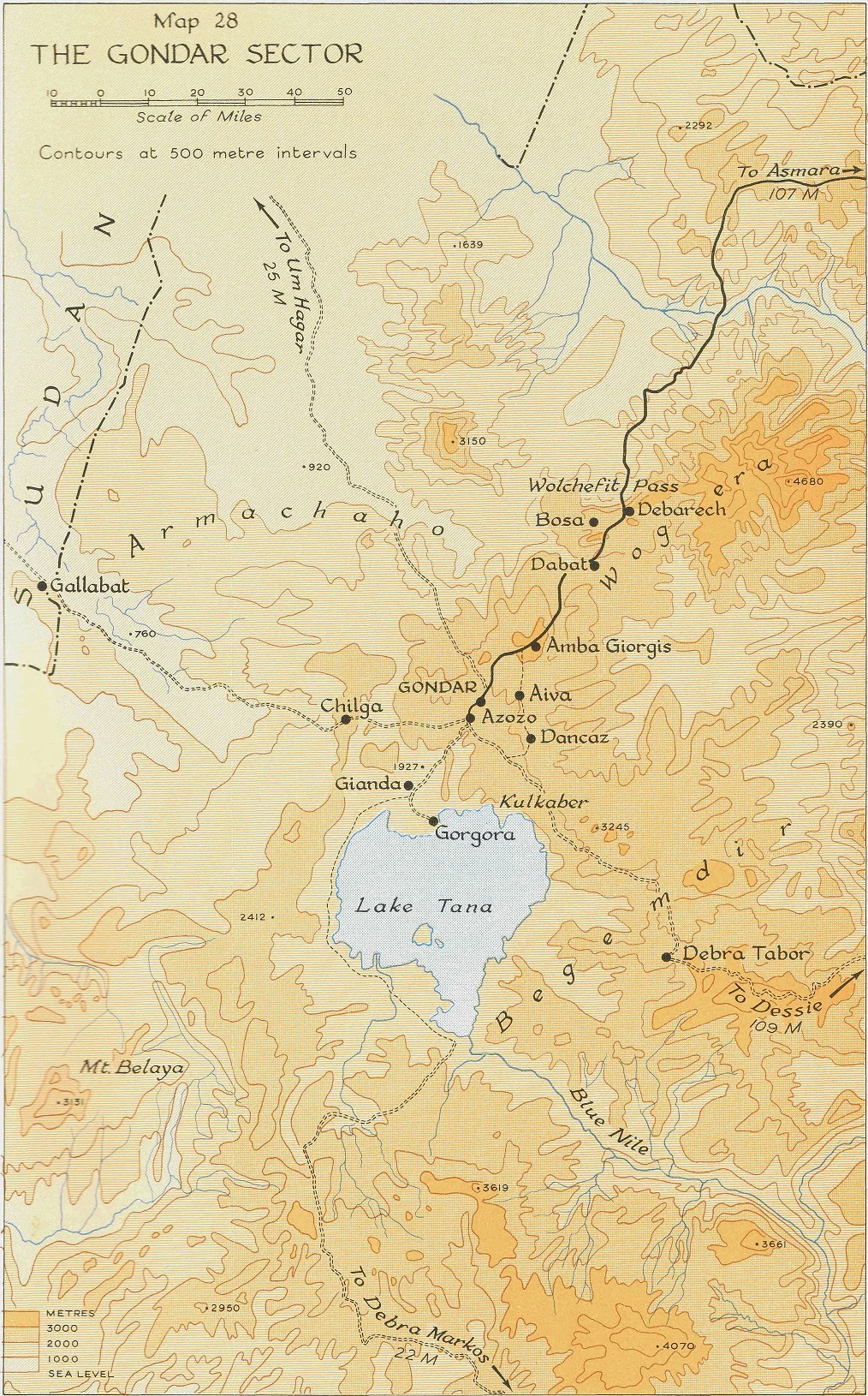

Northern front, East Africa, 1940
On June 10, 1940, Mussolini declared war on Britain and France. Two hundred thousand Italian and colonial troops in Italian East Africa faced a British force that, spread across Libya, Iraq, Syria, Iran, Sudan, Kenya, British Somaliland, and Aden, could muster only a fraction of that number in any given theater. The obvious move, had the Italians played aggressively, was to drive north out of Eritrea, take Khartoum, cut the British supply line along the Nile, and split the British position in the Middle East. For seven months, they did not. They captured Kassala, took Gallabat, occupied Karora, and then stopped. The delay gave General Archibald Wavell time to reinforce. When the British finally struck in January 1941, the Italians retreated before they were pushed, and the campaign that could have changed the war became a strange footnote.
The Duke of Aosta's Problem
Amedeo, Duke of Aosta, held the title of Viceroy and Governor-General of Africa Orientale Italiana. He was commander-in-chief of the combined Italian armed forces in East Africa and General of the Air Force. On June 1, 1940, he had tens of thousands of troops under command. By August 1, mobilization had increased that number significantly, including Italian metropolitan troops and the Ascari - the colonial soldiers recruited from Eritrea, Somalia, and Ethiopia who formed the bulk of Italian combat strength in Africa. But Aosta's position was structurally hopeless. The British Royal Navy controlled the Red Sea and the Suez Canal. Italy could not reinforce or resupply him. He had been ordered by Mussolini to mount only limited offensives against Sudan while conducting a larger operation against French Somaliland to protect Eritrea. Aosta knew his stockpiles of fuel, ammunition, and spare parts would run out. He husbanded them.
Kassala and the Cotton Route
Kassala was a Sudanese provincial town of about 25,000 people, sitting on the Gash River about 12 kilometers from the Eritrean border. A loop of the Sudan Railway ran east toward Ethiopia. The Gash rose in Eritrea, flowed silty for three months a year, and made the land outside the town extraordinarily fertile for cotton. The Italian Via Imperiale ran from Asmara to the border, and after Italy dammed the Gash at Tessenei and extended the road to move its own cotton crop, the whole route became an obvious axis for offensive operations in either direction. When hostilities began, the British at Kassala had two motor machine-gun companies of the Sudan Defence Force, a mounted infantry company, some Arab Corps troops, and the local police. The Italian attack came on July 4. Three Italian companies with armored cars and support took Kassala after a morning of fighting; a British wireless failure delayed their counterattack and it never happened. Gallabat fell the same day. Karora was occupied without opposition. Kurmuk fell on July 7.
A Bluff That Worked
The British position in Sudan looked thin on paper. Major-General William Platt, the Kaid of the Sudan Defence Force, had three British infantry battalions, the 4,500-man SDF, and some local irregulars, against Italian forces that totaled around 200,000. The Royal Air Force had three bomber squadrons, a flight of six Gladiator fighters at Port Sudan, and an army cooperation squadron. But the Italians did not press. After fortifying Kassala and Gallabat, they made no further offensive. Platt used the pause to extemporize. The Gazelle Force - a small motorized raiding unit - patrolled and raided the Gash River delta north of Kassala, convincing the Italians that British strength was far greater than it actually was. In August the Italians invaded British Somaliland and pushed the British out to the coast; the British embarked for Aden with some political damage, Churchill being particularly unhappy with Wavell. But the main front stayed quiet.
Breaking the Italian Cipher
Through late 1940, British intelligence closed in on Italian communications. The Italians in Africa had replaced their ciphers by November, but by the end of that month, the Government Code and Cypher School at Bletchley and the Cipher Bureau Middle East in Cairo had broken the Italian Army and Air Force replacement codes. The Italians relied on wireless communication on frequencies easy for the British to intercept, and a flood of material began arriving at Cairo - daily reports from the Viceroy, operational plans for the Regia Aeronautica, the supply situation of the Italian army. On occasion British commanders read messages before their intended recipients. The cipher break gave the British a clear view of the Italian order of battle and supply problems when they began planning their counteroffensive. The Deputy Director of Military Intelligence in Cairo later acknowledged what Ultra had given them.
The Retreat Nobody Expected
The British planned to invade Eritrea from Sudan on February 9, 1941. The Italians did not wait. On January 18, 1941, they abruptly evacuated Kassala and retreated east into Eritrea. Platt was ordered to pursue vigorously. British and Indian troops - the 4th and 5th Indian Divisions - crossed into Eritrea and defeated the Italians at the Battle of Agordat between January 26 and 31, 1941. It was the start of the conquest of Eritrea. On January 20, Haile Selassie, the emperor the Italians had deposed in 1936, re-entered Ethiopia from Sudan with the Gideon Force under Orde Wingate, leading the guerrilla campaign that Mission 101 had been preparing. By April, Addis Ababa had fallen. The Italian East African empire lasted five years. The quiet war on the Sudan border, where Aosta had chosen caution and Platt had made his smaller force look larger, turned out to be the opening of the end. The soldiers who died on both sides - Italian, Ascari, British, Indian, Sudanese - were real people, with families. The campaign is now mostly forgotten outside specialist histories. But for a few months in 1940, the war in the Arabian Peninsula's backyard might have gone very differently.
From the Air
The 1940 Northern Front covered the Sudan-Eritrea and Sudan-Ethiopia borders, with Kassala (15.45°N, 36.40°E) and Gallabat (12.97°N, 36.18°E) as major flashpoints, and the campaign centered approximately 13.25°N, 35.50°E. The region is arid, with sparse vegetation and few all-weather roads. Khartoum Airport (HSSK / KRT) and Asmara International (HHAS / ASM) are the regional hubs. From altitude the Gash River bed is clearly visible flowing west from Eritrea into Sudan, marking what was for seven months in 1940 the northernmost point of Italian East African expansion.
Nearby Stories
- El-Gadarif 56 km away
- Eritrea-Sudan Border 111 km away
- Western Zone, Tigray 134 km away
- Jebel Moya 161 km away
- Wad Madani 170 km away
- Gondar 180 km away
- Nuba Mountains 454 km away