
Gondar
The bus from Addis Ababa takes all day. You leave at dawn, cross the Blue Nile gorge, climb past Debre Markos, stop for lunch at a truck-stop injera joint somewhere near Mota, and pull into Gondar as the afternoon light turns the stone walls of Fasil Ghebbi amber. For most travelers, this moment is the payoff. You have reached the place Ethiopian emperors called home for two hundred years, the city of 44 churches, the staging ground for the Simien Mountains, the place where Timkat - Ethiopian Orthodox Epiphany - transforms the January streets into a moving river of white shammas.
What You Came to See
Fasilides' Castle, built in 1640, is the oldest surviving building in the royal enclosure. Iyasu's Palace - home of Emperor Iyasu I who reigned from 1682 to 1706, the son of Yohannes I and grandson of Fasilides - is the largest, though earthquakes and British bombing during World War II destroyed its once-lavish ornate interior. Dawit's Hall was built by Dawit III, emperor from 1716 to 1721 and son of Iyasu. Mentewab's Palace belonged to the Empress Mentewab, one of the most powerful women in Ethiopian history, who served as regent for both her son and grandson in the mid-18th century. All of it sits inside a 900-meter curtain wall with twelve gates, each with its own story. Hire a guide at the entrance - they are officially licensed, they know the chronology, and they will keep the touts from trailing you.
Bajaj, Minibus, Gari
Getting around is simple once you know the rules. Blue and white minibuses run set routes through the city efficiently and cost almost nothing. Horse-drawn carriages called garis still clatter through some neighborhoods for short rides. The dominant form of transport, though, is the bajaj - the three-wheeled motorized tuktuk that handles three to four passengers and buzzes up every hill. During the day a ride across town should not cost more than 10 birr; at night, no more than about 25 birr. If you need a dedicated vehicle, you can contract a small blue taxi by the day or the week. Buses to Bahir Dar and on to Addis Ababa leave from the main bus station; to reach Lalibela, you will need to change at Gashena, and the trip takes two days.
Timkat, and the Year's Biggest Day
If you are in Ethiopia in January, get yourself to Gondar for Timkat - the Ethiopian Orthodox celebration of Epiphany, held on 19 January. This is the one day of the year when the city becomes almost unrecognizable. Tens of thousands of worshippers in white shammas - the traditional cotton wrap - process from Fasilides' Bath through the city, chanting, dancing, and carrying replicas of the Ark of the Covenant. The bath itself is flooded the night before and blessed at dawn; hundreds of young people jump into the cold water in an act of symbolic rebaptism. Hotels fill months in advance. Prices spike. It is the one time of year you will genuinely struggle to find a room. Go anyway. Nothing else in Ethiopia rivals it.
Gorgora, Debre Berhan Selassie, and the Simiens
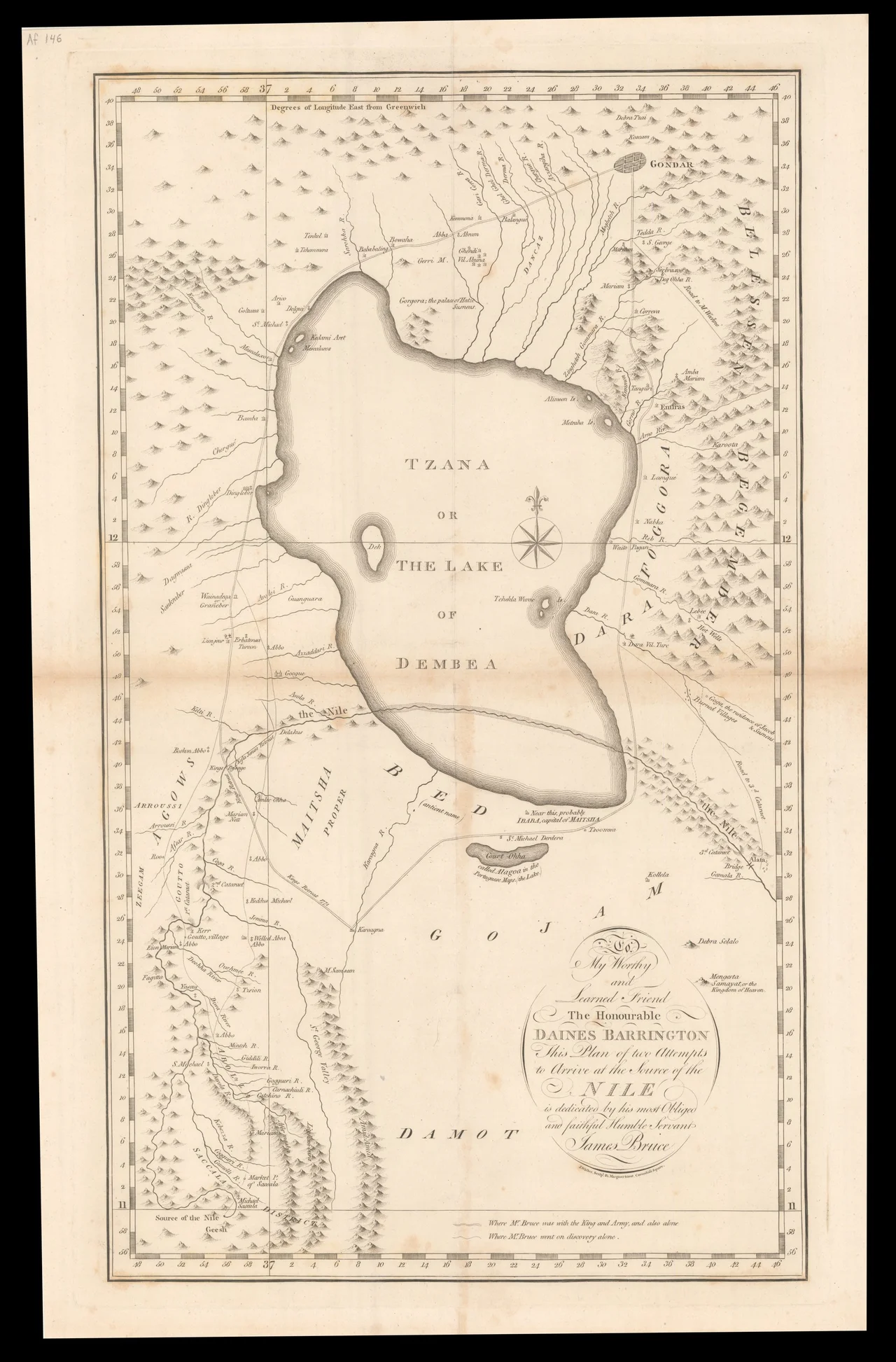
Beyond the royal enclosure, Gondar offers more than most travelers have time for. Debre Berhan Selassie, a 17th-century church on the northern edge of town, has a ceiling covered with paintings of 80 winged angels - rows of their calm, impassive faces looking down on visitors. The church survived the Mahdist sack of Gondar in 1888 when, according to local lore, a swarm of bees drove the invaders away. Gorgora, on the northern shore of Lake Tana about 60 kilometers south of Gondar, has its own briefly-capital history and is a good spot for bird watching. The Church of Debre Sina there has breathtaking 17th-century interior paintings under a thatched roof. And three hours north lie the Simien Mountains, home to gelada baboons with their bleeding-heart chests, walia ibex clinging to cliffs, and some of the best trekking in Africa. Most Simien treks are arranged from Gondar.
Where to Sleep, What to Drink
Gondar accommodates every budget. The most basic rooms start around 20 birr for a bed. The Roman Hotel, from 60 birr for a single self-contained, has excellent food and does meat dishes even during Ethiopian fasting periods. Upper-end hotels cluster near the piazza. Food is classic Ethiopian - injera with tibs, shiro, doro wot, and for Gondar specifically, excellent tej. Gondar is home to Dashen Brewery, and Dashen Beer is ubiquitous here. The tej in town is some of the best in Ethiopia: pure, without sugar, made only from honey, served in rounded berele glasses that you hold by the neck. Tela - local barley beer, sometimes called korefe - is also common. The nightlife strip runs down the slope from Walia Ibex roundabout (look for the statue of an ibex) toward Atse Tewodros Square, with the Walya Club at the top and Balageru and Atse Bakafa farther down.
From the Air
Gondar lies at 12.60°N, 37.47°E at 2,133 meters elevation, north of Lake Tana on the Lesser Angereb River. Gondar Airport - Atse Tewodros Airport - (ICAO: HAGN, IATA: GDQ) is 18 km south of the city in Azezo. Ethiopian Airlines flies daily from Addis Ababa Bole International (ICAO: HAAB, IATA: ADD). From cruising altitude, Gondar appears as a dense cluster of red-roofed buildings on a plateau with the vast expanse of Lake Tana shimmering 35 km to the south. The Simien Mountains rise dramatically to the northeast, with peaks including Ras Dashen at 4,550 meters. Best flying weather October through May; June to September brings heavy afternoon thunderstorms with towering cumulonimbus.
Nearby Stories
- Lake Tana 40 km away
- Simien National Park 40 km away
- Debre Tabor 51 km away
- Welkait 103 km away
- Simien Mountains 115 km away
- Northern front, East Africa, 1940 160 km away
- Eritrea-Sudan Border 192 km away
- Gimbi Massacre 371 km away