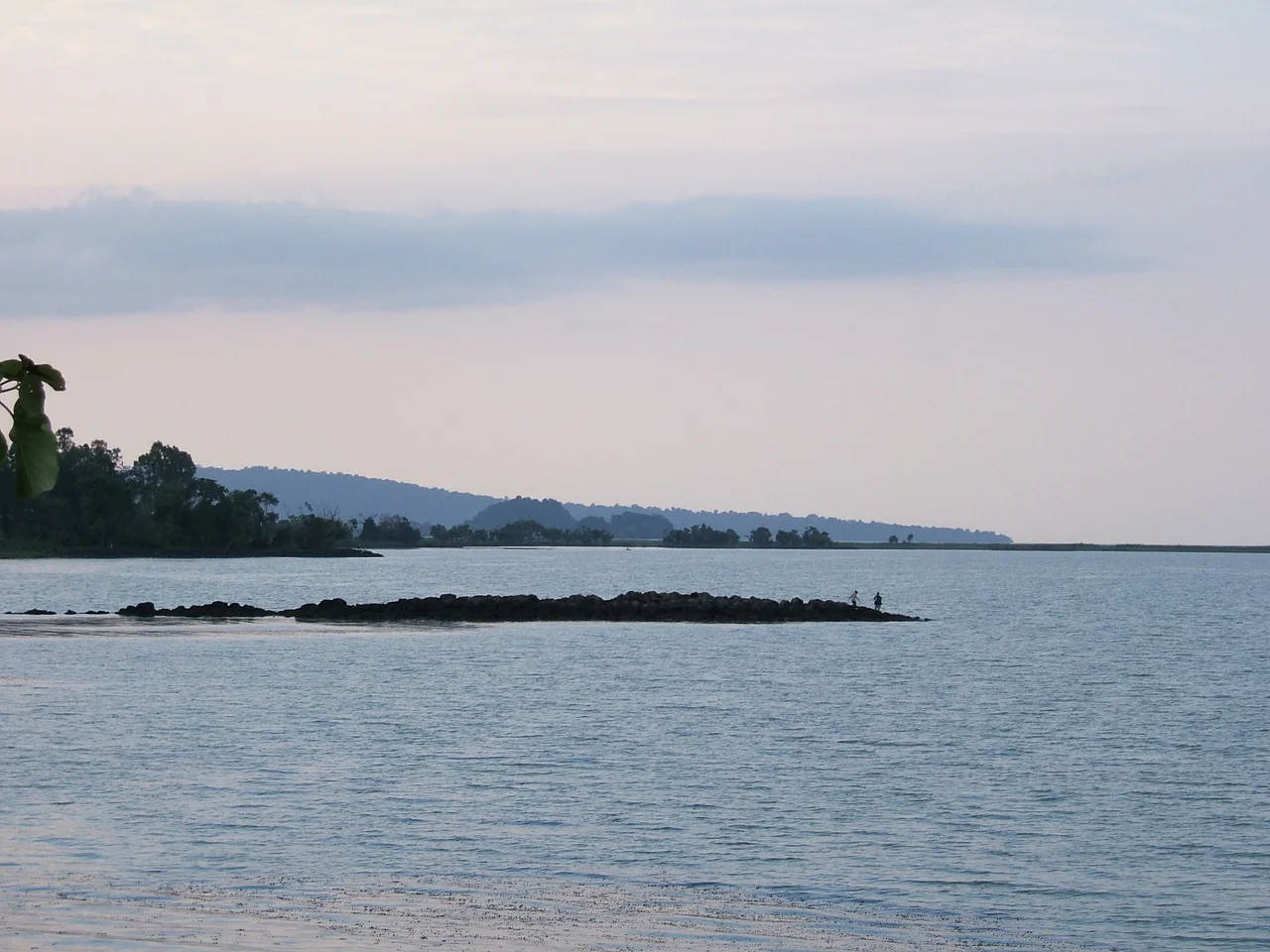

Lake Tana
The Nile begins here. At least one of them does. From a control weir at the southern end of Lake Tana, water spills into a river that will fall over the Blue Nile Falls, cut through the Ethiopian highlands, meet the White Nile at Khartoum, and eventually flow past the Pyramids at Giza before emptying into the Mediterranean. The lake that starts this 5,000-kilometer journey is roughly the size of Long Island, sitting at 1,788 meters in the mountains of Amhara. Its water is colder than the usual tropical lake, its islands carry the bones of kings, and on one of them a rock is shown to visitors where, Ethiopian tradition holds, Mary the mother of Jesus rested on her way back from Egypt.
Volcanic Beginnings
Lake Tana was born about five million years ago in the early Pleistocene, when volcanic activity blocked the rivers flowing through this part of the highlands and forced the water to pool. The lake that formed was originally much larger than what survives today - it is 84 kilometers long, 66 kilometers wide, and only 15 meters deep at its maximum. Seven permanent rivers feed it, along with 40 smaller seasonal streams. The Gilgel Abbay - the Little Nile - is the largest. The Megech, Gumara, and Rib rivers round out the main inputs. Since the control weir was built at the outlet, water levels are managed to supply the Blue Nile Falls and the hydropower station downstream, though the lake still rises and falls significantly each year - peaking in September and October after the summer rains.
A Landscape Stitched With Monasteries
A twentieth-century geographer counted 37 islands on Lake Tana. Nineteen of them, by his reckoning, held or had once held monasteries or churches. The tradition of island monasticism here stretches back to the Middle Ages, and the Ethiopian Orthodox Tewahedo Church still maintains active communities at Kebran Gabriel, Ura Kidane Mehret, Narga Selassie, Daga Estifanos, Medhane Alem of Rema Island, and others. The manuscripts, crosses, and emperor's regalia kept in these monasteries are not museum pieces. They are used. Priests still carry the processional crosses of Ura Kidane Mehret during festival liturgies. The painted walls of the fourteenth-century Debre Maryam and the eighteenth-century Narga Selassie record biblical scenes in the distinctive Ethiopian style, bright-eyed and frontal, that has changed very little in 700 years.
Where Emperors Lie
Daga Island holds the body of Yekuno Amlak, the thirteenth-century ruler who founded the Solomonic dynasty of Ethiopia, in the monastery of St. Stephen. Other emperors interred there include Dawit I, Zara Yaqob, Za Dengel, and Fasilides - five hundred years of Ethiopian imperial history, laid in rooms only monks and pilgrims usually enter. The island of Tana Qirqos holds a different kind of sacred claim: a rock shown to the historian Paul B. Henze as the stone where Mary rested on her journey back from Egypt, and the traditional burial site of Frumentius, the fourth-century Syrian who brought Christianity to Ethiopia. Tana Qirqos is also said, in Ethiopian tradition, to have housed the Ark of the Covenant before it was moved to Axum. These are contested claims elsewhere in the world. Here, they are what people believe.
Beta Israel and a Lost Monastic Tradition
Lake Tana was also the center of something that once existed nowhere else: Jewish monasticism. The Beta Israel, the Ethiopian Jewish community, maintained monasteries here until their emigration to Israel in the late twentieth century. There were no other Jewish monasteries in the world, and scholars who reached the remaining sites after the community largely departed have been piecing together what those communities did, how they lived, and what they believed. The disappearance was one of those quiet historical closings that happens when a centuries-old tradition simply moves elsewhere and the buildings empty. Some of the sites north of the lake have been the subject of archeological survey work as recently as 2015.
The Fish That Speciated in Place
In the water below the monasteries, Lake Tana holds one of the world's most studied small species flocks of fish. The endemic Labeobarbus barbs have diverged into more than a dozen distinct forms, each with its own feeding niche. Some are piscivores - L. acutirostris, L. longissimus, L. megastoma, L. truttiformis - specialized for hunting other fish. Some eat algae. Some eat macrophytes, the larger water plants. L. brevicephalus feeds on zooplankton. L. gorgorensis eats macrophytes and molluscs. Eight species spawn in the lake's wetlands; the others make seasonal runs up the tributaries to breed. It is evolution happening in slow motion, in a single basin, over maybe 30,000 years. Hippos live near the Blue Nile outflow. Local fisheries legislation arrived only in the early 2000s, by which time tilapia and catfish catches had both declined notably. What happens to Lake Tana's fish is being watched - by biologists, by fishermen, and by the governments downstream whose rivers all start here.
From the Air
Lake Tana is centered at 12.00°N, 37.25°E at an elevation of 1,788 meters in northwestern Ethiopia. The lake measures 84 km by 66 km - impossible to miss from cruise altitude. The Blue Nile Falls (Tis Abbai) are 30 km south where the lake discharges. Bahir Dar Airport (HABD / BJR) at the southern shore serves the region; Gondar Airport (HAGN / GDQ) is to the northwest. Summer monsoon (June-September) brings afternoon convection; winters are clear with good visibility. Maintain safe altitude over the Ethiopian Highlands - terrain rises sharply around the lake basin.
Nearby Stories
- Zege Peninsula 28 km away
- Amhara Region 39 km away
- Debre Tabor 48 km away
- Gondar 53 km away
- Simien National Park 109 km away
- Northern front, East Africa, 1940 156 km away
- Eritrea-Sudan Border 247 km away
- Gimbi Massacre 306 km away