
Zege Peninsula
The rule is simple: don't cut the trees, don't plow the land, don't raise large animals. Monks imposed this prohibition on the Zege Peninsula centuries ago, for religious reasons, and an inadvertent consequence of their piety was the preservation of one of Ethiopia's densest coffee forests. Wild Coffea arabica grows here as a genuine understory species, the way it grew before humans decided to plant it in rows. To arrive at Zege from Bahir Dar is to move, in thirty-two kilometers, from the capital of the Amhara Regional State into the forested heart of medieval Ethiopian Christianity. Lake Tana, at 3,600 square kilometers, is Ethiopia's largest lake and the source of the Blue Nile. The Zege Peninsula juts into its southern shore like a green thumb. The monks call it sacred. The ancient Greeks called the lake Copper Tinted, or the Jewel of Ethiopia.
The Seven Stars
Abune Betre Mariam, one of the seven saints whom Ethiopian Orthodox tradition calls the Seven Stars of Lake Tana, founded Mehal Zege Giyorgis in 1264 CE. The date matters because it places this monastery among the oldest continuously operating religious institutions in sub-Saharan Africa. Six more monastic churches followed on the peninsula between the fourteenth and seventeenth centuries. Many of the churches here carry a distinctive architectural feature: a steeple topped with seven ostrich eggs, one for each of the founding saints. The ostrich eggs are both symbol and practical touch; they signify the seven evangelists of the region and, according to one tradition, also keep snakes away from the holy space.
Ura Kidane Mehret
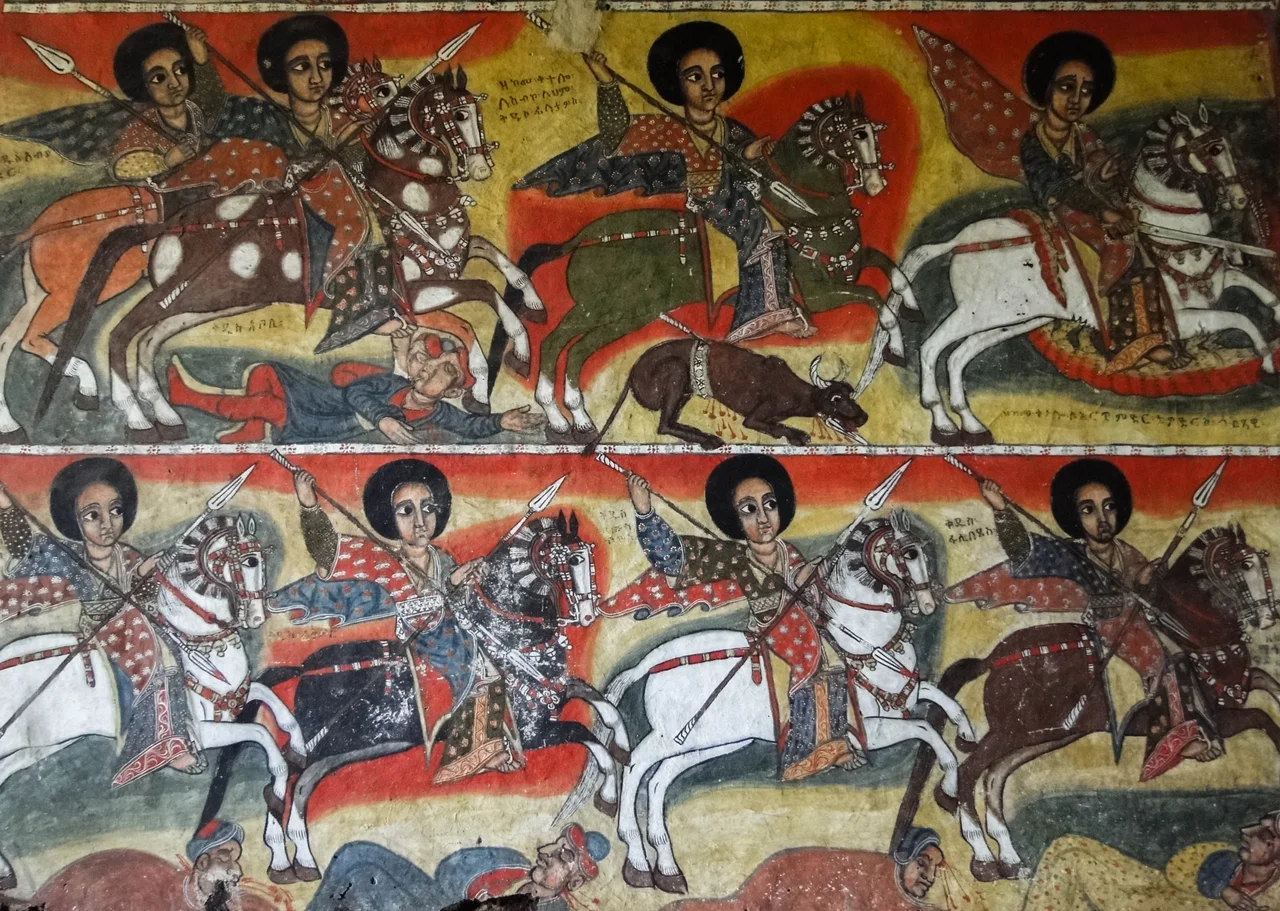
Set among the coffee trees is Ura Kidane Mehret, the Covenant of Mercy, which many visitors consider the most beautiful church on Lake Tana. The saint Betre Mariyam, whose name means 'Rod of Mary' in Amharic, founded the convent in the fourteenth century. The present circular church dates from the sixteenth, and its interior is covered with murals painted between 100 and 250 years ago. The most significant of them were painted by Alaqa Engida during the reign of Emperor Menelik II, who ruled from 1889 to 1913. The subjects include Negus Tekle Haymanot of Gojjam and his followers, the saints of the Ethiopian church, and biblical scenes rendered in the vivid reds, yellows, and deep blues that define the Ethiopian Orthodox style. The treasury in a nearby outbuilding holds the embroidered robes of Tekle Haymanot and his wife Laqetch Gegre Mehdin, along with the crowns of Emperor Yohannes IV, Emperor Tewodros II, and Emperor Tekle Giyorgis.
What the Forest Holds
The forest around the churches is not landscaped. It is old. The coffee is the endemic Arabica plant growing as it naturally grows when humans leave it alone, which has turned the peninsula into a living genetic archive of the species that eventually went on to caffeinate most of the world. Beyond coffee, the canopy shelters fish eagles, hornbills, vervet monkeys, and a soundscape that wraps around you as soon as you step off the boat at the shore. Mehal Zege Giyorgis, the founding monastery, hides inside this dense forest, its round walls plastered and its conical roof thatched in the classical Ethiopian style. It holds a museum of icons, crosses, illuminated manuscripts, mural paintings, and what tradition calls the iron cloth of Abune Betre Mariam, the founding saint. Women are not permitted to enter all of the monasteries on the peninsula. Some follow the old rule; others, including Ura Kidane Mehret, welcome everyone.
The Wider Constellation
The peninsula is part of a larger sacred geography. Lake Tana has about 37 islands and roughly 30 monasteries, and each has its own story. Tana Cherkos, a small island monastery, is said to have sheltered the Ark of the Covenant for 800 years before the relic was moved to Aksum. Dega Estefanos, perched on a hill 100 meters above the lake, holds the mummified remains of five Ethiopian emperors, displayed now in glass-sided coffins. Narga Selassie, Trinity of the Rest, stands on Dek Island, the lake's largest. Debre Maryam is younger, built by Emperor Tewodros in the nineteenth century. Kebran Gabriel, founded in the fourteenth century and rebuilt in the seventeenth, is closed to the public but is often described as the most beautiful of all. Its roof is supported by twelve carved stone pillars, one for each apostle.
A Living Tradition
What makes Zege remarkable is not that it survived. Ethiopia has survived invasions, famines, revolutions, and wars that destroyed cities; the churches on this peninsula were just beyond the reach of Ahmad Gran's sixteenth-century jihad and the Italian bombs of the twentieth century. What makes Zege remarkable is that it remains in use. Monks still chant the liturgy at dawn. Pilgrims still arrive by boat across Lake Tana. Coffee still grows wild in the forest outside the church walls. The Zeghie Satekela Museum preserves hand-crafted objects and musical instruments that local communities still play at festivals. The ostrich eggs are still on the roof peaks. The Blue Nile still flows out of Lake Tana, heading for Khartoum and Cairo, passing by this forested peninsula that has been sacred since 1264.
From the Air
Coordinates: 11.70°N, 37.33°E. On the southern shore of Lake Tana, 32 km from Bahir Dar. Lake Tana is a dominant water feature visible from high altitude. Bahir Dar Airport (HABD) is the nearest airfield. Recommended viewing altitude: 8,000-12,000 feet AGL for scenic overflight. Expect afternoon convective activity over the lake during the June-September kiremt rains.
Nearby Stories
- Debre Tabor 19 km away
- Lake Tana 22 km away
- Fasilides 53 km away
- Lalibela 118 km away
- Northern front, East Africa, 1940 211 km away
- Gimbi Massacre 277 km away
- National Museum of Ethiopia 279 km away
- Eritrea-Sudan Border 288 km away