
NS Documentation Centre of the City of Cologne
On the walls of ten small basement cells in central Cologne, there are around 1,800 inscriptions. They were scratched and written into the plaster between December 1935 and March 1945 by people who had been arrested by the Gestapo and brought to the EL-DE Haus, the secret police headquarters for the Cologne region. Some of the writings are names. Some are dates. Some are messages to loved ones the writer knew might never read them, or prayers, or single defiant words. The Allied bombing campaign reduced most of central Cologne to powder, but the EL-DE Haus was barely scratched. The walls held. The writing held. And since 1988 those ten cells have been the heart of the largest regional memorial site for victims of Nazism anywhere in Germany.
The Building That Should Not Have Survived
The EL-DE Haus takes its name from the initials of its original owner, a Catholic businessman named Leopold Dahmen. Construction finished in 1935; that same December the Gestapo moved in and made it the headquarters for their operations across the Cologne region. For the next nine and a half years, the building functioned as an office, a holding facility, and — in its final months — a killing site. In the closing weeks of the war, several hundred people, most of them foreign forced labourers, were murdered in the building's courtyard. Then, against all odds, the EL-DE Haus survived the air war that turned most of central Cologne to rubble. The cathedral survived too, a few streets away. Beyond that, much of what stood in 1939 was gone by 1945. The Gestapo building stayed almost untouched.
The Cells
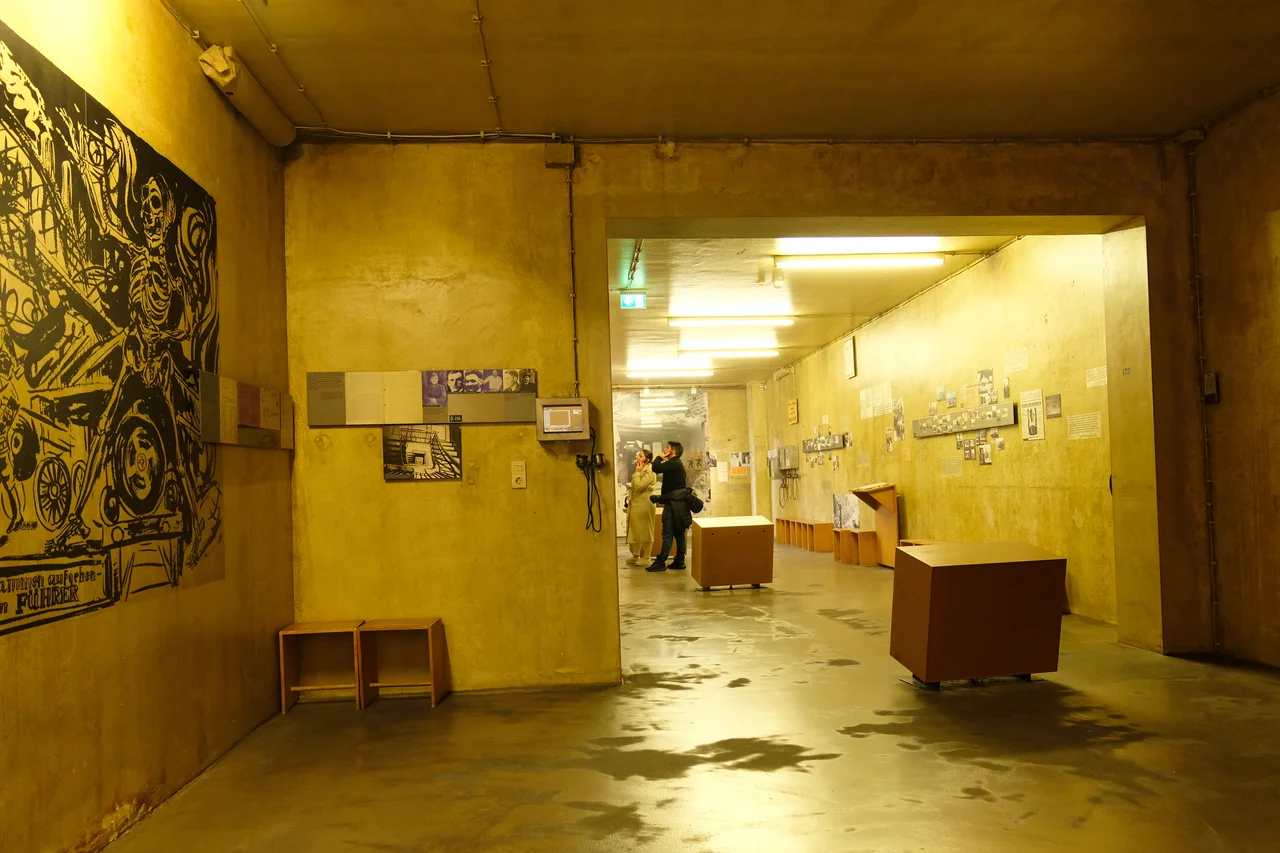
After the war the building cycled through other uses for decades. It was the Cologne city council, in a resolution on 13 December 1979, that decided this place would become a memorial. The former Gestapo prison was inaugurated as a memorial site on 4 December 1981, and the permanent exhibition opened in the upper floors in June 1997. But the most affecting space in the building is below ground. The ten basement cells are among the best-preserved Nazi-era prisons anywhere in Europe, and they hold what those who were imprisoned there left behind. Some 1,800 inscriptions and drawings cover the plaster walls. Names of cellmates. Hometowns. Prayers in several languages. Tally marks counting days. People wrote because they wanted someone, eventually, to know they had been there. The cells make sure that the someone is whoever walks down the stairs today.
A Centre for Memory and Research
The NS Documentation Centre, or NS-DOK, does more than preserve the building. Its permanent exhibition, "Cologne During the Nazi Era," works systematically through the seizure of power, the propaganda machine, daily life under dictatorship, youth culture and the Hitler Youth, the genocide of Cologne's Jewish residents and its Sinti and Roma communities, the local resistance, and the war years. The centre runs more than 130 events a year and supports the Information and Education Centre against Right-wing Extremism. Its library, photo archives, and witness-statement collections make it a serious research institution as well as a memorial. Among the projects it actively supports is the artist Gunter Demnig's Stolpersteine — the small brass "stumbling stones" set into pavements across Europe to mark the last freely chosen home of someone the Nazis deported.
Carrying It Forward
Since 1989, the city of Cologne has run a visitor programme for surviving former forced labourers, bringing them back to the place where they were held and giving them the dignity of recognition. For more than a decade the programme has been led by Elzbieta Adamski, who in 2004 received the Order of Merit of the Republic of Poland from President Aleksander Kwaśniewski for her work on Polish-German reconciliation. In 2000 the centre received a special appreciation from the European Museum of the Year Award. In 2006 a History Channel prize honoured its research into the Edelweiss Pirates and the Navajos — non-conformist Cologne youth who refused to join the Hitler Youth and were beaten, jailed, and in some cases executed for it. The point of all of this work is straightforward and inconvenient: the people who walked through the EL-DE Haus's doors in handcuffs were not statistics. Whoever wrote on the basement walls expected to be remembered, and Cologne has set itself the task of making sure they are.
From the Air
The EL-DE Haus and NS Documentation Centre stand at Appellhofplatz 23–25, roughly 50.941°N, 6.950°E, in central Cologne about 500 metres west of the cathedral. From the air the building blends into the surrounding city blocks — the whole point of an unremarkable Gestapo headquarters was always that it should not look like one. Nearest airport is Cologne Bonn (EDDK / CGN), 14 km southeast across the Rhine.
Nearby Stories
- Diamond Interchange: How a Simple Idea Reshapes Towns Like Julich 2.8 km away
- Dusseldorf-Unterbach 6.1 km away
- Baumwollspinnerei Ermen & Engels 11 km away
- RAF Bruggen 15 km away
- Hagen Open-air Museum 21 km away
- Belgium 130 km away
- Marcinelle Mining Disaster 173 km away
- Zwingenberg Castle 178 km away